School of Biomedical Sciences, University of Hong Kong, Hong Kong SAR, China.
Department of Statistics and Actuarial Science, University of Hong Kong, Hong Kong SAR, China.
Nat Commun. 2023 Jul 6;14(1):3995. doi: 10.1038/s41467-023-39608-w.
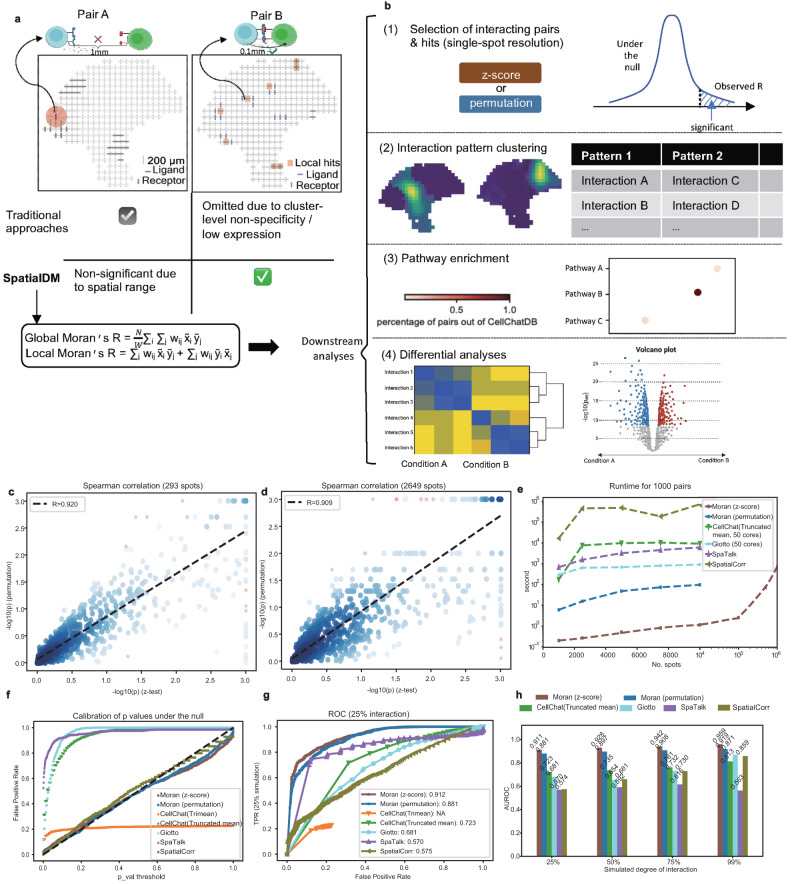
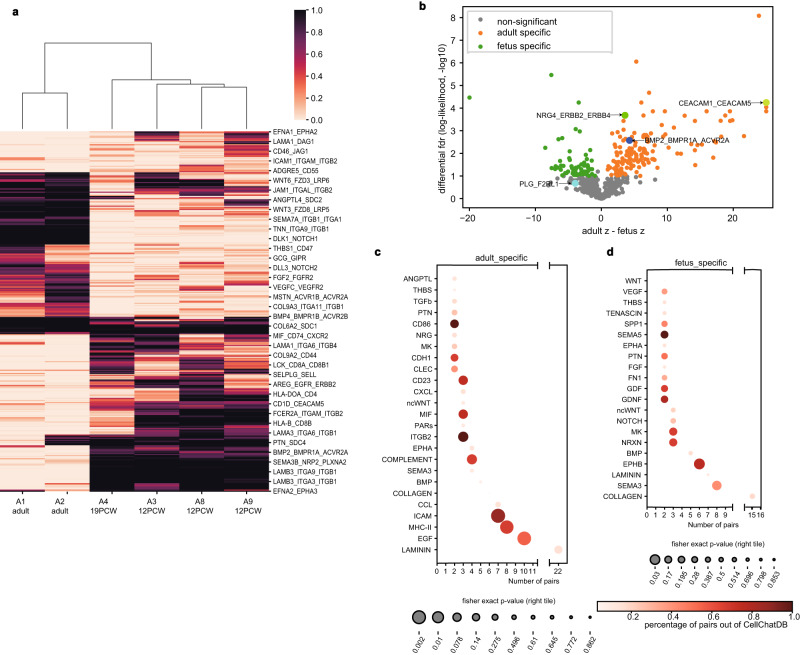
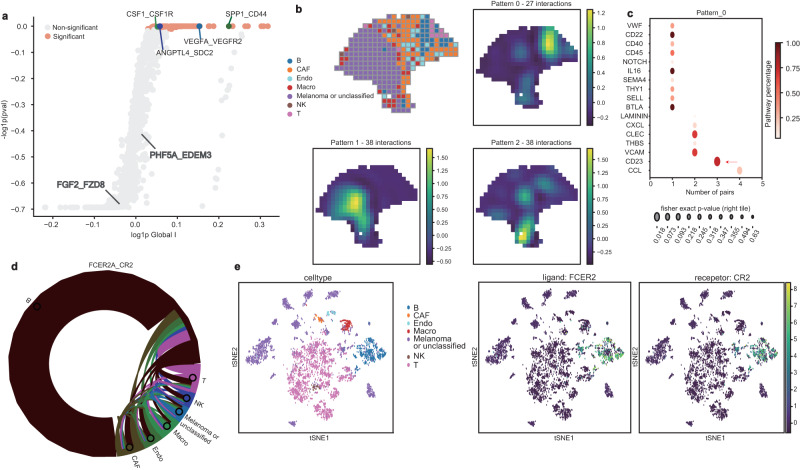
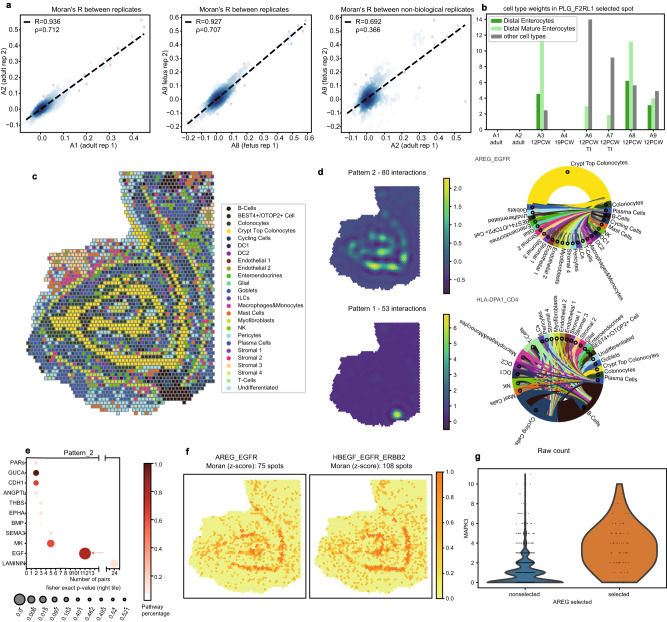
Cell-cell communication is a key aspect of dissecting the complex cellular microenvironment. Existing single-cell and spatial transcriptomics-based methods primarily focus on identifying cell-type pairs for a specific interaction, while less attention has been paid to the prioritisation of interaction features or the identification of interaction spots in the spatial context. Here, we introduce SpatialDM, a statistical model and toolbox leveraging a bivariant Moran's statistic to detect spatially co-expressed ligand and receptor pairs, their local interacting spots (single-spot resolution), and communication patterns. By deriving an analytical null distribution, this method is scalable to millions of spots and shows accurate and robust performance in various simulations. On multiple datasets including melanoma, Ventricular-Subventricular Zone, and intestine, SpatialDM reveals promising communication patterns and identifies differential interactions between conditions, hence enabling the discovery of context-specific cell cooperation and signalling.
细胞间通讯是剖析复杂细胞微环境的关键方面。现有的基于单细胞和空间转录组学的方法主要侧重于识别特定相互作用的细胞类型对,而较少关注相互作用特征的优先级排序或在空间背景下识别相互作用点。在这里,我们介绍了 SpatialDM,这是一种统计模型和工具箱,利用双变量 Moran 统计来检测空间上共表达的配体和受体对、它们的局部相互作用点(单点分辨率)和通讯模式。通过推导分析性零分布,该方法可扩展到数百万个点,并在各种模拟中表现出准确和稳健的性能。在包括黑色素瘤、脑室-室下区和肠道在内的多个数据集上,SpatialDM 揭示了有前景的通讯模式,并识别了不同条件之间的差异相互作用,从而能够发现特定于上下文的细胞合作和信号转导。