Podda Mauro, Pisanu Adolfo, Pellino Gianluca, De Simone Adriano, Selvaggi Lucio, Murzi Valentina, Locci Eleonora, Rottoli Matteo, Calini Giacomo, Cardelli Stefano, Catena Fausto, Vallicelli Carlo, Bova Raffaele, Vigutto Gabriele, D'Acapito Fabrizio, Ercolani Giorgio, Solaini Leonardo, Biloslavo Alan, Germani Paola, Colutta Camilla, Occhionorelli Savino, Lacavalla Domenico, Sibilla Maria Grazia, Olmi Stefano, Uccelli Matteo, Oldani Alberto, Giordano Alessio, Guagni Tommaso, Perini Davina, Pata Francesco, Nardo Bruno, Paglione Daniele, Franco Giusi, Donadon Matteo, Di Martino Marcello, Bruzzese Dario, Pacella Daniela
Department of Surgical Science, Emergency Surgery Unit, University of Cagliari, Cagliari, Italy.
Department of Advanced Medical and Surgical Sciences, Università Degli Studi Della Campania "Luigi Vanvitelli", Naples, Italy.
World J Emerg Surg. 2025 Mar 3;20(1):17. doi: 10.1186/s13017-025-00594-7.
Mild acute biliary pancreatitis (MABP) presents significant clinical and economic challenges due to its potential for relapse. Current guidelines advocate for early cholecystectomy (EC) during the same hospital admission to prevent recurrent acute pancreatitis (RAP). Despite these recommendations, implementation in clinical practice varies, highlighting the need for reliable and accessible predictive tools. The MINERVA study aims to develop and validate a machine learning (ML) model to predict the risk of RAP (at 30, 60, 90 days, and at 1-year) in MABP patients, enhancing decision-making processes.
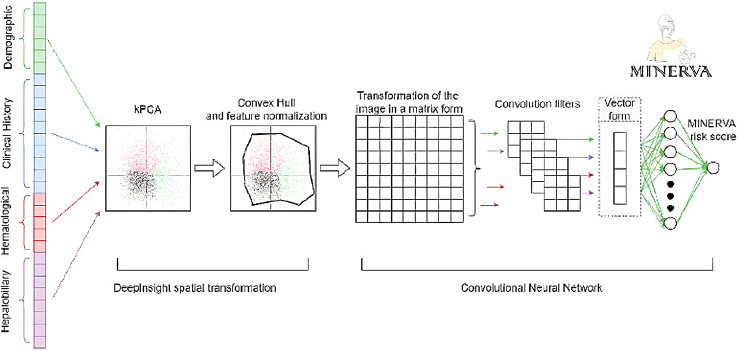
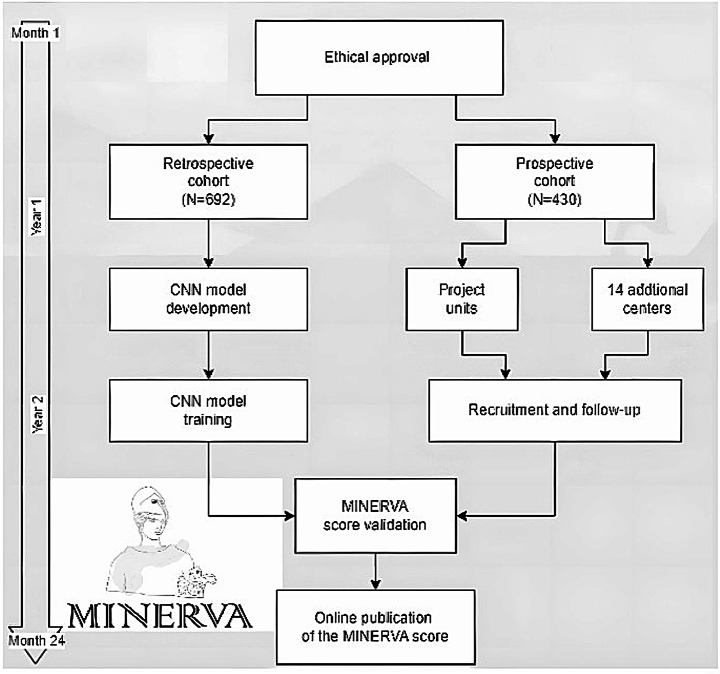
The MINERVA study will be conducted across multiple academic and community hospitals in Italy. Adult patients with a clinical diagnosis of MABP, in accordance with the revised Atlanta Criteria, who have not undergone EC during index admission will be included. Exclusion criteria encompass non-biliary aetiology, severe pancreatitis, and the inability to provide informed consent. The study involves both retrospective data from the MANCTRA-1 study and prospective data collection. Data will be captured using REDCap. The ML model will utilise convolutional neural networks (CNN) for feature extraction and risk prediction. The model includes the following steps: the spatial transformation of variables using kernel Principal Component Analysis (kPCA), the creation of 2D images from transformed data, the application of convolutional filters, max-pooling, flattening, and final risk prediction via a fully connected layer. Performance metrics such as accuracy, precision, recall, and area under the ROC curve (AUC) will be used to evaluate the model.
The MINERVA study aims to address the specific gap in predicting RAP risk in MABP patients by leveraging advanced ML techniques. By incorporating a wide range of clinical and demographic variables, the MINERVA score aims to provide a reliable, cost-effective, and accessible tool for healthcare professionals. The project emphasises the practical application of AI in clinical settings, potentially reducing the incidence of RAP and associated healthcare costs.
ClinicalTrials.gov ID: NCT06124989.
轻度急性胆源性胰腺炎(MABP)因其复发可能性而带来重大的临床和经济挑战。当前指南提倡在同一次住院期间尽早进行胆囊切除术(EC),以预防复发性急性胰腺炎(RAP)。尽管有这些建议,但临床实践中的实施情况各不相同,这凸显了对可靠且易于获取的预测工具的需求。MINERVA研究旨在开发并验证一种机器学习(ML)模型,以预测MABP患者发生RAP的风险(在30天、60天、90天及1年时),从而优化决策过程。
MINERVA研究将在意大利的多家学术和社区医院开展。纳入符合修订后的亚特兰大标准、在首次住院期间未接受EC的临床诊断为MABP的成年患者。排除标准包括非胆源性病因、重症胰腺炎以及无法提供知情同意书。该研究涉及来自MANCTRA - 1研究的回顾性数据和前瞻性数据收集。数据将使用REDCap进行采集。ML模型将利用卷积神经网络(CNN)进行特征提取和风险预测。该模型包括以下步骤:使用核主成分分析(kPCA)对变量进行空间变换,从变换后的数据创建二维图像,应用卷积滤波器、最大池化、展平,最后通过全连接层进行风险预测。将使用诸如准确率、精确率、召回率和ROC曲线下面积(AUC)等性能指标来评估模型。
MINERVA研究旨在通过利用先进的ML技术来填补预测MABP患者RAP风险方面的特定空白。通过纳入广泛的临床和人口统计学变量,MINERVA评分旨在为医疗保健专业人员提供一种可靠、经济高效且易于获取的工具。该项目强调了人工智能在临床环境中的实际应用,有可能降低RAP的发生率及相关医疗成本。
ClinicalTrials.gov标识符:NCT06124989。