Rüther Ferenc Darius, Grisold Andrea, Wechsler-Fördös Agnes, Gropmann Alexander, Behnke Michael, Hansen Sonja, Geffers Christine, Aghdassi Seven Johannes Sam
Institute of Hygiene and Environmental Medicine, Charité - Universitätsmedizin Berlin, Corporate Member of Freie Universität Berlin and Humboldt-Universität Zu Berlin, Berlin, Germany.
National Reference Center for Surveillance of Nosocomial Infections, Berlin, Germany.
Antimicrob Resist Infect Control. 2025 Mar 4;14(1):18. doi: 10.1186/s13756-025-01532-7.
The WHO Infection Prevention and Control Assessment Framework (IPCAF) can be used for systematically evaluating infection prevention and control (IPC) practices in healthcare facilities. In 2018, a survey among Austrian hospitals using the IPCAF revealed an overall high level of IPC implementation. Here, we report the results of a second survey in Austrian hospitals with the IPCAF, to once again evaluate the state of IPC implementation and investigate potential developments since 2018.
A total of 139 Austrian acute care hospitals participating in the German surveillance network "KISS" were invited to complete a translated online version of the IPCAF between October 2023 and January 2024. The IPCAF functions like a questionnaire, where each response is assigned a specific point value, enabling the calculation of an overall IPC score. Based on this score, hospitals were categorized into four distinct IPC levels: inadequate, basic, intermediate, and advanced. The aggregated scores were then calculated and compared with the results from 2018.
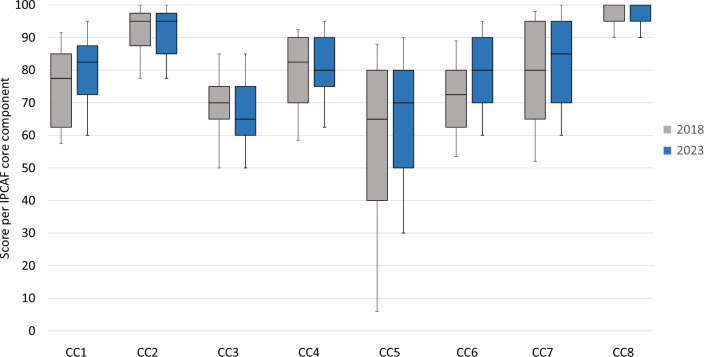
Complete datasets from 81 hospitals were received and analyzed. The median overall IPCAF score was 645 (interquartile range: 598-685), with 59 hospitals (72.9%) categorized as advanced, and 21 hospitals (25.9%) as intermediate. One hospital (1.2%) fell into the basic category. Questions pertaining to IPC education and training as well as the application of multimodal IPC strategies showed the lowest scores. Compared to 2018, the current median score of 645 was slightly higher (median score 2018: 620; data from 65 hospitals) and the proportion of hospitals with a full-time IPC professional per 250 beds increased markedly by 37 percentage points. However, the most pronounced decrease (median score - 5) was observed for questions on the WHO core component of IPC education and training.
IPC standards in Austria show an overall increasing trend, especially in terms of IPC staffing. However, areas for improvement remain, and hospitals should make efforts to strengthen IPC education and training programs.
世界卫生组织感染预防与控制评估框架(IPCAF)可用于系统评估医疗机构的感染预防与控制(IPC)措施。2018年,一项针对奥地利医院使用IPCAF的调查显示,IPC实施总体水平较高。在此,我们报告在奥地利医院使用IPCAF进行的第二次调查结果,以再次评估IPC实施状况,并调查自2018年以来的潜在发展情况。
共有139家参与德国监测网络“KISS”的奥地利急症护理医院受邀在2023年10月至2024年1月期间完成IPCAF的在线翻译版本。IPCAF的功能类似于一份问卷,每个回答都被赋予一个特定的分值,从而能够计算出IPC的总体得分。基于该得分,医院被分为四个不同的IPC级别:不足、基本、中级和高级。然后计算汇总得分,并与2018年的结果进行比较。
收到并分析了81家医院的完整数据集。IPCAF总体得分中位数为645(四分位间距:598 - 685),其中59家医院(72.9%)被归类为高级,21家医院(25.9%)为中级。一家医院(1.2%)属于基本类别。与IPC教育和培训以及多模式IPC策略应用相关的问题得分最低。与2018年相比,当前中位数得分645略高(2018年中位数得分:620;来自65家医院的数据),每250张床位配备全职IPC专业人员的医院比例显著增加了37个百分点。然而,在关于IPC教育和培训的WHO核心组成部分的问题上,得分下降最为明显(中位数得分 - 5)。
奥地利的IPC标准总体呈上升趋势,特别是在IPC人员配备方面。然而,仍有改进空间,医院应努力加强IPC教育和培训项目。