Duadi Doron, Yosovich Avraham, Beiderman Marianna, Agdarov Sergey, Ozana Nisan, Beiderman Yevgeny, Zalevsky Zeev
Bar Ilan University, Faculty of Engineering and Nanotechnology Center, Ramat Gan, Israel.
Ruppin Academic Center, Faculty of Engineering, Kfar Monash, Israel.
J Biomed Opt. 2025 Mar;30(3):037001. doi: 10.1117/1.JBO.30.3.037001. Epub 2025 Mar 4.
Alcohol consumption monitoring is essential for forensic and healthcare applications. While breath and blood alcohol concentration sensors are currently the most common methods, there is a growing need for faster, non-invasive, and more efficient assessment techniques. The rationale for our binary classification relates to law enforcement applications in countries with strict limits on alcohol consumption such as China, which seeks to prevent driving with even the smallest amount of alcohol in the bloodstream.
We propose a remote optical technique for assessing alcohol consumption using speckle pattern analysis, enhanced by machine learning for binary classification. This method offers remote and fast alcohol consumption evaluation without requiring before and after comparisons.
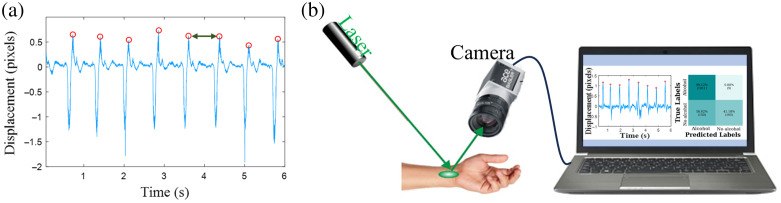
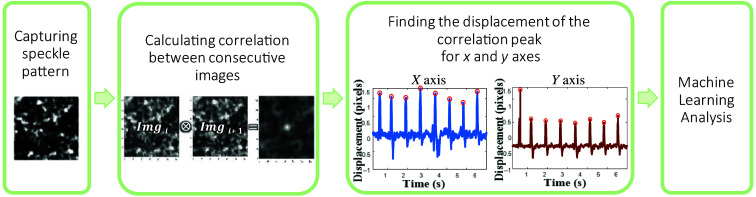
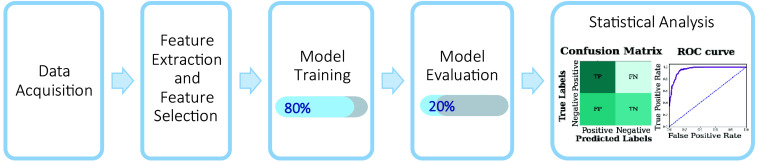
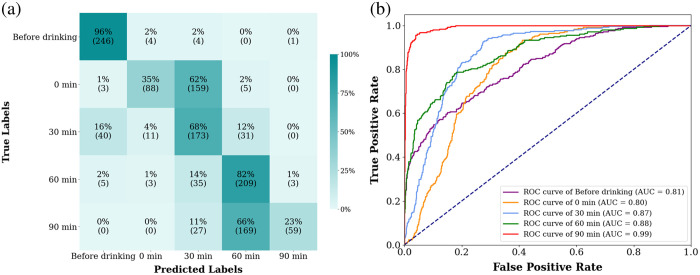
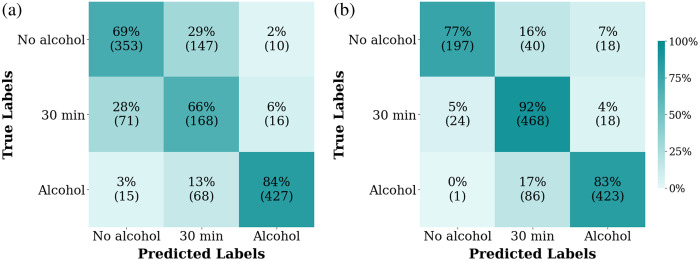
Our experimental setup includes a laser directed toward the subject's radial artery, a camera capturing defocused speckle pattern images of the illuminated area, and a computer. Participants consumed alcohol and were tested periodically. We developed a machine learning classification model that performs automatic feature selection based on temporal analysis of the speckle patterns. The model was evaluated using various labeling schemes: classification with five labels, consolidation to three labels by merging similar labels, and three different binary classifications cases ("Alcohol" or "No alcohol").
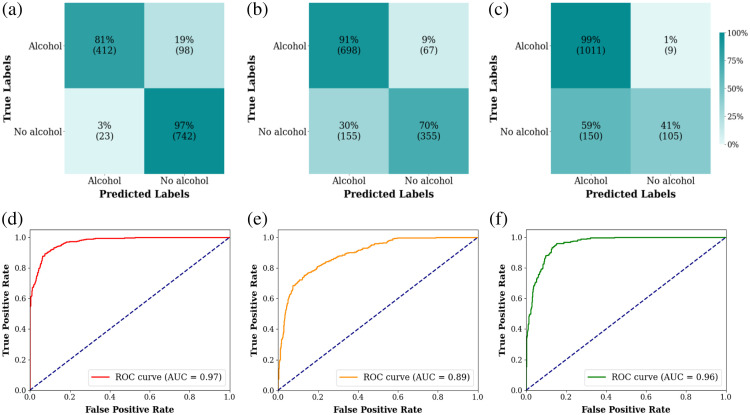
Our classification models showed improving accuracy as we reduced the number of labels. The initial five-label model achieved 61% accuracy. When consolidated into three labels, the models achieved accuracies of 74% and 85% for the two cases. The binary classification models performed best, with model A achieving 91% accuracy and 97% specificity, model B achieving 83% accuracy, and model C achieving 88% accuracy with 99% sensitivity.
Our binary classification model C can successfully distinguish between pre- and post-alcohol consumption with high sensitivity and accuracy. This performance is particularly valuable for clinical and forensic applications, where minimizing false negatives is crucial.
酒精摄入量监测对于法医和医疗应用至关重要。虽然呼气和血液酒精浓度传感器是目前最常用的方法,但对更快、非侵入性且更高效的评估技术的需求日益增长。我们进行二元分类的基本原理与中国等对酒精消费有严格限制的国家的执法应用有关,这些国家旨在防止血液中哪怕含有微量酒精时驾驶。
我们提出一种远程光学技术,用于通过散斑图案分析评估酒精摄入量,并通过机器学习进行增强以进行二元分类。该方法无需前后比较即可提供远程且快速的酒精摄入量评估。
我们的实验装置包括一束指向受试者桡动脉的激光、一台捕捉照明区域散焦散斑图案图像的相机以及一台计算机。参与者饮用酒精并定期接受测试。我们开发了一种机器学习分类模型,该模型基于散斑图案的时间分析进行自动特征选择。该模型使用各种标记方案进行评估:具有五个标签的分类、通过合并相似标签合并为三个标签,以及三种不同的二元分类情况(“饮酒”或“未饮酒”)。
我们的分类模型在减少标签数量时显示出准确率提高。最初的五标签模型准确率为61%。合并为三个标签时,两种情况的模型准确率分别为74%和85%。二元分类模型表现最佳,模型A准确率为91%,特异性为97%,模型B准确率为83%,模型C准确率为88%,灵敏度为99%。
我们的二元分类模型C能够以高灵敏度和准确率成功区分饮酒前后的情况。这种性能对于临床和法医应用特别有价值,在这些应用中最小化假阴性至关重要。