Berge Line Iden, Angeles Renira Corinne, Gedde Marie Hidle, Fæø Stein Erik, Mannseth Janne, Vislapuu Maarja, Søyland Puaschitz Natalie Genevieve, Hillestad Eirin, Aarsland Dag, Achterberg Wilco Peter, Allore Heather, Ballard Clive, Li Fan, Selbæk Geir, Vahia Ipsit Vihang, Husebo Bettina Sandgate
Center for Elderly and Nursing Home Medicine, Department of Global Public Health and Primary Care, Faculty of Medicine, University of Bergen, Bergen, Norway.
NKS Olaviken Gerontopsychiatric Hospital, Erdal, Norway.
Alzheimers Dement. 2025 Mar;21(3):e14622. doi: 10.1002/alz.14622.
We investigated the effectiveness of the multicomponent learning, innovation, volunteer support, empowerment (LIVE) intervention on caregiver burden and care time in dyads of home-dwelling people with dementia and caregivers.
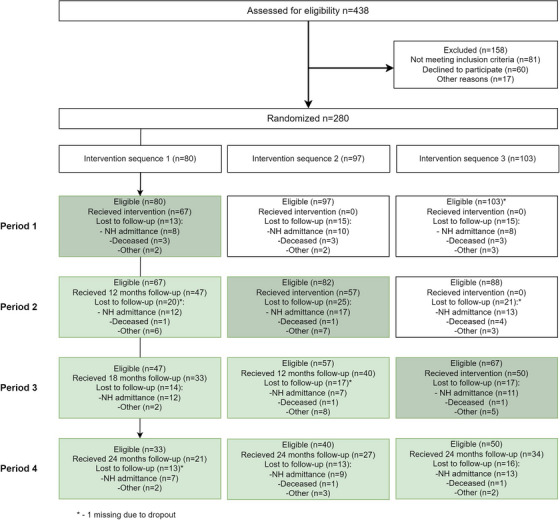
A 24 month, multicenter, stepped-wedge trial, randomized dyads to receive the 6-month LIVE intervention by municipal coordinators (May 2019 to December 2021). Primary outcomes were caregiver burden assessed by Relative Stress Scale (RSS) and informal care time spent on personal activities assessed by Resource Utilization in Dementia Personal Activities of Daily Living (RUD-PADL). Analyses used an intention-to-treat.
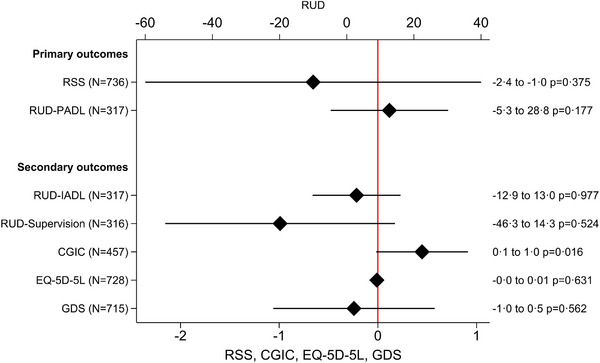
Two hundred eighty dyads were enrolled. Caregivers during the intervention period reported lower levels of RSS of 0.7 points (standard deviation [SD]: 0.8) compared to the caregivers in the control period. Caregivers during the intervention period reported more time spent on PADL of 11.7 hours/month (SD: 8.7) compared to caregivers during the control period; both were not statistically significant (P > 0.05).
The LIVE intervention did not reduce caregiver burden or care time.
ClinicalTrials.gov NCT04043364.
Two hundred eighty persons with dementia and caregivers were included in a stepped wedge randomized controlled trial. We used the learning, innovation, volunteer support, empowerment (LIVE) intervention. The LIVE intervention did not reduce caregiver burden or informal care time. The LIVE intervention improved the caregiver's clinical global impression of change. Positive change was most pronounced for coordinator personalized support.
我们调查了多成分学习、创新、志愿者支持、赋权(LIVE)干预对居家痴呆患者及其照护者二元组中照护者负担和照护时间的有效性。
一项为期24个月的多中心阶梯楔形试验,将二元组随机分组,由市政协调员实施为期6个月的LIVE干预(2019年5月至2021年12月)。主要结局指标为通过相对压力量表(RSS)评估的照护者负担,以及通过痴呆症日常生活个人活动资源利用量表(RUD-PADL)评估的用于个人活动的非正式照护时间。分析采用意向性分析。
共纳入280个二元组。与对照组期间的照护者相比,干预期间的照护者报告的RSS水平降低了0.7分(标准差[SD]:0.8)。与对照组期间的照护者相比,干预期间的照护者报告用于PADL的时间每月增加了11.7小时(SD:8.7);两者均无统计学意义(P>0.05)。
LIVE干预并未减轻照护者负担或减少照护时间。
ClinicalTrials.gov NCT04043364。
280名痴呆患者及其照护者被纳入一项阶梯楔形随机对照试验。我们采用了学习、创新、志愿者支持、赋权(LIVE)干预。LIVE干预并未减轻照护者负担或减少非正式照护时间。LIVE干预改善了照护者对变化的临床整体印象。协调员的个性化支持带来的积极变化最为明显。