Roy Abinash, Subramanya Pailoor
Department of Yoga Studies, School of Medicine and Public Health, Central University of Kerala, Tejaswini Hills, Periya PO, Kasaragod Dist., Kerala, 671320, India.
Department of Yoga Studies, School of Medicine and Public Health, Central University of Kerala, Tejaswini Hills, Periya PO, Kasaragod Dist., Kerala, 671320, India.
J Ayurveda Integr Med. 2025 Mar-Apr;16(2):101057. doi: 10.1016/j.jaim.2024.101057. Epub 2025 Mar 4.
Meditation, encompassing focussed attention (FA) and open monitoring (OM) approaches, is recognised for its potential to enhance cognitive functions. Sustained attention, a critical component of attentional processes, influences cognitive capacity and is linked to meditation benefits. However, a robust and extensive review analysis needs to address the specific relationship between meditation and sustained attention in nonclinical populations.
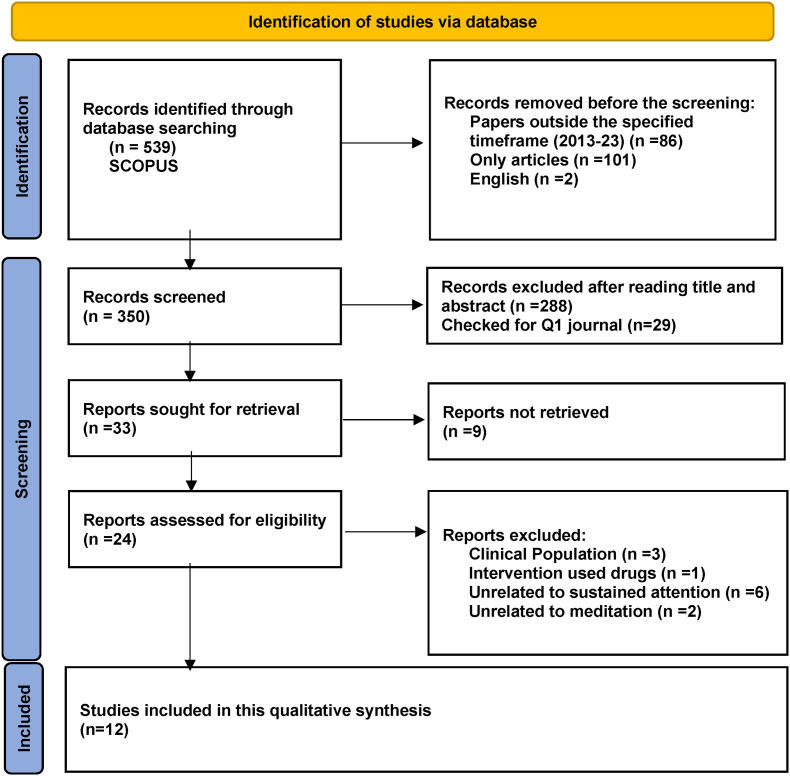
Following PRISMA guidelines, the authors reviewed English articles published from 2013 to 2023 in Q1 SCOPUS-indexed journals. Inclusion criteria comprised original research studies exploring the impact of meditation on sustained attention in healthy individuals. The modified Jadad Scale assessed methodological quality.
12 studies (four RCTs, eight non-RCTs) with 1447 participants were included. Concentrative or FA meditation demonstrated consistent positive effects on sustained attention, including reduced perceived stress and increased focussed attention. OM meditation significantly improved sustained attention, as evidenced by reduced mind wandering and enhanced N2 responses. Meditators consistently outperformed non-meditators in sustained attention tasks, demonstrating faster reactions and lower error rates.
This review explored the impact of meditation on sustained attention across diverse non-clinical populations through 12 investigations involving 1447 subjects with meditation interventions spanning from 21 days to 3 months. The study revealed that both FA and OM meditation approaches positively impact sustained attention, highlighting their potential role in enhancing cognitive function. Meditators consistently exhibited superior sustained attention abilities, suggesting the cognitive benefits of regular meditation practice. The findings of this study are consistent with prior research, contributing to the growing body of knowledge on the advantageous impacts of meditation on sustained attention. However, caution is needed in generalizing findings due to study limitations. Future research should use standardized methodologies and conduct longer-term follow-ups to better elucidate the effects of meditation interventions on sustained attention across diverse populations.
冥想包括专注注意力(FA)和开放监测(OM)方法,其增强认知功能的潜力已得到认可。持续注意力是注意力过程的关键组成部分,影响认知能力,并与冥想的益处相关。然而,需要进行强有力且广泛的综述分析,以探讨非临床人群中冥想与持续注意力之间的具体关系。
作者遵循PRISMA指南,回顾了2013年至2023年在第一季度被SCOPUS索引的期刊上发表的英文文章。纳入标准包括探索冥想对健康个体持续注意力影响的原创研究。采用改良的Jadad量表评估方法学质量。
纳入了12项研究(4项随机对照试验,8项非随机对照试验),共1447名参与者。专注或FA冥想对持续注意力显示出一致的积极影响,包括感知压力降低和专注注意力增强。OM冥想显著改善了持续注意力,表现为思维游荡减少和N2反应增强。在持续注意力任务中,冥想者始终优于非冥想者,反应更快,错误率更低。
本综述通过12项涉及1447名受试者的调查,探讨了冥想对不同非临床人群持续注意力的影响,冥想干预时间从21天到3个月不等。研究表明,FA和OM冥想方法均对持续注意力有积极影响,突出了它们在增强认知功能方面的潜在作用。冥想者始终表现出卓越的持续注意力能力,表明定期冥想练习对认知有益。本研究结果与先前研究一致,为冥想对持续注意力的有利影响这一不断增长的知识体系做出了贡献。然而,由于研究局限性,在推广研究结果时需谨慎。未来的研究应采用标准化方法,并进行长期随访,以更好地阐明冥想干预对不同人群持续注意力的影响。