Peng Shan, Liu Yueru, Zhao Wei, Liu Xinpeng, Yu Ronghua, Yu Yonglin
Department of Pathology, Affiliated Hospital of Zunyi Medical University, Zunyi, Guizhou, China.
Department of Pathology, Zunyi Medical University, Zunyi, Guizhou, China.
Front Chem. 2025 Feb 19;13:1546637. doi: 10.3389/fchem.2025.1546637. eCollection 2025.
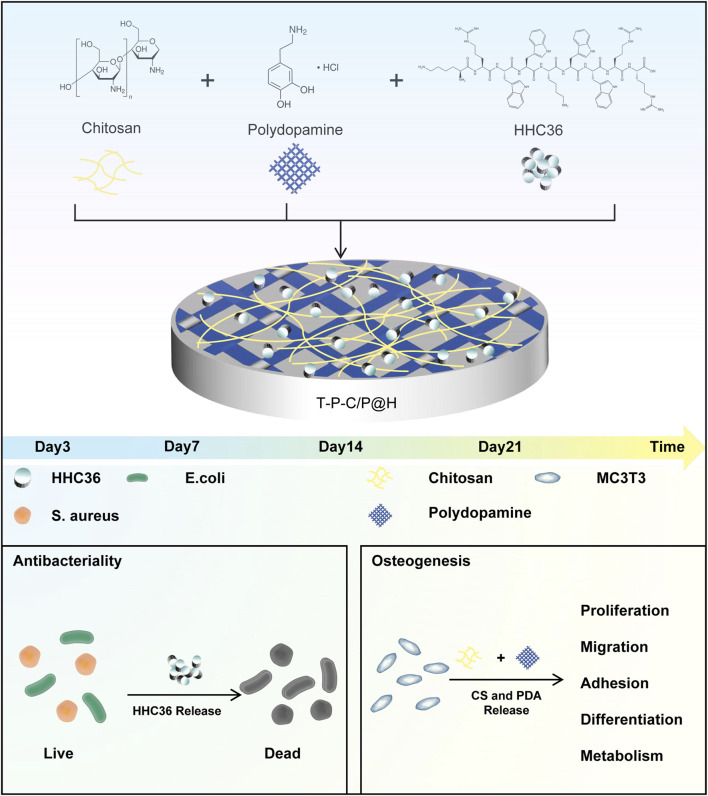
Infection is one of the leading causes of failure in titanium-based implant materials during clinical surgeries, often resulting in delayed or non-union of bone healing. Furthermore, the overuse of antibiotics can lead to bacterial resistance. Therefore, developing a novel titanium-based implant material with both antimicrobial and osteogenic properties is of great significance. In this study, chitosan (CS), polydopamine (PDA), and antimicrobial peptides (AMPs) HHC36 were applied to modify the surface of titanium, resulting in the successful preparation of the composite material Ti-PDA-CS/PDA@HHC36 (abbreviated as T-P-C/P@H). CS promotes osteogenesis and cell adhesion, providing an ideal microenvironment for bone repair. PDA enhances the material's biocompatibility and corrosion resistance, offering cell adhesion sites, while both components exhibit pH-responsive characteristics. The HHC36 effectively prevents infection, protecting the bone repair material from bacterial damage. Overall, the synergistic effects of these components in T-P-C/P@H not only confer excellent antimicrobial and osteogenic properties but also improve biocompatibility, offering a new strategy for applying titanium-based implants in clinical settings.
感染是临床手术中钛基植入材料失败的主要原因之一,常常导致骨愈合延迟或不愈合。此外,抗生素的过度使用会导致细菌耐药性。因此,开发一种兼具抗菌和成骨特性的新型钛基植入材料具有重要意义。在本研究中,壳聚糖(CS)、聚多巴胺(PDA)和抗菌肽(AMPs)HHC36被用于修饰钛表面,成功制备了复合材料Ti-PDA-CS/PDA@HHC36(简称为T-P-C/P@H)。CS促进成骨和细胞黏附,为骨修复提供理想的微环境。PDA增强材料的生物相容性和耐腐蚀性,提供细胞黏附位点,且这两种成分都具有pH响应特性。HHC36有效预防感染,保护骨修复材料免受细菌损伤。总体而言,T-P-C/P@H中这些成分的协同作用不仅赋予其优异的抗菌和成骨特性,还改善了生物相容性,为钛基植入物在临床应用提供了新策略。