Storz Maximilian Andreas, Stübing Frieda, Huber Roman
Department of Internal Medicine II, Centre for Complementary Medicine, Medical Center, Faculty of Medicine, University of Freiburg, University of Freiburg, Freiburg, Germany.
Nutr J. 2025 Mar 8;24(1):37. doi: 10.1186/s12937-025-01088-7.
Morbid Obesity (MO), defined by a Body Mass Index (BMI) > 40 kg/m, is the most severe form of obesity. The risk of suffering from any chronic medical condition is almost twice as high in MO as compared to overweight. Despite obesity being one of the most serious contemporary public health concerns, there is a paucity of nutrient intake data in adults with MO. Nutritional assessments in morbidly obese adults are often based on individuals seeking weight loss surgery rather than focusing on the general community.
Using National Health and Nutrition Examination Surveys data (NHANES, 2007-2016), we estimated nutrient intakes in the general US population with MO, thereby focusing on a comparative assessment to the Dietary Guidelines for Americans (DGA, 2020-2025). Nutrient intakes were assessed in morbidly obese US adults with a BMI > 40 kg/m, regardless of their intention to seek weight loss treatment and regardless of reporting special diets. Sex- and age-specific nutrient intake assessments were performed, with the aim to identify population subgroups that may warrant particular attention from a public health perspective.
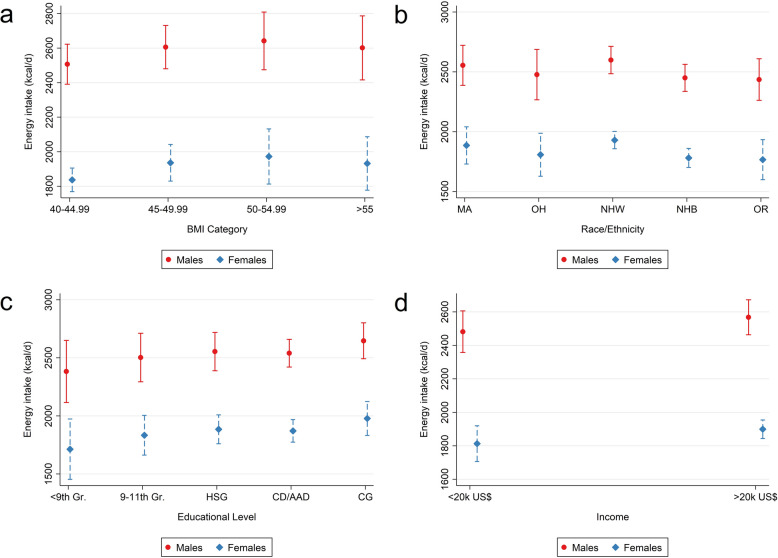
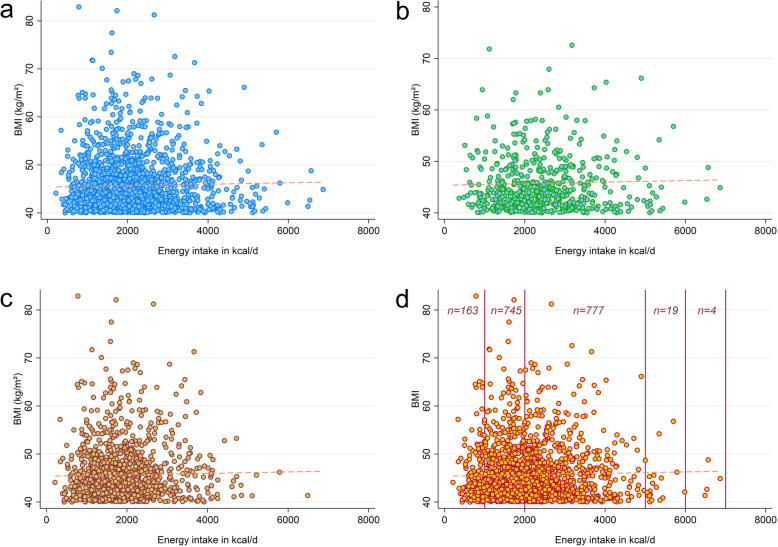
The study sample comprised 1,708 participants with MO. This may be extrapolated to represent 14,047,276 US Americans. MO was more prevalent in females as compared to males (65.60% vs 34.40%) and the sample's average age was 46.25 years, with a tendency towards a lower mean age in higher BMI groups. The alignment with the DGA was poor across both sexes, and particularly with regard to the nutrients of public health concern (fiber, calcium), saturated fatty acid intake and the intakes of several fat-soluble vitamins. Fiber intake was found to be particularly low in females with MO. Total energy intake was not associated with BMI in participants with MO. Morbidly obese individuals frequently reported special diets, with up to 28% of the examined population disclosing at least one special diet.
Using a descriptive epidemiological approach, we identified numerous sociodemographic and nutritional factors associated with MO. The poor alignment with US national dietary guidelines warrants special considerations and dedicated public health nutrition efforts to combat the increasing obesity-related burden.
病态肥胖(MO)定义为体重指数(BMI)>40kg/m²,是最严重的肥胖形式。与超重者相比,MO患者患任何慢性疾病的风险几乎高出一倍。尽管肥胖是当代最严重的公共卫生问题之一,但关于成年MO患者的营养摄入数据却很少。病态肥胖成年人的营养评估通常基于寻求减肥手术的个体,而非关注普通人群。
利用国家健康与营养检查调查(NHANES,2007 - 2016年)数据,我们估算了美国普通MO人群的营养摄入量,从而重点与《美国人膳食指南》(DGA,2020 - 2025年)进行对比评估。对BMI>40kg/m²的美国病态肥胖成年人的营养摄入量进行评估,无论其是否打算寻求减肥治疗,也无论其是否报告特殊饮食。进行了按性别和年龄划分的营养摄入量评估,旨在确定从公共卫生角度可能需要特别关注的人群亚组。
研究样本包括1708名MO参与者。这可外推以代表14047276名美国人。与男性相比,MO在女性中更为普遍(65.60%对34.40%),样本的平均年龄为46.25岁,BMI较高的组平均年龄有较低的趋势。男女与DGA的一致性都很差,尤其是在公共卫生关注的营养素(纤维、钙)、饱和脂肪酸摄入量以及几种脂溶性维生素的摄入量方面。发现MO女性的纤维摄入量特别低。MO参与者的总能量摄入量与BMI无关。病态肥胖个体经常报告特殊饮食,多达28%的受调查人群披露至少一种特殊饮食。
通过描述性流行病学方法,我们确定了许多与MO相关的社会人口学和营养因素。与美国国家膳食指南的较差一致性值得特别考虑,并需要专门的公共卫生营养努力来应对日益增加的肥胖相关负担。