Lee Gilbert Aaron, Hsu Justin Bo-Kai, Chang Yu-Wei, Hsieh Li-Chun, Li Yi-Tien, Wu Ying Chieh, Chu Cheng-Ying, Chiang Yung-Hsiao, Guo Wan-Yuo, Wu Chih-Chun, Chen Liang-Wei, Kao Hung-Wen, Lin Wan-Li, Tseng Li-Wen, Weng Ting-Wei, Kuo Duen-Pang, Cheng Sho-Jen, Chen Yung-Chieh, Huang Shiu-Wen, Kung Hsing-Jien, Chen Cheng-Yu
Department of Medical Research, Taipei Medical University Hospital, Taipei, Taiwan.
Department of Microbiology and Immunology, School of Medicine, College of Medicine, Taipei Medical University, Taipei, Taiwan.
J Biomed Sci. 2025 Mar 8;32(1):34. doi: 10.1186/s12929-025-01126-w.
Glioblastoma multiforme (GBM) is an aggressive brain tumor with chemoresistant, immunosuppressive, and invasive properties. Despite standard therapies, including surgery, radiotherapy, and temozolomide (TMZ) chemotherapy, tumors inevitably recur in the peritumoral region. Targeting GBM-mediated immunosuppressive and invasive properties is a promising strategy to improve clinical outcomes.
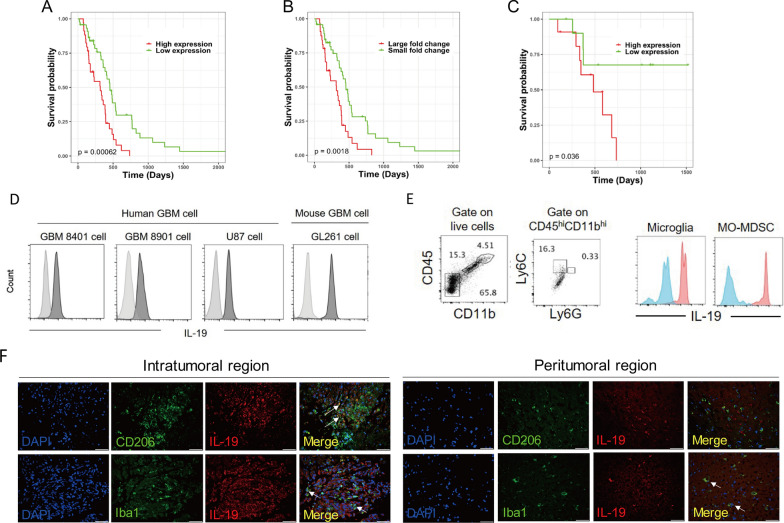
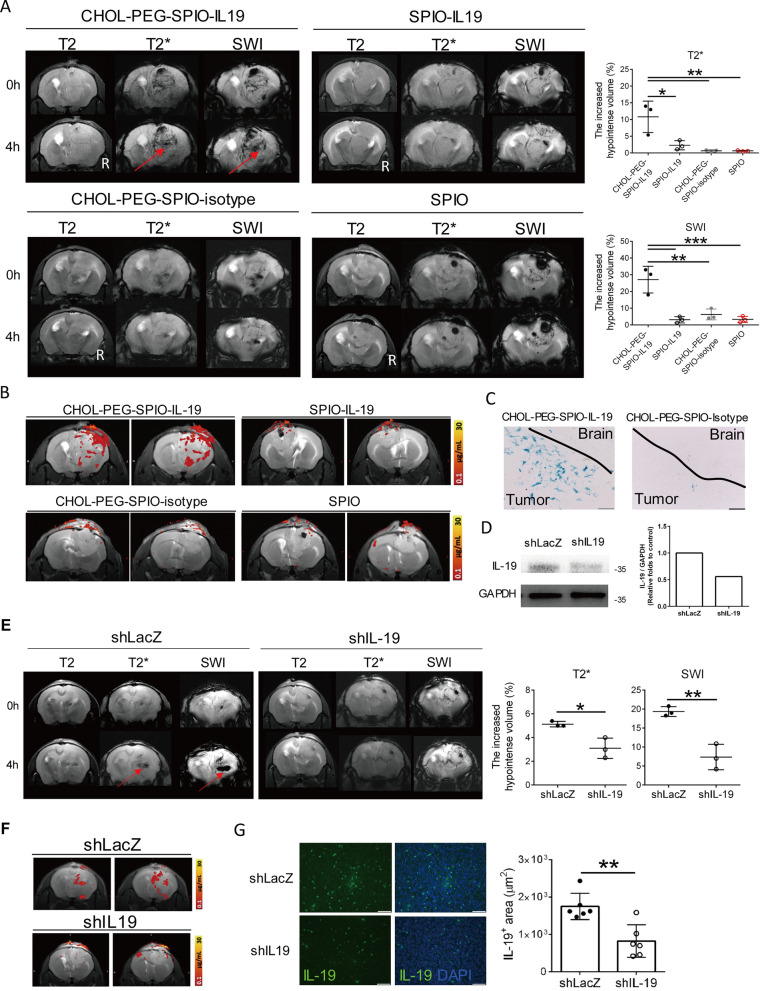
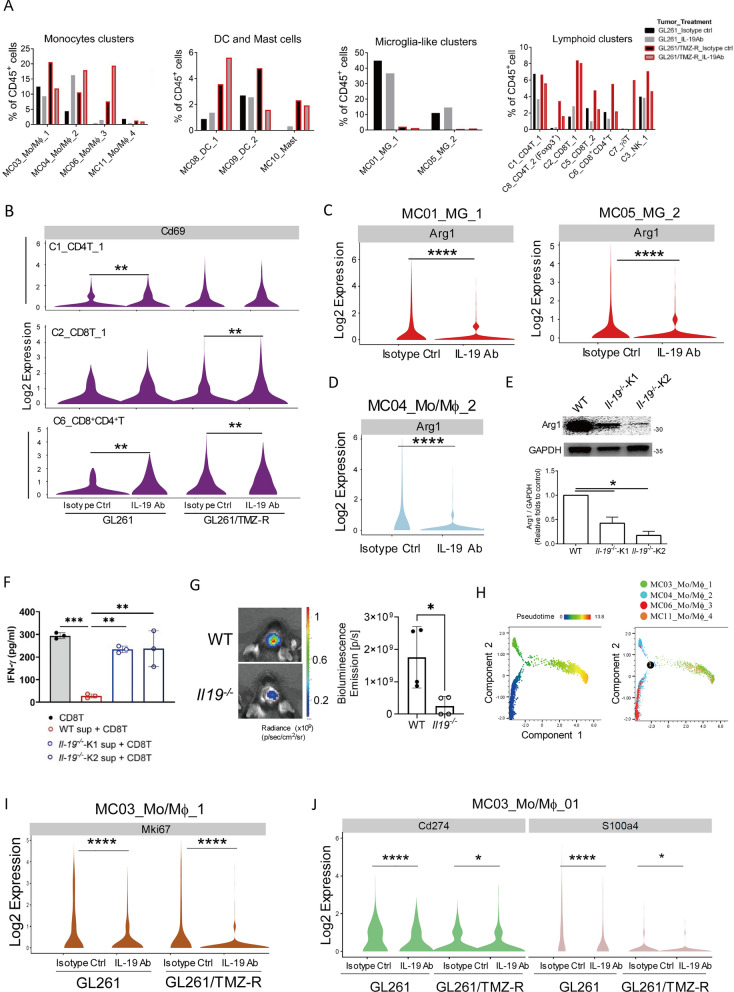
We utilized clinical and genomic data from the Taiwan GBM cohort and The Cancer Genome Atlas (TCGA) to analyze RNA sequencing data from patient tumor samples, determining the association of interleukin-19 (Il-19) expression with survival and immunosuppressive activity. Gene set enrichment analysis (GSEA) was performed to assess the relationship between the enrichment levels of immune subsets and Il-19 expression level, and Ingenuity Pathway Analysis (IPA) was used to predict immune responses. Cytokine array and single-cell RNA sequencing were used to examine the effects of IL-19 blockade on tumor immune microenvironment, including tumor-infiltrating leukocyte profiles, differentiation and immunosuppressive genes expression in tumor associated macrophages (TAM). CRISPR Il-19 cell lines and Il-19 mice were used to examine the role of IL-19 in tumor invasion and M2-like macrophage-mediated immunosuppression. Additionally, we developed novel cholesterol-polyethylene glycol-superparamagnetic iron oxide-IL-19 antibody nanoparticles (CHOL-PEG-SPIO-IL-19), characterized them using dynamic light scattering and transmission electron microscopy, Fourier-Transform Infrared spectroscopy, prussian blue assay, and conducted in vivo magnetic resonance imaging (MRI) in a human glioblastoma stem cell-derived GBM animal model.
Genomic screening and IPA analysis identified IL-19 as a predicted immunosuppressive cytokine in the peritumoral region, associated with poor survival in patients with GBM. Blocking IL-19 significantly inhibited tumor progression of both TMZ-sensitive (TMZ-S) and TMZ-resistant (TMZ-R) GBM-bearing mice, and modulated the immune response within the GBM microenvironment. Single-cell transcriptome analysis reveal that IL-19 antibody treatment led to a marked increase in dendritic cells and monocyte/macrophage subsets associated with interferon-gamma signaling pathways. IL-19 blockade promoted T cell activation and reprogrammed tumor-associated macrophages toward weakened pro-tumoral phenotypes with reduced Arginase 1 expression. Il19 M2-like bone marrow-derived macrophages with lower Arginase 1 level lost their ability to suppress CD8 T cell activation. These findings indicated that IL-19 suppression limits TAM-mediated immune suppression. Molecular studies revealed that IL-19 promotes TMZ-resistant GBM cell migration and invasion through a novel IL-19/WISP1 signaling pathway. For clinical translation, we developed a novel CHOL-PEG-SPIO-IL-19 nanoparticles to target IL-19 expression in glioblastoma tissue. MRI imaging demonstrated enhanced targeting efficiency in brain tumors, with in vivo studies showing prominent hypointense areas in T2*-weighted MRI scans of tumor-bearing mice injected with CHOL-PEG-SPIO-IL-19, highlighting nanoparticle presence in IL-19-expressing regions. Prussian blue staining further confirmed the localization of these nanoparticles in tumor tissues, verifying their potential as a diagnostic tool for detecting IL-19 expression in glioblastoma. This system offers a theranostic approach, integrating diagnostic imaging and targeted therapy for IL-19-expressing GBM.
IL-19 is a promising theranostic target for reversing immunosuppression and restricting the invasive activity of chemoresistant GBM cells.
多形性胶质母细胞瘤(GBM)是一种侵袭性脑肿瘤,具有化学抗性、免疫抑制和侵袭性。尽管采用了包括手术、放疗和替莫唑胺(TMZ)化疗在内的标准治疗方法,但肿瘤仍不可避免地在肿瘤周围区域复发。针对GBM介导的免疫抑制和侵袭特性是改善临床结果的一种有前景的策略。
我们利用来自台湾GBM队列和癌症基因组图谱(TCGA)的临床和基因组数据,分析患者肿瘤样本的RNA测序数据,确定白细胞介素-19(Il-19)表达与生存及免疫抑制活性之间的关联。进行基因集富集分析(GSEA)以评估免疫亚群的富集水平与Il-19表达水平之间的关系,并使用 Ingenuity 通路分析(IPA)预测免疫反应。使用细胞因子阵列和单细胞RNA测序来检查IL-19阻断对肿瘤免疫微环境的影响,包括肿瘤浸润白细胞谱、肿瘤相关巨噬细胞(TAM)中的分化和免疫抑制基因表达。使用CRISPR Il-19细胞系和Il-19小鼠来研究IL-19在肿瘤侵袭和M2样巨噬细胞介导的免疫抑制中的作用。此外,我们开发了新型胆固醇-聚乙二醇-超顺磁性氧化铁-IL-19抗体纳米颗粒(CHOL-PEG-SPIO-IL-19),使用动态光散射、透射电子显微镜、傅里叶变换红外光谱、普鲁士蓝测定对其进行表征,并在人胶质母细胞瘤干细胞衍生的GBM动物模型中进行体内磁共振成像(MRI)。
基因组筛选和IPA分析确定Il-19是肿瘤周围区域预测的免疫抑制细胞因子,与GBM患者的不良生存相关。阻断IL-19显著抑制了携带TMZ敏感(TMZ-S)和TMZ耐药(TMZ-R)GBM小鼠的肿瘤进展,并调节了GBM微环境内的免疫反应。单细胞转录组分析表明,IL-19抗体治疗导致与干扰素-γ信号通路相关的树突状细胞和单核细胞/巨噬细胞亚群显著增加。IL-19阻断促进T细胞活化,并使肿瘤相关巨噬细胞重新编程为促肿瘤表型减弱、精氨酸酶1表达降低的状态。精氨酸酶1水平较低的Il19 M2样骨髓来源巨噬细胞失去了抑制CD8 T细胞活化的能力。这些发现表明,抑制IL-19可限制TAM介导的免疫抑制。分子研究表明,IL-19通过新的IL-19/WISP1信号通路促进TMZ耐药GBM细胞的迁移和侵袭。为了进行临床转化,我们开发了新型CHOL-PEG-SPIO-IL-19纳米颗粒,以靶向胶质母细胞瘤组织中的IL-19表达。MRI成像显示在脑肿瘤中的靶向效率增强,体内研究表明,在注射CHOL-PEG-SPIO-IL-19的荷瘤小鼠的T2 *加权MRI扫描中出现明显的低信号区域,突出了纳米颗粒在表达IL-19区域的存在。普鲁士蓝染色进一步证实了这些纳米颗粒在肿瘤组织中的定位,验证了它们作为检测胶质母细胞瘤中IL-19表达的诊断工具的潜力。该系统提供了一种治疗诊断方法,将诊断成像和针对表达IL-19的GBM的靶向治疗相结合。
IL-19是逆转免疫抑制和限制化学抗性GBM细胞侵袭活性的有前景的治疗诊断靶点。