Lai Hurong, Tu Yansong, Liao Caifeng, Zhang Shan, He Ling, Li Jian
The Second Affiliated Hospital, Jiangxi Medical College, Nanchang University, Nanchang, Jiangxi, China.
Faculty of Science, University of Melbourne, Grattan Street, Parkville, VIC, 3010, Australia.
Cardiovasc Diabetol. 2025 Mar 8;24(1):109. doi: 10.1186/s12933-025-02667-y.
Obesity and abnormal lipid metabolism increase the risk of various cardiometabolic diseases, including diabetes, heart disease, and stroke. However, the impact of abdominal obesity (AO) and non-traditional lipid parameters on the risk of cardiometabolic multimorbidity (CMM) remains unclear. This study aims to investigate the separate and combined effects of AO and non-traditional lipid parameters on the incidence risk of CMM.
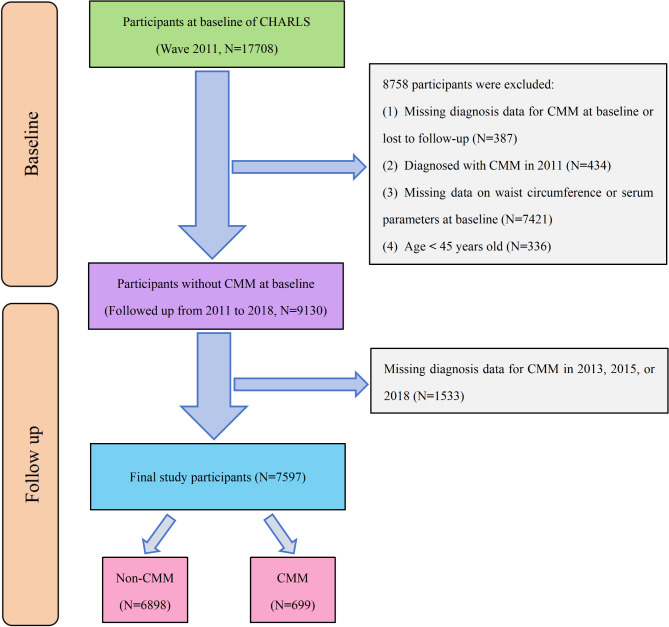
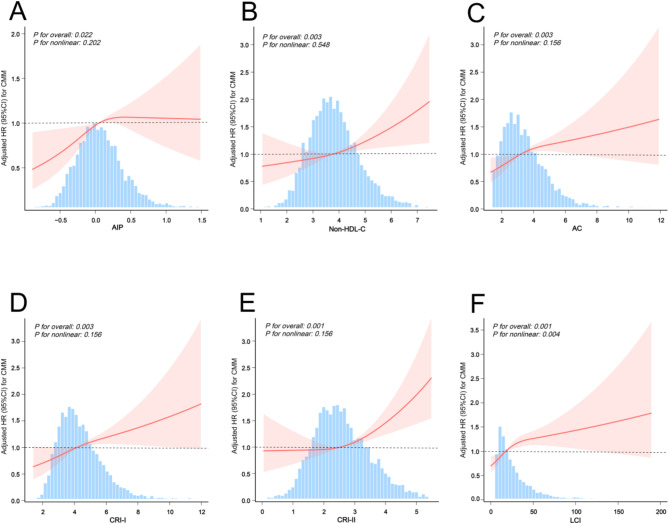
This study enrolled 7,597 eligible participants from the China health and retirement longitudinal study (CHARLS). Cox proportional hazards models were used to perform adjusted regression analyses and mediation analyses, with Kaplan-Meier analysis used for cumulative hazards. Restricted cubic splines were utilized to evaluate the nonlinear relationship between non-traditional lipid parameters and the risk of CMM among participants with AO. Subgroup analyses were conducted with stratification by age, gender, BMI, smoking status, drinking status, and hypertension to investigate interaction effects across different populations. Additionally, sensitivity analyses were further performed to evaluate the impact of various subgroups on diabetes, heart disease, and stroke.
During the 7-year follow-up period, a total of 699 participants (9.20%) were newly diagnosed with CMM. Kaplan-Meier curves revealed that the subgroup with both AO and high levels of non-traditional lipid parameters had the highest cumulative hazard for developing CMM. In the fully adjusted model, Cox regression analysis revealed that participants with both high levels of non-traditional lipid parameters and AO exhibited the highest risk of developing CMM. Subgroup and sensitivity analyses further confirmed the robustness of these findings, showing consistent results across different demographic groups and under various analytical conditions. Furthermore, AO was found to significantly mediated the associations between non-traditional lipid parameters and the risk of developing CMM.
The separate and combined effects of AO and non-traditional lipid parameters were significantly associated with the risk of developing CMM. Notably, AO may induce CMM by partially mediating the effects of serum lipids in human metabolism. The findings highlighted the importance of joint evaluation of AO and non-traditional lipid parameters for primary prevention of CMM.
肥胖和脂质代谢异常会增加患各种心脏代谢疾病的风险,包括糖尿病、心脏病和中风。然而,腹部肥胖(AO)和非传统脂质参数对心脏代谢多发病(CMM)风险的影响仍不清楚。本研究旨在探讨AO和非传统脂质参数对CMM发病风险的单独及联合作用。
本研究纳入了来自中国健康与养老追踪调查(CHARLS)的7597名符合条件的参与者。采用Cox比例风险模型进行调整后的回归分析和中介分析,采用Kaplan-Meier分析计算累积风险。利用受限立方样条评估AO参与者中非传统脂质参数与CMM风险之间的非线性关系。通过按年龄、性别、体重指数、吸烟状况、饮酒状况和高血压进行分层的亚组分析,研究不同人群中的交互作用。此外,进一步进行敏感性分析,以评估各亚组对糖尿病、心脏病和中风的影响。
在7年的随访期内,共有699名参与者(9.20%)被新诊断为CMM。Kaplan-Meier曲线显示兼具AO和高水平非传统脂质参数的亚组发生CMM的累积风险最高。在完全调整模型中,Cox回归分析显示,非传统脂质参数水平高且有AO的参与者发生CMM的风险最高。亚组和敏感性分析进一步证实了这些发现的稳健性,在不同人口统计学组和各种分析条件下均显示出一致的结果。此外,发现AO显著介导了非传统脂质参数与发生CMM风险之间的关联。
AO和非传统脂质参数的单独及联合作用均与发生CMM的风险显著相关。值得注意的是,AO可能通过部分介导血清脂质在人体代谢中的作用来诱发CMM。这些发现凸显了联合评估AO和非传统脂质参数对CMM一级预防的重要性。