Brêchet Arthur, Kohler Philipp, Dörr Tamara, Grässli Fabian, Vock Michael, Salát Jiří, Růžek Daniel, Friedl Andrée, Vuichard-Gysin Danielle, Croxatto Antony, Lienhard Reto, Ackermann-Gäumann Rahel
Microbiologie, ADMED Analyses et Diagnostics Médicaux, La Chaux-de-Fonds, Switzerland.
Division of Infectious Diseases, Infection Prevention and Travel Medicine, Cantonal Hospital of St. Gallen, St. Gallen, Switzerland.
Sci Rep. 2025 Mar 11;15(1):8346. doi: 10.1038/s41598-025-92560-1.
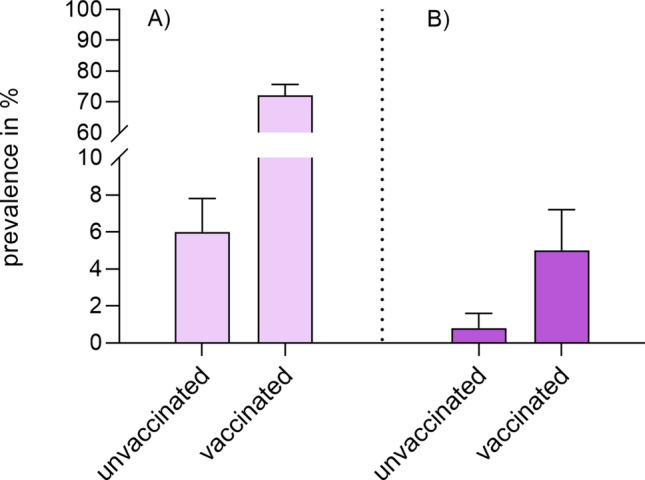
Tick-borne encephalitis virus (TBEV) infection can manifest as disease of variable severity, ranging from subclinical infection to severe disease with neurological involvement and potentially fatal outcome. Although TBE is recognized as a major public health problem in Europe, the true burden of disease is potentially underestimated. Here, we investigated TBEV-specific antibody prevalence, infection incidence, and seroreversion and antibody decline rates in a prospective Swiss healthcare worker (HCW) cohort. We screened serum samples from 1444 HCWs between June and October 2020, and from a subset again between August and September 2021, using a TBEV envelope (E) protein IgG ELISA. Positive samples underwent further analysis with a TBEV non-structural protein 1 (NS1) IgG ELISA, and seroconversions in unvaccinated individuals were confirmed by seroneutralization testing. Questionnaire data were used to determine vaccination status and risk factors. TBEV E protein-specific IgG prevalence was 72.1% (95% CI 68.2-75.7%) in TBEV-vaccinated and 6% (95% CI 4.4-7.8%) in unvaccinated individuals. The estimated annual incidence of infection was 735/100,000. Age was the only factor significantly associated with seroprevalence. The seroreversion rate in unvaccinated individuals was 30.3% within one year, which is almost ten times higher than in vaccinated individuals (3.4%, annual decline rate 8.0%). NS1-specific IgG antibodies were six times more common in vaccinated than unvaccinated HCWs. In conclusion, undetected TBEV infections are common, and infection incidence is much higher than reported clinical cases. Individuals with abortive infections have high antibody decline and seroreversion rates. Whether lifelong protection is conferred and by which immune subsets remain unclear.
蜱传脑炎病毒(TBEV)感染可表现为严重程度各异的疾病,从亚临床感染到伴有神经系统受累且可能致命的严重疾病。尽管蜱传脑炎在欧洲被视为一个主要的公共卫生问题,但疾病的实际负担可能被低估了。在此,我们调查了瑞士一个前瞻性医护人员(HCW)队列中TBEV特异性抗体的流行率、感染发病率、血清学逆转以及抗体下降率。我们在2020年6月至10月期间对1444名医护人员的血清样本进行了筛查,并在2021年8月至9月期间对其中一部分人员再次进行了筛查,采用TBEV包膜(E)蛋白IgG酶联免疫吸附测定法(ELISA)。阳性样本用TBEV非结构蛋白1(NS1)IgG ELISA进行进一步分析,未接种疫苗个体的血清转化通过血清中和试验得以确认。问卷数据用于确定疫苗接种状况和风险因素。接种TBEV疫苗个体中TBEV E蛋白特异性IgG流行率为72.1%(95%置信区间68.2 - 75.7%),未接种疫苗个体中为6%(95%置信区间4.4 - 7.8%)。估计年感染发病率为735/10万。年龄是与血清阳性率显著相关的唯一因素。未接种疫苗个体的血清学逆转率在一年内为30.3%,几乎是接种疫苗个体(3.4%,年下降率8.0%)的十倍。接种疫苗的医护人员中NS1特异性IgG抗体的出现频率是未接种疫苗者的六倍。总之,未被检测到的TBEV感染很常见,且感染发病率远高于报告的临床病例。隐性感染个体的抗体下降率和血清学逆转率很高。终身保护是否能实现以及由哪些免疫亚群提供保护仍不清楚。