Rieille Nadia, Klaus Christine, Hoffmann Donata, Péter Olivier, Voordouw Maarten J
Central Institute of Valais Hospitals, Infectious diseases, Av Grand Champsec 86, -1950, Sion, CH, Switzerland.
Institute of Biology, Laboratory of Ecology and Evolution of parasites, University of Neuchâtel, Rue Emile-Argand 11, 2000, Neuchâtel, Neuchâtel, Switzerland.
BMC Vet Res. 2017 Jul 11;13(1):217. doi: 10.1186/s12917-017-1136-y.
Tick-borne encephalitis (TBE) is an important tick-borne disease in Europe. Detection of the TBE virus (TBEV) in local populations of Ixodes ricinus ticks is the most reliable proof that a given area is at risk for TBE, but this approach is time-consuming and expensive. A cheaper and simpler approach is to use immunology-based methods to screen vertebrate hosts for TBEV-specific antibodies and subsequently test the tick populations at locations with seropositive animals.
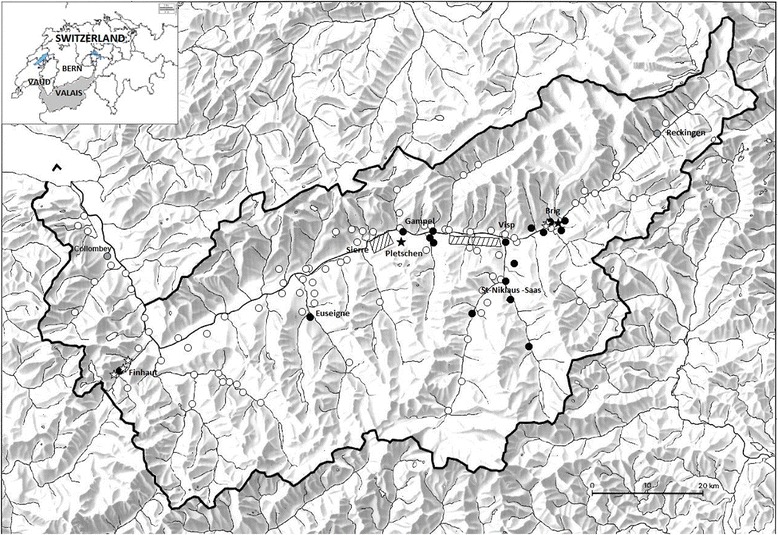
The purpose of the present study was to use goats as sentinel animals to identify new risk areas for TBE in the canton of Valais in Switzerland. A total of 4114 individual goat sera were screened for TBEV-specific antibodies using immunological methods. According to our ELISA assay, 175 goat sera reacted strongly with TBEV antigen, resulting in a seroprevalence rate of 4.3%. The serum neutralization test confirmed that 70 of the 173 ELISA-positive sera had neutralizing antibodies against TBEV. Most of the 26 seropositive goat flocks were detected in the known risk areas in the canton of Valais, with some spread into the connecting valley of Saas and to the east of the town of Brig. One seropositive site was 60 km to the west of the known TBEV-endemic area. At two of the three locations where goats were seropositive, the local tick populations also tested positive for TBEV.
The combined approach of screening vertebrate hosts for TBEV-specific antibodies followed by testing the local tick population for TBEV allowed us to detect two new TBEV foci in the canton of Valais. The present study showed that goats are useful sentinel animals for the detection of new TBEV risk areas.
蜱传脑炎(TBE)是欧洲一种重要的蜱传疾病。在蓖麻硬蜱当地种群中检测蜱传脑炎病毒(TBEV)是证明特定区域存在TBE风险的最可靠证据,但这种方法既耗时又昂贵。一种更便宜、更简单的方法是使用基于免疫学的方法来筛查脊椎动物宿主中的TBEV特异性抗体,随后在血清反应呈阳性的动物所在地点检测蜱虫种群。
本研究的目的是利用山羊作为哨兵动物,识别瑞士瓦莱州新的TBE风险区域。使用免疫学方法对总共4114份山羊个体血清进行了TBEV特异性抗体筛查。根据我们的ELISA检测,175份山羊血清与TBEV抗原发生强烈反应,血清阳性率为4.3%。血清中和试验证实,173份ELISA阳性血清中有70份具有针对TBEV的中和抗体。26个血清反应呈阳性的山羊群中,大多数在瓦莱州已知的风险区域被检测到,有些分布到了萨斯连接山谷和布里格镇以东。一个血清反应呈阳性的地点位于已知TBEV流行区域以西60公里处。在山羊血清反应呈阳性的三个地点中的两个,当地的蜱虫种群对TBEV检测也呈阳性。
先筛查脊椎动物宿主中的TBEV特异性抗体,随后检测当地蜱虫种群中的TBEV,这种联合方法使我们在瓦莱州检测到了两个新的TBEV疫源地。本研究表明,山羊是检测新的TBEV风险区域的有用哨兵动物。