Oberheide Ansgar, van den Oetelaar Maxime C M, Scheele Jakob J A, Borggräfe Jan, Engelen Semmy F H, Sattler Michael, Ottmann Christian, Cossar Peter J, Brunsveld Luc
Laboratory of Chemical Biology, Department of Biomedical Engineering and Institute for Complex Molecular Systems, Eindhoven University of Technology Groene Loper 3 5612 AE Eindhoven The Netherlands
Helmholtz Munich, Molecular Targets and Therapeutics Center, Institute of Structural Biology Ingolstädter Landstrasse 1 85764 Neuherberg Germany.
RSC Med Chem. 2025 Feb 7;16(5):2190-2201. doi: 10.1039/d4md00833b. eCollection 2025 May 22.
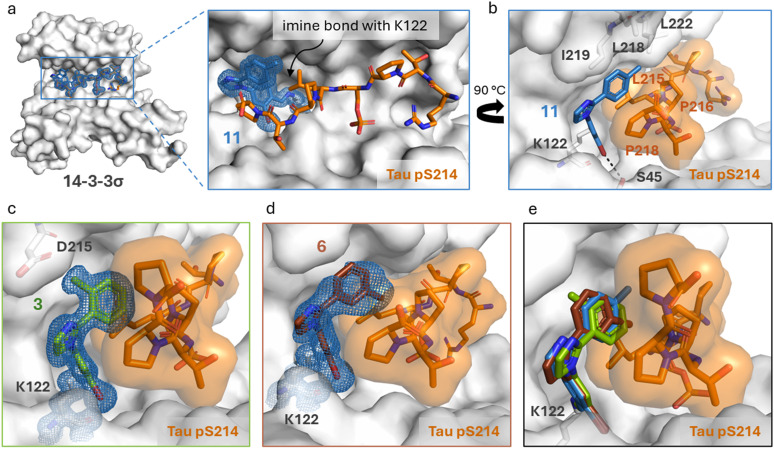
Protein-protein interactions (PPIs) are key regulators of various cellular processes. Modulating PPIs with small molecules has gained increasing attention in drug discovery, particularly targeting the 14-3-3 protein family, which interacts with several hundred client proteins and plays a central role in cellular networks. However, targeting a specific PPI of the hub protein 14-3-3, with its plethora of potential client proteins, poses a significant selectivity challenge. This not only involves the selectivity of 14-3-3 PPIs with other client proteins, but also the selective stabilization of a specific 14-3-3 binding site within a protein partner featuring several binding sites. The interaction of 14-3-3 with Tau, characterized by different phospho-site driven binding modes, forms a valuable, disease-relevant, 14-3-3 multivalent model PPI to explore this selectivity issue. This work presents the identification and early-stage optimization of small molecule fragment-like stabilizers for a specific binding site of the 14-3-3/Tau PPI. Using different biophysical assays, the stabilizing potency of the imine-bond forming molecules was mapped and X-ray crystallography studies provided structural data on the binding mode of the ternary complexes. Exploiting the unique topologies and functionalities of the different binding sites enabled the engineering of selectivity for this initial molecular glue matter for the pS214 binding site, over a second 14-3-3 binding site in Tau (pS324). These reversible covalent tool compounds will allow for the further exploration of the role of 14-3-3 in Tau aggregation.
蛋白质-蛋白质相互作用(PPIs)是各种细胞过程的关键调节因子。在药物发现中,利用小分子调节PPIs越来越受到关注,特别是针对14-3-3蛋白家族,该家族与数百种客户蛋白相互作用,并在细胞网络中发挥核心作用。然而,针对中心蛋白14-3-3的特定PPI,由于其有大量潜在的客户蛋白,面临着重大的选择性挑战。这不仅涉及14-3-3与其他客户蛋白的PPI选择性,还涉及在具有多个结合位点的蛋白伴侣中特定14-3-3结合位点的选择性稳定。14-3-3与Tau的相互作用以不同的磷酸化位点驱动的结合模式为特征,形成了一个有价值的、与疾病相关的14-3-3多价模型PPI,以探讨这一选择性问题。这项工作展示了针对14-3-3/Tau PPI特定结合位点的小分子片段样稳定剂的鉴定和早期优化。使用不同的生物物理测定方法,绘制了亚胺键形成分子的稳定效力,X射线晶体学研究提供了三元复合物结合模式的结构数据。利用不同结合位点的独特拓扑结构和功能,能够设计出针对pS214结合位点的这种初始分子胶物质相对于Tau中第二个14-3-3结合位点(pS324)的选择性。这些可逆共价工具化合物将有助于进一步探索14-3-3在Tau聚集过程中的作用。