Lv Meng, Zhao BinXin, Mao Yan, Wang Yongmei, Su Xiaohui, Zhang Zaixian, Wu Jie, Gao Xueqiang, Wang Qi
Breast Disease Diagnosis and Treatment Center, The Affiliated Hospital of Qingdao University, Qingdao, Shandong, China.
Department of Radiation Oncology, The Affiliated Hospital of Qingdao University, Qingdao, Shandong, China.
Front Oncol. 2025 Feb 25;15:1491843. doi: 10.3389/fonc.2025.1491843. eCollection 2025.
This study aims to investigate the diagnostic accuracy of various deep learning methods on DCE-MRI, in order to provide a simple and accessible tool for predicting pathologic response of NAC in breast cancer patients.
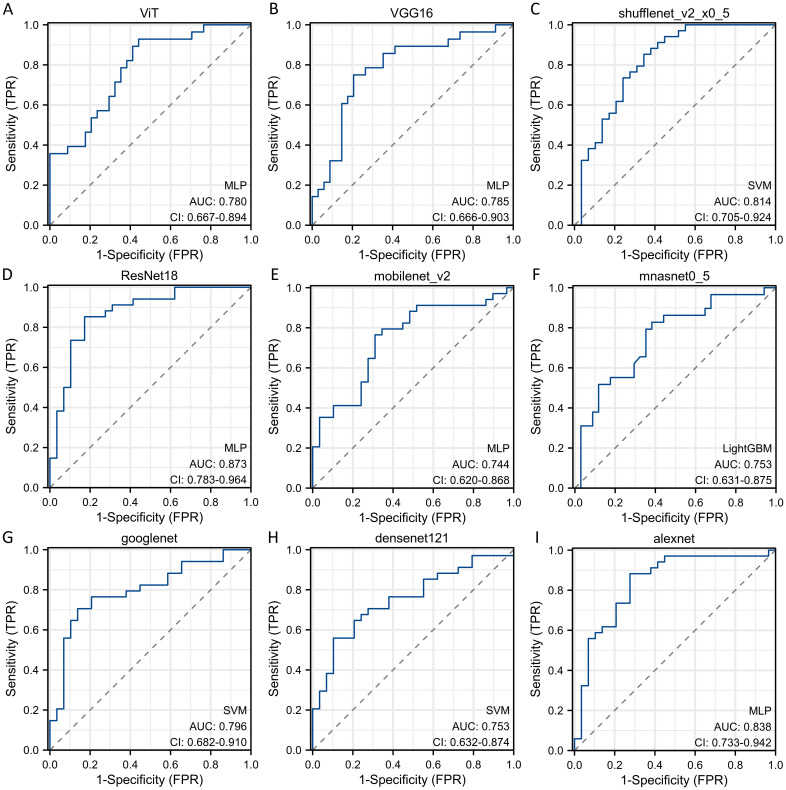
In this study, we enrolled 313 breast cancer patients who had complete DCE-MRI data and underwent NAC followed by breast surgery. According to Miller-Payne criteria, the efficacy of NAC was categorized into two groups: the patients achieved grade 1-3 of Miller-Payne criteria were classified as the non-responders, while patients achieved grade 4-5 of Miller-Payne criteria were classified as responders. Multiple deep learning frameworks, including ViT, VGG16, ShuffleNet_v2, ResNet18, MobileNet_v2, MnasNet-0.5, GoogleNet, DenseNet121, and AlexNet, were used for transfer learning of the classification model. The deep learning features were obtained from the final fully connected layer of the deep learning models, with 256 features extracted based on DCE-MRI data for each patient of each deep learning model. Various machine-learning techniques, including support vector machine (SVM), K-nearest neighbor (KNN), RandomForest, ExtraTrees, XGBoost, LightGBM, and multiple-layer perceptron (MLP), were employed to construct classification models.
We utilized various deep learning models to extract features and subsequently constructed machine learning models. Based on the performance of different machine learning models' AUC values, we selected the classifiers with the best performance. ResNet18 exhibited superior performance, with an AUC of 0.87 (95% CI: 0.82 - 0.91) and 0.87 (95% CI: 0.78 - 0.96) in the train and test cohorts, respectively.
Using pre-treatment DCE-MRI images, our study trained multiple deep models and developed the best-performing DLR model for predicting pathologic response of NAC in breast cancer patients. This prognostic tool provides a dependable and impartial basis for effectively identifying breast cancer patients who are most likely to benefit from NAC before its initiation. At the same time, it can also identify those patients who are insensitive to NAC, allowing them to proceed directly to surgical treatment and prevent the risk of losing the opportunity for surgery due to disease progression after NAC.
本研究旨在探讨各种深度学习方法对动态对比增强磁共振成像(DCE-MRI)的诊断准确性,以便提供一种简单且可及的工具来预测乳腺癌患者新辅助化疗(NAC)的病理反应。
在本研究中,我们纳入了313例有完整DCE-MRI数据且接受了NAC随后进行乳房手术的乳腺癌患者。根据米勒-佩恩标准,将NAC的疗效分为两组:达到米勒-佩恩标准1-3级的患者被归类为无反应者,而达到米勒-佩恩标准4-5级的患者被归类为反应者。多种深度学习框架,包括视觉Transformer(ViT)、VGG16、ShuffleNet_v2、ResNet18、MobileNet_v2、MnasNet-0.5、谷歌Net、DenseNet121和AlexNet,被用于分类模型的迁移学习。深度学习特征从深度学习模型的最终全连接层获得,基于每个深度学习模型的每个患者的DCE-MRI数据提取256个特征。采用各种机器学习技术,包括支持向量机(SVM)、K近邻(KNN)、随机森林、极端随机树、XGBoost、LightGBM和多层感知器(MLP)来构建分类模型。
我们利用各种深度学习模型提取特征,随后构建机器学习模型。基于不同机器学习模型的曲线下面积(AUC)值的表现,我们选择了性能最佳的分类器。ResNet18表现出卓越的性能,在训练队列和测试队列中的AUC分别为0.87(95%置信区间:0.82 - 0.91)和0.87(95%置信区间:0.78 - 0.96)。
利用治疗前的DCE-MRI图像,我们的研究训练了多个深度模型,并开发了性能最佳的深度学习回归(DLR)模型来预测乳腺癌患者NAC的病理反应。这种预后工具为在NAC开始前有效识别最可能从NAC中获益的乳腺癌患者提供了可靠且公正的依据。同时,它还可以识别那些对NAC不敏感的患者,使他们能够直接进行手术治疗,并防止因NAC后疾病进展而失去手术机会的风险。