Truchan Karolina, Zagrajczuk Barbara, Cholewa-Kowalska Katarzyna, Osyczka Anna Maria
Department of Cell Biology and Imaging, Institute of Zoology and Biomedical Research, Faculty of Biology, Jagiellonian University, Gronostajowa St. 9, Krakow, 30-387, Poland.
Department of Glass Technology and Amorphous Coatings, Faculty of Materials Science and Ceramics, AGH University of Science and Technology, Mickiewicza Ave. 30, Krakow, 30-059, Poland.
J Biol Eng. 2025 Mar 14;19(1):23. doi: 10.1186/s13036-025-00491-2.
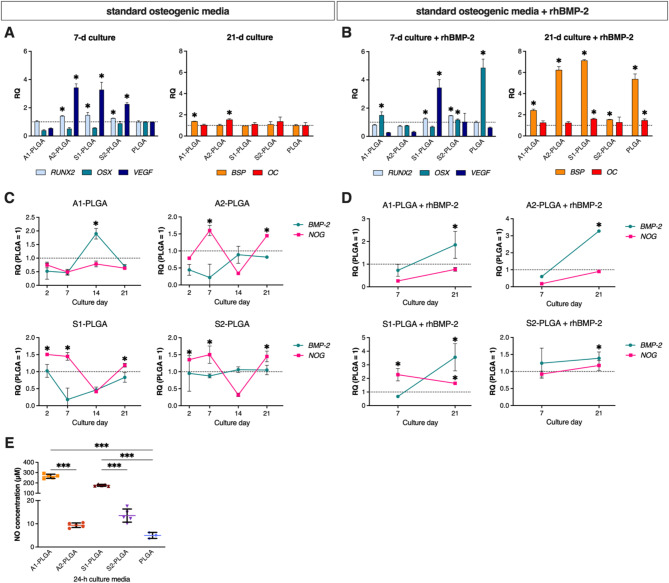
Adipose-derived stem cells (ASCs) provide an ample, easily accessible source of multipotent cells, an alternative to bone marrow-derived stromal cells (BMSCs), capable of differentiating into osteoblasts. However, the osteogenic potential of ASCs is reportedly lower than that of BMSCs and protocols to effectively differentiate ASCs into osteoblasts are in high demand. Here, we present novel strategies for effective osteogenic differentiation of human ASCs by combining their culture on bioactive growth surfaces with their treatment with specific supplements in osteogenic medium and application of fluid shear stress. Human ASCs were cultured on PLGA-based composites containing 50 wt% sol-gel bioactive glasses (SBGs) from the SiO-CaO±PO system, either unmodified or modified with 5 wt% ZnO or SrO. The osteogenic medium was supplemented with recombinant human bone morphogenetic protein 2 (BMP-2), MEK1/2 kinase inhibitor (PD98059) and indirect Smurf1 inhibitor (Phenamil). Fluid shear stress was applied with a standard horizontal rocker. ASC culture on SBG-PLGA composites along with the osteogenic medium supplements enhanced the expression of both early and late osteogenic markers. Modification of SBG with either SrO or ZnO further enhanced osteogenic gene expression compared to ASCs cultured on composites containing unmodified SBGs. Notably, the application of fluid shear stress synergistically strengthened the osteogenic effects of bioactive composites and medium supplements. We also show that the presented culture strategies can drive ASCs toward osteoblastic cells in a 3-day culture period and provide mineralizing osteoblasts through a short, 7-day ASC preculture on bioactive composites. Our results also indicate that the applied osteogenic treatment leads to the phosphorylation of β-catenin and CREB or the COX-2 expression. We believe the presented strategies are feasible for rapid ASC differentiation to early osteoblasts or mineralizing osteoblastic cells for various potential cell-based bone regeneration therapies.
脂肪来源干细胞(ASC)提供了丰富且易于获取的多能细胞来源,是骨髓来源基质细胞(BMSC)的替代物,能够分化为成骨细胞。然而,据报道ASC的成骨潜力低于BMSC,因此迫切需要有效将ASC分化为成骨细胞的方案。在此,我们提出了通过将人ASC在生物活性生长表面上培养、在成骨培养基中用特定补充剂处理以及施加流体剪切应力相结合的方法,实现人ASC有效成骨分化的新策略。将人ASC培养在基于聚乳酸 - 乙醇酸共聚物(PLGA)的复合材料上,该复合材料含有50 wt%来自SiO - CaO±PO系统的溶胶 - 凝胶生物活性玻璃(SBG),要么未改性,要么用5 wt%的ZnO或SrO改性。成骨培养基中添加了重组人骨形态发生蛋白2(BMP - 2)、MEK1/2激酶抑制剂(PD98059)和间接Smurf1抑制剂(非那米利)。用标准水平摇床施加流体剪切应力。在SBG - PLGA复合材料上培养ASC并添加成骨培养基补充剂可增强早期和晚期成骨标志物的表达。与在含有未改性SBG的复合材料上培养的ASC相比,用SrO或ZnO对SBG进行改性可进一步增强成骨基因表达。值得注意的是,流体剪切应力的施加协同增强了生物活性复合材料和成骨培养基补充剂的成骨作用。我们还表明,所提出的培养策略可在3天培养期内将ASC驱动为成骨细胞,并通过在生物活性复合材料上进行短时间(7天)的ASC预培养提供矿化的成骨细胞。我们的结果还表明,所应用的成骨处理导致β - 连环蛋白和CREB的磷酸化或COX - 2的表达。我们相信,所提出的策略对于将ASC快速分化为早期成骨细胞或矿化的成骨细胞以用于各种潜在的基于细胞的骨再生治疗是可行的。