Alsallal Muna, Ahmed Hanan Hassan, Kareem Radhwan Abdul, Yadav Anupam, Ganesan Subbulakshmi, Shankhyan Aman, Gupta Sofia, Joshi Kamal Kant, Sameer Hayder Naji, Yaseen Ahmed, Athab Zainab H, Adil Mohaned, Farhood Bagher
Electronics and Communication Department, College of Engineering, Al-Muthanna University, Education Zone, Samawah, AL-Muthanna, Iraq.
College of Pharmacy, Alnoor University, Mosul, Iraq.
Discov Oncol. 2025 Mar 17;16(1):336. doi: 10.1007/s12672-025-02115-z.
This study aims to assess a hybrid framework that combines radiomic features with deep learning and attention mechanisms to improve the accuracy of classifying lung cancer subtypes using CT images.
A dataset of 2725 lung cancer images was used, covering various subtypes: adenocarcinoma (552 images), SCC (380 images), small cell lung cancer (SCLC) (307 images), large cell carcinoma (215 images), and pulmonary carcinoid tumors (180 images). The images were extracted as 2D slices from 3D CT scans, with tumor-containing slices selected from scans obtained across five healthcare centers. The number of slices per patient varied between 7 and 30, depending on tumor visibility. CT images were preprocessed using standardization, cropping, and Gaussian smoothing to ensure consistency across scans from different imaging instruments used at the centers. Radiomic features, including first-order statistics (FOS), shape-based, and texture-based features, were extracted using the PyRadiomics library. A DeepCNN architecture, integrated with attention mechanisms in the second convolutional block, was used for deep feature extraction, focusing on diagnostically important regions. The dataset was split into training (60%), validation (20%), and testing (20%) sets. Various feature selection techniques, such as Non-negative Matrix Factorization (NMF) and Recursive Feature Elimination (RFE), were used, and multiple machines learning models, including XGBoost and Stacking, were evaluated using accuracy, sensitivity, and AUC metrics. The model's reproducibility was validated using ICC analysis across different imaging conditions.
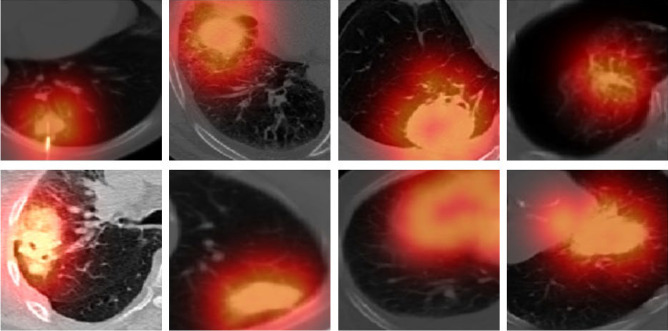
The hybrid model, which integrates DeepCNN with attention mechanisms, outperformed traditional methods. It achieved a testing accuracy of 92.47%, an AUC of 93.99%, and a sensitivity of 92.11%. XGBoost with NMF showed the best performance across all models, and the combination of radiomic and deep features improved classification further. Attention mechanisms played a key role in enhancing model performance by focusing on relevant tumor areas, reducing misclassification from irrelevant features. This also improved the performance of the 3D Autoencoder, boosting the AUC to 93.89% and accuracy to 93.24%.
This study shows that combining radiomic features with deep learning-especially when enhanced by attention mechanisms-creates a powerful and accurate framework for classifying lung cancer subtypes. Clinical trial number Not applicable.
本研究旨在评估一种将放射组学特征与深度学习及注意力机制相结合的混合框架,以提高使用CT图像对肺癌亚型进行分类的准确性。
使用了一个包含2725张肺癌图像的数据集,涵盖多种亚型:腺癌(552张图像)、鳞状细胞癌(SCC)(380张图像)、小细胞肺癌(SCLC)(307张图像)、大细胞癌(215张图像)和肺类癌肿瘤(180张图像)。图像从3D CT扫描中提取为2D切片,从五个医疗中心获得的扫描中选择包含肿瘤的切片。每位患者的切片数量在7到30之间,具体取决于肿瘤的可见性。CT图像使用标准化、裁剪和高斯平滑进行预处理,以确保各中心使用的不同成像仪器扫描结果的一致性。使用PyRadiomics库提取放射组学特征,包括一阶统计量(FOS)、基于形状和基于纹理的特征。一种在第二个卷积块中集成了注意力机制的深度卷积神经网络(DeepCNN)架构用于深度特征提取,重点关注具有诊断重要性的区域。数据集被分为训练集(60%)、验证集(20%)和测试集(20%)。使用了各种特征选择技术,如非负矩阵分解(NMF)和递归特征消除(RFE),并使用准确率、敏感性和AUC指标评估了包括XGBoost和堆叠(Stacking)在内的多种机器学习模型。通过组内相关系数(ICC)分析在不同成像条件下验证了模型的可重复性。
将DeepCNN与注意力机制相结合的混合模型优于传统方法。它实现了92.47%的测试准确率、93.99%的AUC和92.11%的敏感性。使用NMF的XGBoost在所有模型中表现最佳,放射组学特征和深度特征的组合进一步提高了分类效果。注意力机制通过聚焦相关肿瘤区域,减少无关特征导致的错误分类,在提高模型性能方面发挥了关键作用。这也提高了3D自动编码器的性能,将AUC提高到93.89%,准确率提高到93.24%。
本研究表明,将放射组学特征与深度学习相结合,特别是在注意力机制的增强下,可为肺癌亚型分类创建一个强大且准确的框架。临床试验编号:不适用。