Harnik Michael A, Oswald Oskar, Huber Markus, Hofer Debora M, Komann Marcus, Dreiling Johannes, Stamer Ulrike M
Department of Anaesthesiology and Pain Medicine, Inselspital, Bern University Hospital, University of Bern, Bern, Switzerland.
Department of Anaesthesiology, Intensive Care, Emergency and Pain Medicine, Centre for Interdisciplinary Pain Medicine, University Hospital Würzburg, Würzburg, Germany.
Pain Rep. 2025 Mar 18;10(2):e1257. doi: 10.1097/PR9.0000000000001257. eCollection 2025 Apr.
Effective pain management after total knee arthroplasty (TKA) is essential for recovery. Continuous peripheral nerve blocks (PNBc) are often believed to provide superior pain relief compared with single-injection peripheral nerve blocks (PNBs). However, multidimensional pain-related patient-reported outcomes (PROs) have not been extensively studied.
Based on registry data, this study compared pain intensities summarized as a pain composite score (PCS) and postoperative opioid use between PNBc and PNBs nerve blocks in patients undergoing TKA, and evaluated additional PROs.
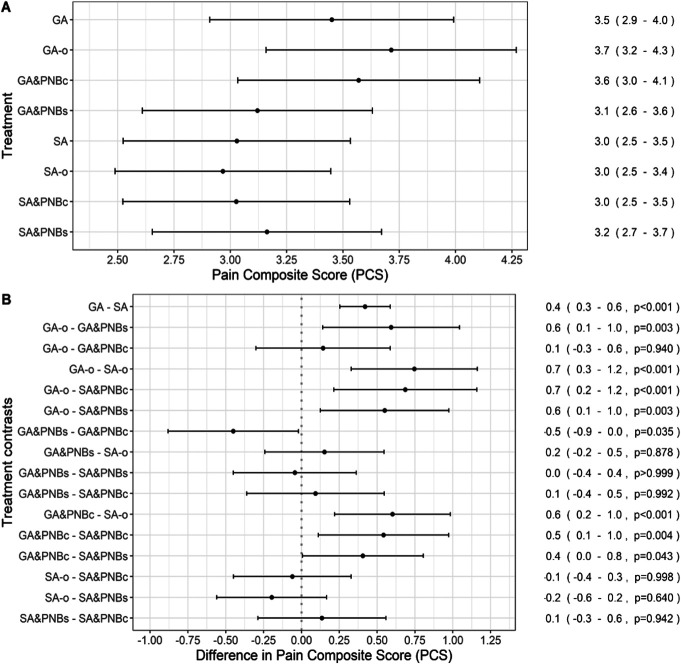
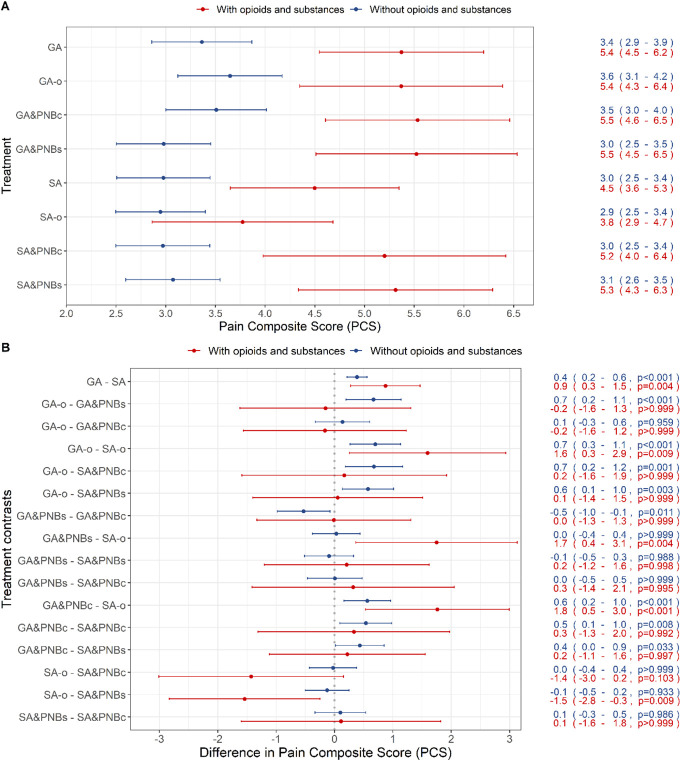
Data from 4,328 adults undergoing TKA enrolled in the PAIN OUT registry (ClinicalTrials.gov NCT02083835) were analyzed. Patients were categorized into general anesthesia (GA) or spinal anesthesia (SA), with subgroups general anesthesia only (GA-o) or spinal anesthesia only (SA-o), and combinations with single-injection PNB (GA&PNBs and SA&PNBs) or continuous PNB via catheter (GA&PNBc and SA&PNBc). The primary end point was PCS, summarizing pain intensities and time in severe pain during the first 24 hours. Secondary end points included opioid use and additional PROs.
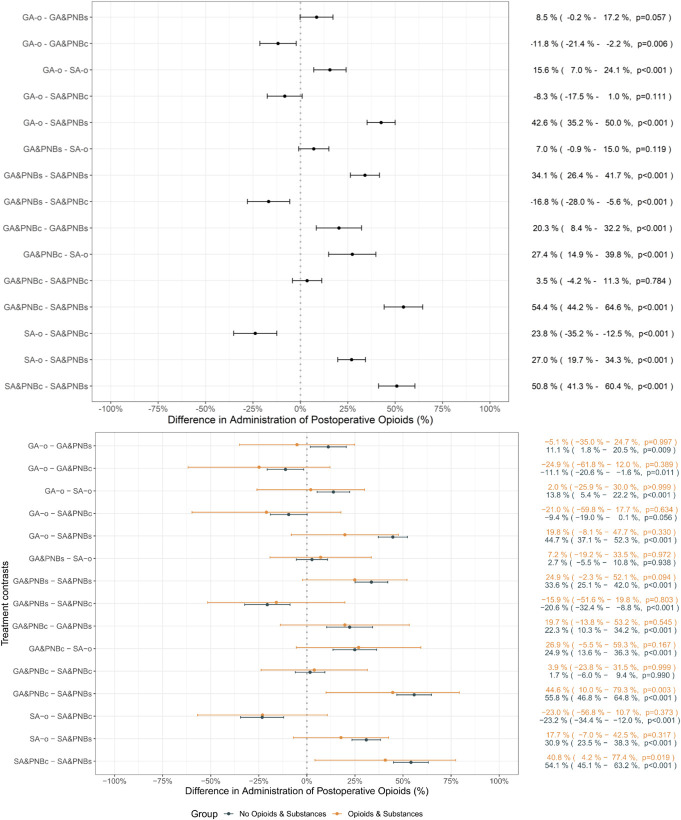
The use of GA&PNBc was associated with a higher PCS (+0.5 [0.0-0.9], = 0.035) compared with GA&PNBs, while PCS was similar between SA&PNBs and SA&PNBc. Opioid use was more frequent in GA&PNBc (+20.3%) and SA&PNBc (+50.8%) compared with the respective PNBs groups ( < 0.001). Patient-reported outcomes were higher in PNBc groups (median score 3.2 vs 2.7-2.9 in other groups; < 0.001).
Continuous PNBc showed no clear advantage over PNBs in pain relief, opioid use, or further PROs. Future research should incorporate comprehensive PROs to better evaluate analgesic techniques in TKA.
全膝关节置换术(TKA)后有效的疼痛管理对恢复至关重要。与单次注射外周神经阻滞(PNB)相比,连续外周神经阻滞(PNBc)通常被认为能提供更好的疼痛缓解。然而,多维疼痛相关的患者报告结局(PRO)尚未得到广泛研究。
基于注册数据,本研究比较了接受TKA的患者中,PNBc和PNB神经阻滞之间以疼痛综合评分(PCS)总结的疼痛强度及术后阿片类药物使用情况,并评估了其他PRO。
分析了PAIN OUT注册研究(ClinicalTrials.gov NCT02083835)中4328例接受TKA的成年人的数据。患者被分为全身麻醉(GA)或脊髓麻醉(SA),亚组包括仅全身麻醉(GA-o)或仅脊髓麻醉(SA-o),以及与单次注射PNB联合(GA&PNBs和SA&PNBs)或通过导管连续PNB(GA&PNBc和SA&PNBc)。主要终点是PCS,总结了前24小时内的疼痛强度和重度疼痛时间。次要终点包括阿片类药物使用情况和其他PRO。
与GA&PNBs相比,GA&PNBc的使用与更高的PCS相关(+0.5 [0.0 - 0.9],P = 0.035),而SA&PNBs和SA&PNBc之间的PCS相似。与各自的PNB组相比(P < 0.001),GA&PNBc(+20.3%)和SA&PNBc(+50.8%)中阿片类药物的使用更频繁。PNBc组的患者报告结局更高(中位数评分3.2,而其他组为2.7 - 2.9;P < 0.001)。
在疼痛缓解、阿片类药物使用或其他PRO方面,连续PNBc与PNB相比没有明显优势。未来的研究应纳入全面的PRO,以更好地评估TKA中的镇痛技术。