Silva Sthefany Emanuelle, Silva Lorena Souza, Eufrasio Ludmila Gouveia, Cruz Gabriela Silva, Lucini Fabíola, Vechi Hareton Teixeira, Alves Manoella do Monte, Ribeiro Luciana Rodrigues Ferreira, de Souza Karine Lilian, Moreira José Aparecido, de Souza Janete Gouveia, Morio Florent, da Costa Gisela Lara, Baptista Barbara de Oliveira, Tomé Luiz Marcelo Ribeiro, Pedroso Sílvia Helena Sousa Pietra, Iani Felipe Campos de Melo, Adelino Talita Émile Ribeiro, Castelo-Branco Débora, Rossato Luana, Peres Nalu Teixeira de Aguiar, Santos Daniel Assis, Oliveira Manoel Marques Evangelista, da Silva Kássia Jéssica Galdino, Bastos Rafael Wesley
Departamento de Microbiologia e Parasitologia, Laboratório de Uso Comum, Centro de Biociências, Universidade Federal do Rio Grande do Norte, Campus Universitário UFRN, Bloco D1, Av. Sen. Salgado Filho, 3000 - Lagoa Nova, Natal, RN 59064-741, Brazil.
Departamento de Microbiologia, Universidade Federal de Minas Gerais, Brazil.
Curr Res Microb Sci. 2025 Feb 11;8:100359. doi: 10.1016/j.crmicr.2025.100359. eCollection 2025.
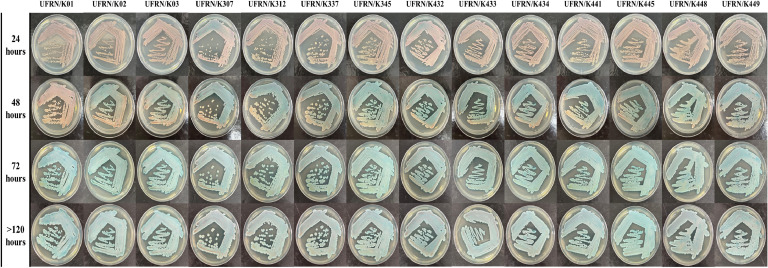
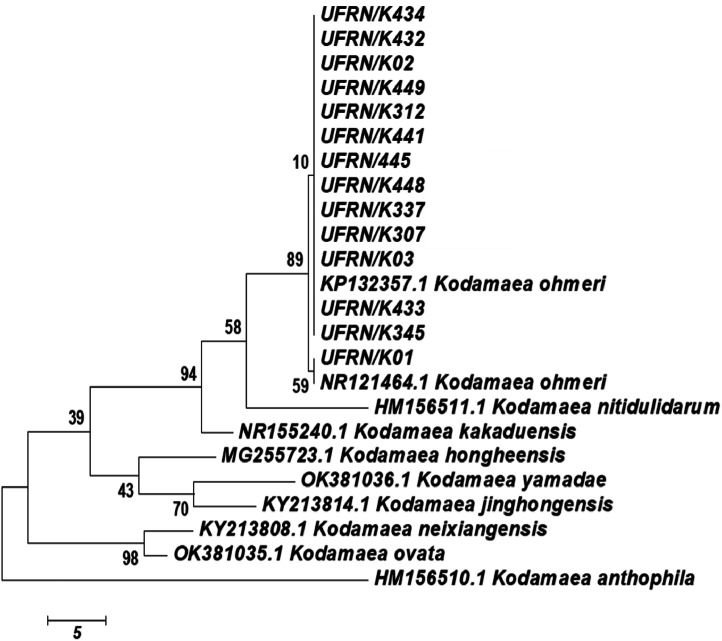
is an emerging and opportunistic yeast associated with a high mortality rate in humans. As it is commonly found in the environment, it is possible that environmental conditions and agricultural practices contribute to the adaptation of this yeast and the selection of antifungal resistance. During a multicentric study in Brazil, conducted under a One Health perspective, 14 isolates of were identified from different sources: three from blood cultures, three from animals (swine and poultry), and eight from animal environments (swine and poultry). Yeasts were isolated using CHROmagar® medium and identified by MALDI-TOF MS and ITS rDNA barcoding. Minimum inhibitory concentration (MIC) was determined using the broth microdilution method for clinical (azoles, echinocandins, pyrimidine analogs, and polyenes), and environmental antifungals (tebuconazole, pyraclostrobin, carbendazim, and mancozeb), and hospital disinfectants (quaternary ammonium compounds). Of note, color variations of were noted on CHROmagar® depending on the incubation time, which is likely to complicate its identification. Following polyphasic identification and taxonomic confirmation, all isolates demonstrated low MIC values for clinical antifungals, disinfectants, and tebuconazole. However, all isolates were able to grow in the presence of carbendazim, mancozeb, and pyraclostrobin. Together, these findings highlight the risks associated with the use of environmental azoles, such as tebuconazole, as they may impact non-target fungi of medical importance, but other fungicides do not present the same risk. This is the first study to demonstrate that , an important emerging yeast in human medicine, can be isolated from various sources, including patients. Although the isolates exhibited low MIC values for clinical antifungals, it is crucial to monitor changes in sensitivity patterns over time in emerging microorganisms to prevent the development of multidrug resistance, which may originate in the environment.
是一种新兴的机会致病性酵母菌,与人类的高死亡率相关。由于它在环境中普遍存在,环境条件和农业实践可能促成了这种酵母菌的适应性以及抗真菌耐药性的选择。在巴西开展的一项基于“同一健康”视角的多中心研究中,从不同来源鉴定出了14株该酵母菌:3株来自血培养,3株来自动物(猪和家禽),8株来自动物环境(猪和家禽)。使用CHROmagar®培养基分离酵母菌,并通过基质辅助激光解吸电离飞行时间质谱(MALDI - TOF MS)和内转录间隔区(ITS)核糖体DNA条形码进行鉴定。采用肉汤微量稀释法测定临床用抗真菌药(唑类、棘白菌素类、嘧啶类似物和多烯类)、环境用抗真菌剂(戊唑醇、吡唑醚菌酯、多菌灵和代森锰锌)以及医院消毒剂(季铵化合物)的最低抑菌浓度(MIC)。值得注意的是,在CHROmagar®培养基上,根据培养时间的不同,该酵母菌会出现颜色变化,这可能会使其鉴定变得复杂。经过多相鉴定和分类学确认,所有分离株对临床用抗真菌药、消毒剂和戊唑醇的MIC值都较低。然而,所有分离株都能够在多菌灵、代森锰锌和吡唑醚菌酯存在的情况下生长。这些发现共同凸显了使用环境用唑类(如戊唑醇)相关的风险,因为它们可能会影响具有医学重要性的非靶标真菌,但其他杀菌剂不存在同样的风险。这是第一项证明在人类医学中一种重要的新兴酵母菌可以从包括患者在内的各种来源分离出来的研究。尽管这些分离株对临床用抗真菌药的MIC值较低,但对于新兴微生物,随着时间推移监测其敏感性模式的变化以防止可能源自环境的多重耐药性的发展至关重要。