Hung Wei-Ting, Baker Barry, Campbell Patrick C, Tang Youhua, Ahmadov Ravan, Romero-Alvarez Johana, Li Haiqin, Schnell Jordan
Air Resources Laboratory National Oceanic and Atmospheric Administration College Park MD USA.
Cooperative Institute for Satellite and Earth System Studies University of Maryland College Park MD USA.
Geohealth. 2025 Mar 22;9(3):e2024GH001253. doi: 10.1029/2024GH001253. eCollection 2025 Mar.
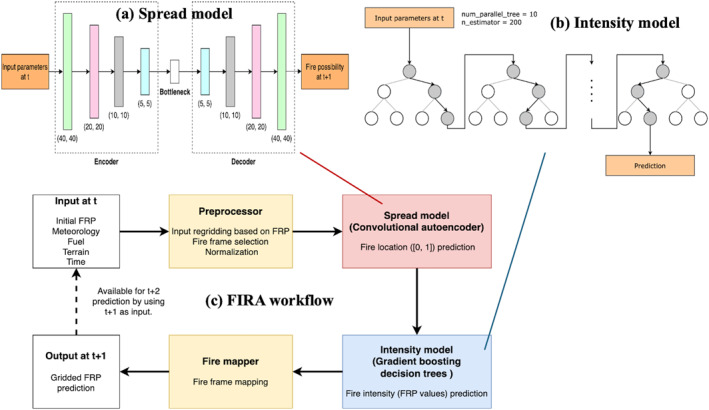
Fire activities introduce hazardous impacts on the environment and public health by emitting various chemical species into the atmosphere. Most operational air quality forecast (AQF) models estimate smoke emissions based on the latest available satellite fire products, which may not represent real-time fire behaviors without considering fire spread. Hence, a novel machine learning (ML) based fire spread forecast model, the Fire Intensity and spRead forecAst (FIRA), is developed for AQF model applications. FIRA aims to improve the performance of AQF models by providing realistic, dynamic fire characteristics including the spatial distribution and intensity of fire radiative power (FRP). In this study, data sets in 2020 over the continental United States (CONUS) and a historical California fire in 2024 are used for model training and evaluation. For application assessment, FIRA FRP predictions are applied to the Unified Forecast System coupled with smoke (UFS-Smoke) model as inputs, focusing on a California fire case in September 2020. Results show that FIRA captures fire spread with R-squared ( ) near 0.7 and good spatial similarity (∼95%). The comparison between UFS-Smoke simulations using near-real-time fire products and FIRA FRP predictions show good agreements, indicating that FIRA can accurately represent future fire activities. Although FIRA generally underestimates fire intensity, the uncertainties can be mitigated by applying scaling factors to FRP values. Use of the scaled FIRA largely outperforms the experimental UFS-Smoke model in predicting aerosol optical depth and the three-dimensional smoke contents, while also demonstrating the ability to improve surface fine particulate matter (PM) concentrations affected by fires.
火灾活动通过向大气中排放各种化学物质,对环境和公众健康产生有害影响。大多数运行中的空气质量预报(AQF)模型基于最新的卫星火灾产品来估算烟雾排放,而这些产品在不考虑火灾蔓延的情况下可能无法代表实时火灾行为。因此,为了AQF模型应用,开发了一种基于机器学习(ML)的新型火灾蔓延预测模型——火灾强度与蔓延预测(FIRA)。FIRA旨在通过提供包括火灾辐射功率(FRP)的空间分布和强度在内的真实、动态火灾特征,来提高AQF模型的性能。在本研究中,使用了2020年美国大陆(CONUS)的数据集以及2024年加利福尼亚州的一场历史火灾来进行模型训练和评估。为了进行应用评估,将FIRA的FRP预测作为输入应用于与烟雾耦合的统一预报系统(UFS - Smoke)模型,重点关注2020年9月加利福尼亚州的一场火灾案例。结果表明,FIRA以接近0.7的决定系数( )捕捉火灾蔓延,并且具有良好的空间相似性(约95%)。使用近实时火灾产品的UFS - Smoke模拟与FIRA的FRP预测之间的比较显示出良好的一致性,表明FIRA可以准确地代表未来的火灾活动。尽管FIRA通常会低估火灾强度,但通过对FRP值应用缩放因子可以减轻不确定性。在预测气溶胶光学深度和三维烟雾含量方面,使用缩放后的FIRA在很大程度上优于实验性的UFS - Smoke模型,同时也证明了其改善受火灾影响的地表细颗粒物(PM)浓度的能力。