Anwar Ilhame, Faye Aissatou, Donadille Cécile, Briand Madrid Laélia, Lalanne Laurence, Jauffret-Roustide Marie, Auriacombe Marc, Roux Perrine
Aix Marseille Univ, Inserm, IRD, SESSTIM, Sciences Economiques & Sociales de la Santé & Traitement de l'Information Médicale, ISSPAM, Marseille, France
Aix Marseille Univ, Inserm, IRD, SESSTIM, Sciences Economiques & Sociales de la Santé & Traitement de l'Information Médicale, ISSPAM, Marseille, France.
BMJ Open. 2025 Mar 24;15(3):e091707. doi: 10.1136/bmjopen-2024-091707.
We identified factors associated with hepatitis C virus (HCV) testing in the previous 6 months in people who inject drugs (PWID) according to gender.
COSINUS () is a multisite longitudinal cohort study conducted between June 2016 and May 2019.
Harm reduction facilities in two French cities (Marseille and Bordeaux).
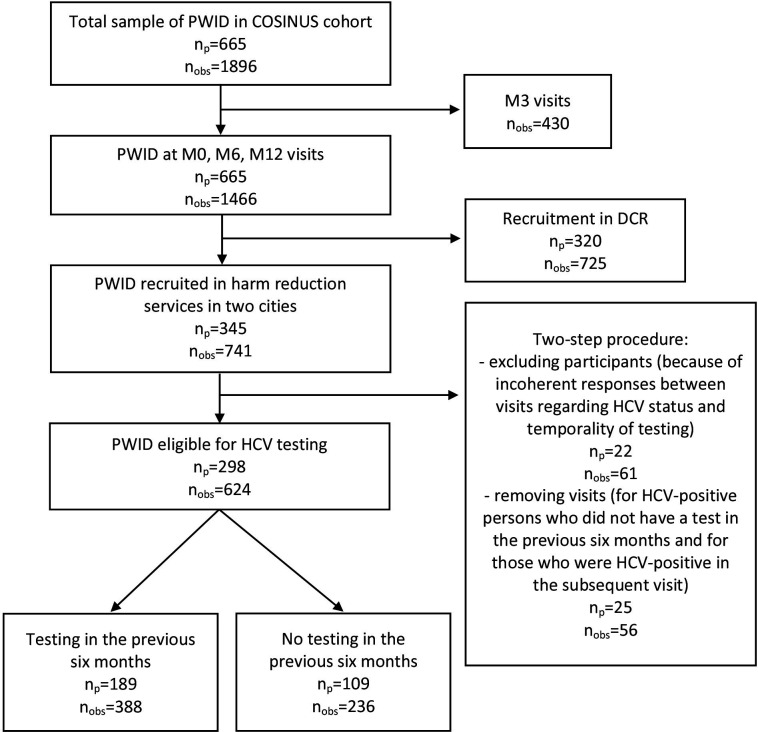
Eligibility criteria were as follows: 18 years of age or older, French speaking, regular use of illegal drugs or of prescribed medication, having injected at least once in the previous month and being able to provide informed consent to participate. We selected data for 298 participants (624 observations).
Self-reporting HCV testing in the previous 6 months. Gender was defined as self-identifying as a woman, man or transgender person.
Seventy-nine per cent (n=235) of the sample were men, and 63% (n=189) reported HCV testing in the previous 6 months. Our results suggest that men recently incarcerated (OR (95% CI): 3.26 (1.31, 8.12), p=0.011), those regularly attending harm reduction facilities (OR (95% CI): 2.49 (1.47, 4.22), p=0.001), and those with lifetime attempted suicide (OR (95% CI): 2.07 (1.08, 3.95), p=0.028) were more likely to have been tested for HCV in the previous 6 months, whereas older men were less likely (OR (95% CI): 0.46 (0.24, 0.89), p=0.022). Women who had slept in the street (OR (95% CI): 3.95 (1.12, 13.89), p=0.032) were more likely to have been tested for HCV in the previous 6 months, whereas those employed (OR (95% CI): 0.31 (0.12, 0.83), p=0.019) and those with lifetime attempted suicide (OR (95% CI): 0.39 (0.16, 0.97), p=0.044) were less likely.
Our results highlight the importance of improving current harm reduction facilities for PWID by adapting them to women's needs and paying special attention to women's mental health. Furthermore, in the context of primary care, improving provider training and reducing injection-related stigma may improve HCV testing uptake in older men and employed women.
我们根据性别确定了在过去6个月内注射毒品者(PWID)进行丙型肝炎病毒(HCV)检测的相关因素。
COSINUS()是一项于2016年6月至2019年5月开展的多地点纵向队列研究。
法国两个城市(马赛和波尔多)的减少伤害设施。
纳入标准如下:年龄18岁及以上,说法语,经常使用非法药物或处方药,在过去一个月内至少有过一次注射,并且能够提供知情同意书以参与研究。我们选取了298名参与者的数据(624次观察)。
自我报告在过去6个月内进行过HCV检测。性别定义为自我认定为女性、男性或跨性别者。
样本中79%(n = 235)为男性,63%(n = 189)报告在过去6个月内进行过HCV检测。我们的结果表明,近期被监禁的男性(比值比(95%置信区间):3.26(1.31,8.12),p = 0.011)、经常前往减少伤害设施的男性(比值比(95%置信区间):2.49(1.47,4.22),p = 0.001)以及有过终身自杀未遂经历的男性(比值比(95%置信区间):2.07(1.08,3.95),p = 0.028)在过去6个月内进行HCV检测的可能性更高,而年龄较大的男性可能性较低(比值比(95%置信区间):0.46(0.24,0.89),p = 0.022)。曾露宿街头的女性(比值比(95%置信区间):3.95(1.12,13.89),p = 0.032)在过去6个月内进行HCV检测的可能性更高,而就业女性(比值比(95%置信区间):0.31(0.12,0.83),p = 0.019)和有过终身自杀未遂经历的女性(比值比(95%置信区间):0.39(0.16,0.97),p = 0.044)可能性较低。
我们的结果强调了通过根据女性需求调整现有减少伤害设施并特别关注女性心理健康来改善针对注射毒品者的现有减少伤害设施的重要性。此外,在初级保健背景下,改善医疗服务提供者培训并减少与注射相关的污名化可能会提高年龄较大男性和就业女性的HCV检测接受率。