Park Yongsoo, Ko Kyung Soo, Rhee Byoung Doo
Department of Internal Medicine, Sanggye Paik Hospital, College of Medicine, Inje University, 1342 Dongil-ro, Nowon-gu, Seoul 01757, Republic of Korea.
Int J Mol Sci. 2025 Mar 19;26(6):2758. doi: 10.3390/ijms26062758.
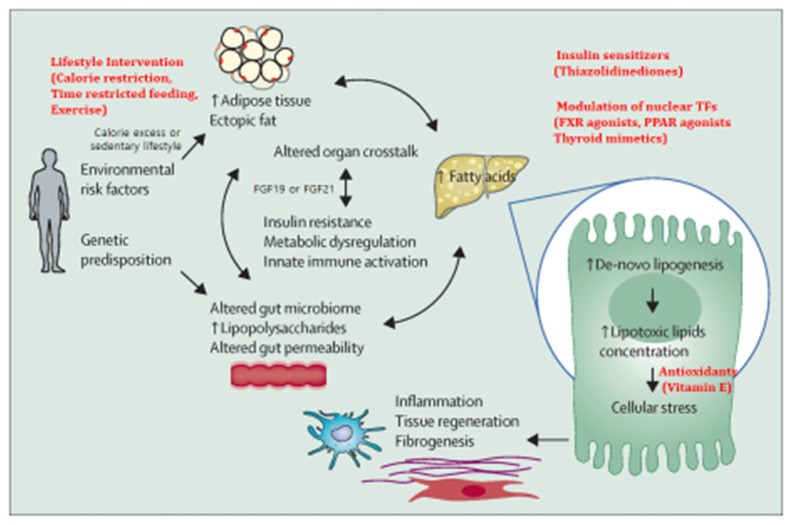
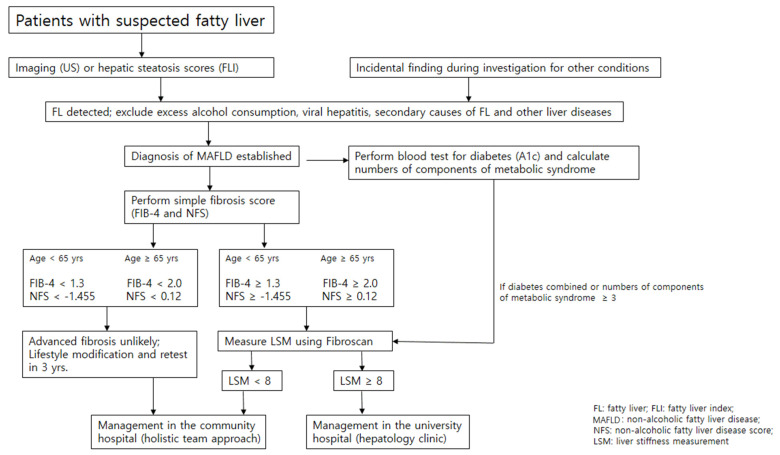
Non-alcoholic fatty liver disease (NAFLD) has frequently been associated with obesity, type 2 diabetes (T2D), and dyslipidemia, all of which are shared by increased insulin resistance. It has become the most common liver disorder in Korea as well as in developed countries and is therefore associated with an increased health burden of morbidity and mortality. It has an association with T2D, and T2D increases the risk of cirrhosis and related complications. NAFLD encompasses a disease continuum from simple steatosis to non-alcoholic steatohepatitis which is characterized by faster fibrosis progression. Although its liver-related complication is estimated to be, at most, 10%, it will be a leading cause of cirrhosis and hepatocellular carcinoma soon in Korea. Although the main causes of death in people with NAFLD are cardiovascular disease and extra-hepatic malignancy, advanced liver fibrosis is a key prognostic marker for liver-related outcomes and can be assessed with combinations of non-invasive tests in the community. A number of components of metabolic syndrome involved could be another important prognostic information of NAFLD assessed easily in the routine care of the community. There is a few approved therapies for NAFLD, although several drugs, including antioxidants, attract practitioners' attention. Because of the modest effect of the present therapeutics, let alone complex pathophysiology and substantial heterogeneity of disease phenotypes, combination treatment is a viable option for many patients with NAFLD in the Korean community. Comprehensive approach taking healthy lifestyle and weight reduction into account remain a mainstay to the prevention and treatment of NAFLD.
非酒精性脂肪性肝病(NAFLD)常与肥胖、2型糖尿病(T2D)和血脂异常相关,所有这些都与胰岛素抵抗增加有关。它已成为韩国以及发达国家最常见的肝脏疾病,因此与发病率和死亡率增加所带来的健康负担加重相关。它与T2D有关,而T2D会增加肝硬化及相关并发症的风险。NAFLD涵盖了从单纯性脂肪变性到非酒精性脂肪性肝炎的疾病连续谱,其特征是纤维化进展更快。尽管其肝脏相关并发症估计最多为10%,但在韩国它很快将成为肝硬化和肝细胞癌的主要原因。虽然NAFLD患者的主要死因是心血管疾病和肝外恶性肿瘤,但晚期肝纤维化是肝脏相关预后的关键标志物,可在社区通过多种非侵入性检查组合进行评估。所涉及的代谢综合征的一些组成部分可能是在社区常规护理中易于评估的NAFLD的另一个重要预后信息。虽然包括抗氧化剂在内的几种药物引起了从业者的关注,但目前批准用于NAFLD的疗法很少。由于目前治疗方法的效果有限,更不用说疾病表型复杂的病理生理学和显著的异质性,联合治疗对韩国社区的许多NAFLD患者来说是一种可行的选择。考虑健康生活方式和体重减轻的综合方法仍然是NAFLD预防和治疗的主要手段。