Department of Kinesiology and Nutrition, University of Illinois Chicago.
University of Illinois Cancer Center, University of Illinois Chicago.
JAMA Netw Open. 2023 Oct 2;6(10):e2339337. doi: 10.1001/jamanetworkopen.2023.39337.
Time-restricted eating (TRE) has become increasingly popular, yet longer-term randomized clinical trials have not evaluated its efficacy and safety in patients with type 2 diabetes (T2D).
To determine whether TRE is more effective for weight reduction and glycemic control than daily calorie restriction (CR) or a control condition in adults with T2D.
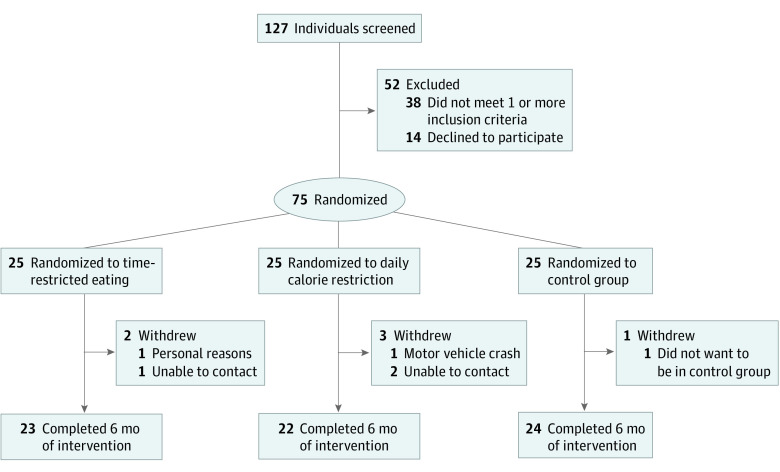
DESIGN, SETTING, AND PARTICIPANTS: This 6-month, parallel-group, randomized clinical trial was performed between January 25, 2022, and April 1, 2023, at the University of Illinois Chicago. Participants were aged 18 to 80 years with obesity and T2D. Data analysis was based on intention to treat.
Participants were randomized to 1 of 3 groups: 8-hour TRE (eating 12 to 8 pm only, without calorie counting), CR (25% energy restriction daily), or control.
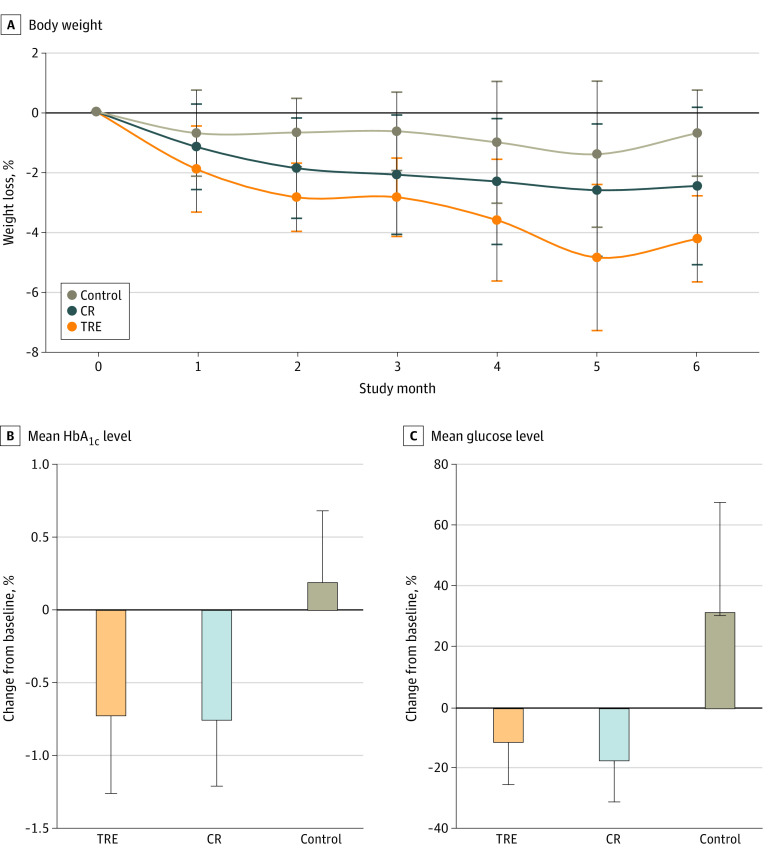
The primary outcome measure was change in body weight by month 6. Secondary outcomes included changes in hemoglobin A1c (HbA1c) levels and metabolic risk factors.
Seventy-five participants were enrolled with a mean (SD) age of 55 (12) years. The mean (SD) body mass index (calculated as weight in kilograms divided by height in meters squared) was 39 (7) and the mean (SD) HbA1c level was 8.1% (1.6%). A total of 53 participants (71%) were women. One participant (1%) was Asian, 30 (40%) were Hispanic White, 40 (53%) were non-Hispanic Black, and 4 (5%) were non-Hispanic White. Participants in the TRE group were adherent with their eating window on a mean (SD) of 6.1 (0.8) days per week, and 17 (68%) in the CR group were adherent with their prescribed calorie goals over 6 months. The mean (SD) reduction in energy intake was -313 (509) kcal/d for TRE, -197 (426) kcal/d for CR, and -16 (439) kcal/d for controls. By month 6, body weight decreased significantly in the TRE group (-3.56% [95% CI, -5.92% to -1.20%]; P = .004) but not the CR group (-1.78% [95% CI, -3.67% to 0.11%]; P = .06), relative to controls. Levels of HbA1c decreased in the TRE (-0.91% [95% CI, -1.61% to -0.20%]) and CR (-0.94% [95% CI, -1.59% to -0.30%]) groups, relative to controls, with no differences between the TRE and CR groups. Time in euglycemic range, medication effect score, blood pressure, and plasma lipid levels did not differ among groups. No serious adverse events were reported.
This randomized clinical trial found that a TRE diet strategy without calorie counting was effective for weight loss and lowering of HbA1c levels compared with daily calorie counting in a sample of adults with T2D. These findings will need to be confirmed by larger RCTs with longer follow-up.
ClinicalTrials.gov Identifier: NCT05225337.
限时进食(TRE)越来越受欢迎,但长期随机临床试验尚未评估其在 2 型糖尿病(T2D)患者中的疗效和安全性。
确定 TRE 在减轻体重和控制血糖方面是否比每日热量限制(CR)或对照组更有效。
设计、地点和参与者:这是一项为期 6 个月的平行组随机临床试验,于 2022 年 1 月 25 日至 2023 年 4 月 1 日在伊利诺伊大学芝加哥分校进行。参与者年龄在 18 至 80 岁之间,患有肥胖症和 T2D。数据分析基于意向治疗。
参与者被随机分配到 3 组中的 1 组:8 小时 TRE(仅在 12 点至 8 点之间进食,不计算卡路里)、CR(每日 25%能量限制)或对照组。
主要结局测量是第 6 个月时的体重变化。次要结局包括血红蛋白 A1c(HbA1c)水平和代谢风险因素的变化。
共有 75 名参与者入组,平均(SD)年龄为 55(12)岁。平均(SD)体重指数(计算为体重除以身高的平方)为 39(7),平均(SD)HbA1c 水平为 8.1%(1.6%)。共有 53 名参与者(71%)为女性。1 名参与者(1%)为亚洲人,30 名(40%)为西班牙裔白人,40 名(53%)为非西班牙裔黑人,4 名(5%)为非西班牙裔白人。TRE 组的参与者平均(SD)每周有 6.1(0.8)天遵守进食窗口,CR 组中有 17(68%)人在 6 个月内遵守了规定的热量目标。TRE 组的平均(SD)能量摄入减少量为 -313(509)kcal/d,CR 组为 -197(426)kcal/d,对照组为 -16(439)kcal/d。到第 6 个月时,TRE 组的体重明显下降(-3.56%[95%CI,-5.92%至-1.20%];P=0.004),但 CR 组没有(-1.78%[95%CI,-3.67%至 0.11%];P=0.06),与对照组相比。TRE(-0.91%[95%CI,-1.61%至-0.20%])和 CR(-0.94%[95%CI,-1.59%至-0.30%])组的 HbA1c 水平也有所下降,与对照组相比,TRE 和 CR 组之间没有差异。血糖正常范围时间、药物效果评分、血压和血浆脂质水平在各组之间没有差异。没有报告严重不良事件。
这项随机临床试验发现,与每日计算卡路里相比,TRE 饮食策略对于减轻体重和降低 2 型糖尿病患者的 HbA1c 水平是有效的。这些发现需要更大规模的 RCT 更长时间的随访来证实。
ClinicalTrials.gov 标识符:NCT05225337。