Hargreaves Tegan L, McIntyre-Wood Carly, Vandehei Emily, Love Danielle, Garber Molly, Levitt Emily E, Syan Sabrina K, MacKillop Emily, Amlung Michael, Sweet Lawrence H, MacKillop James
Department of Psychiatry and Behavioural Neurosciences, McMaster University, St. Joseph's Healthcare Hamilton, West 5th Campus 100 West 5th Street, Hamilton, ON, L8N 3K7, Canada.
Peter Boris Centre for Addictions Research, St. Joseph's Healthcare Hamilton, 100 West 5th Street, Hamilton, ON, L8P 3P2, Canada.
Alcohol Alcohol. 2025 Mar 25;60(3). doi: 10.1093/alcalc/agaf009.
Magnetic resonance imaging (MRI) studies have identified brain structural predictors of treatment response in individuals with alcohol use disorder (AUD) but with varying findings and primarily in male veterans. The present study investigated cortical surface area and thickness (CT) as predictors of brief intervention response in community-based adults with AUD.
Sixty-five non-treatment-seeking adults with AUD (44.6% male, aged 33.2 ± 1.3 years) underwent an MRI and received a brief intervention comprising personalized feedback and motivational interviewing, with follow-up ~6-8 weeks later to quantify changes in drinks/week (DPW), the primary outcome. Eighteen bilateral a priori regions of interest (ROIs) were used to predict DPW at follow-up, adjusting for baseline drinking. Significant predictors were examined with secondary outcomes, percent drinking and heavy drinking days, and in relation to out-of-scanner measures of impulsivity and comorbidities.
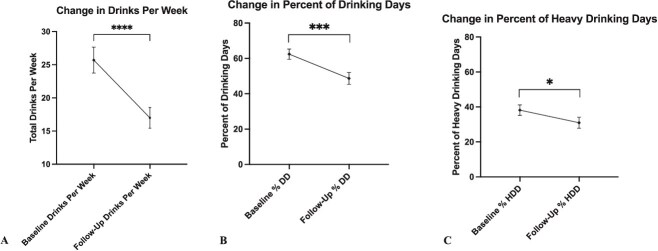
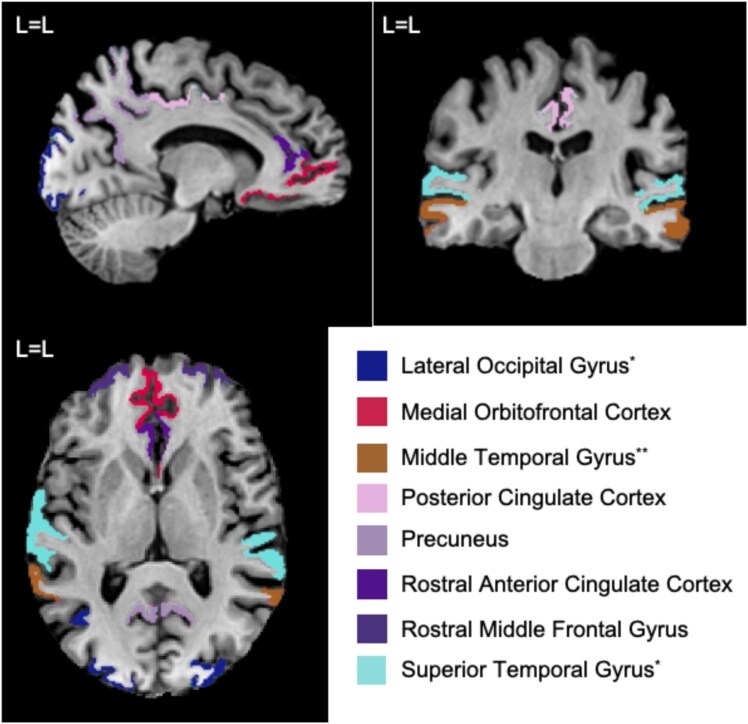
Participants exhibited significant decreases in alcohol consumption in response to the brief intervention. Eight bilateral CT ROIs in the frontal, temporal, and occipital lobes, most notably medial orbitofrontal, middle temporal, and lateral occipital gyri, predicted DPW; however, only three predicted the secondary outcomes. Significant associations were observed between CT in frontal and occipital regions and impulsivity (delay discounting, lack of premeditation), executive functioning, anxiety, and stress.
Thinner frontal, temporal, and occipital ROIs predicted poorer brief intervention response, with notable overlap with brain regions previously implicated in AUD. Clarifying whether these regions reflect premorbid or acquired differences and, if the latter, the potential for recovery of cortical gray matter following drinking reductions are future priorities.
磁共振成像(MRI)研究已确定酒精使用障碍(AUD)患者治疗反应的脑结构预测指标,但研究结果各异,且主要针对男性退伍军人。本研究调查了基于社区的AUD成年患者的皮质表面积和厚度(CT)作为简短干预反应的预测指标。
65名未寻求治疗的AUD成年患者(44.6%为男性,年龄33.2±1.3岁)接受了MRI检查,并接受了包括个性化反馈和动机性访谈的简短干预,约6 - 8周后进行随访,以量化每周饮酒量(DPW)的变化,这是主要结局指标。使用18个双侧先验感兴趣区域(ROI)来预测随访时的DPW,并对基线饮酒情况进行校正。对显著预测指标与次要结局指标、饮酒百分比和重度饮酒天数进行了检验,并与扫描仪外的冲动性和共病测量指标进行了关联分析。
参与者在接受简短干预后酒精摄入量显著减少。额叶、颞叶和枕叶的8个双侧CT ROI,最显著的是内侧眶额回、颞中回和枕外侧回,预测了DPW;然而,只有3个预测了次要结局指标。在额叶和枕叶区域的CT与冲动性(延迟折扣、缺乏预谋)、执行功能、焦虑和压力之间观察到显著关联。
额叶、颞叶和枕叶ROI较薄预示着简短干预反应较差,与先前涉及AUD的脑区有明显重叠。明确这些区域反映的是病前差异还是后天差异,以及如果是后者,饮酒量减少后皮质灰质恢复的可能性是未来的研究重点。