Rafael Ricardo de Mattos Russo, Jalil Emilia M, Velasque Luciane de Souza, Friedman Ruth Khalili, Ramos Michelle, Cunha Cynthia B, Peixoto Eduardo Mesquita, Andrade Lívia Machado de Mello, Depret Davi Gomes, Gil Adriana Costa, Alcântara Dandara Costa, Monteiro Laylla, Knupp Virginia Maria de Azevedo Oliveira, Veloso Valdiléa G, Wilson Erin C, Grinsztejn Beatriz
Department of Public Health Nursing, College of Nursing, State University of Rio de Janeiro, Rio de Janeiro, Brazil.
Evandro Chagas National Institute of Infectious Diseases, Oswaldo Cruz Foundation, Rio de Janeiro, Brazil.
Transgend Health. 2025 Feb 10;10(1):63-72. doi: 10.1089/trgh.2023.0057. eCollection 2025 Feb.
Our study was conducted to estimate intimate partner violence (IPV) prevalence and associated factors among trans and cisgender women at risk of or living with HIV during the coronavirus disease (COVID-19) pandemic in Rio de Janeiro, Brazil.
A cross-sectional study was conducted between May and August 2020 through telephone surveys with cisgender and trans women enrolled in two cohort studies in Rio de Janeiro. We assessed IPV employing the Revised Conflict Tactics Scale during the initial months of shelter-in-place ordinances. Regression models evaluated the factors associated with IPV for each population.
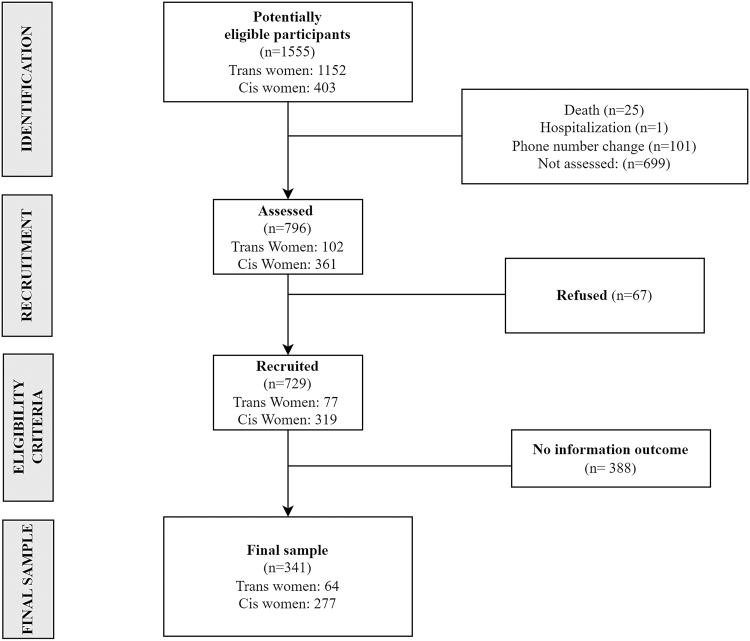
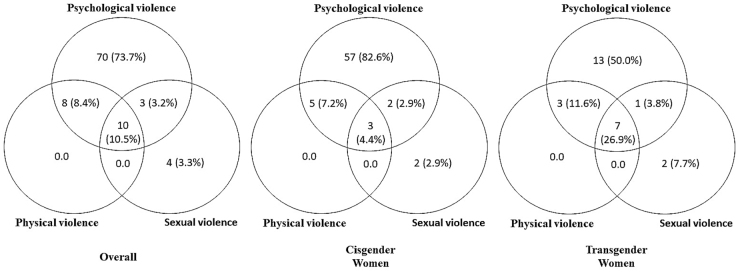
We surveyed 796 women, and 341 participants (47.78%) were eligible and included in the current analysis. All cisgender women and 41 (64.06%) trans women were living with HIV. Overall IPV prevalence was 27.86% (95% confidence interval [95% CI] 23.34-32.88). IPV was 63% higher among trans women than among cisgender women (prevalence ratio 1.63, 95% CI 1.14-2.34, =0.008). Loneliness was significantly associated with IPV in both groups. Younger age and binge drinking were associated with IPV prevalence among trans women. For cisgender women, IPV was associated with withdrawal of cash transfer programs during the shelter-in-place.
Trans women experienced significantly more IPV than cisgender women in the early phase of the COVID-19 epidemic. Plans to prevent and address violence against cisgender and trans women, especially those with heightened vulnerability that may be associated with living with HIV, are needed in public health planning for future pandemics.
我们开展这项研究是为了估计在巴西里约热内卢新冠疫情期间,感染艾滋病毒风险人群中的跨性别女性和顺性别女性以及艾滋病毒感染者中的亲密伴侣暴力(IPV)患病率及其相关因素。
2020年5月至8月期间,通过电话调查对里约热内卢两项队列研究中纳入的顺性别女性和跨性别女性进行了一项横断面研究。在居家隔离令实施的最初几个月,我们采用修订后的冲突策略量表评估亲密伴侣暴力。回归模型评估了各人群中与亲密伴侣暴力相关的因素。
我们调查了796名女性,其中341名参与者(47.78%)符合条件并纳入当前分析。所有顺性别女性和41名(64.06%)跨性别女性感染了艾滋病毒。总体亲密伴侣暴力患病率为27.86%(95%置信区间[95%CI]23.34 - 32.88)。跨性别女性中的亲密伴侣暴力发生率比顺性别女性高63%(患病率比1.63,95%CI 1.14 - 2.34,P = 0.008)。孤独感在两组中均与亲密伴侣暴力显著相关。年龄较小和酗酒与跨性别女性中的亲密伴侣暴力患病率相关。对于顺性别女性,亲密伴侣暴力与居家隔离期间现金转移项目的取消有关。
在新冠疫情早期,跨性别女性遭受的亲密伴侣暴力比顺性别女性显著更多。在未来大流行的公共卫生规划中,需要制定计划来预防和解决针对顺性别女性和跨性别女性的暴力行为,尤其是那些可能因感染艾滋病毒而脆弱性增加的女性。