Lacunza Ezequiel, Fink Valeria, Naipauer Julian, Salas María E, Gun Ana M, Goldman Mary J, Zhu Jingchun, Williams Sion, Figueroa María I, Cahn Pedro, Coso Omar, Cesarman Ethel, Ramos Juan C, Abba Martín C
CINIBA, Universidad Nacional de La Plata.
Dirección de Investigaciones, Fundación Huésped, Buenos Aires, Argentina.
Res Sq. 2025 Mar 11:rs.3.rs-6146471. doi: 10.21203/rs.3.rs-6146471/v1.
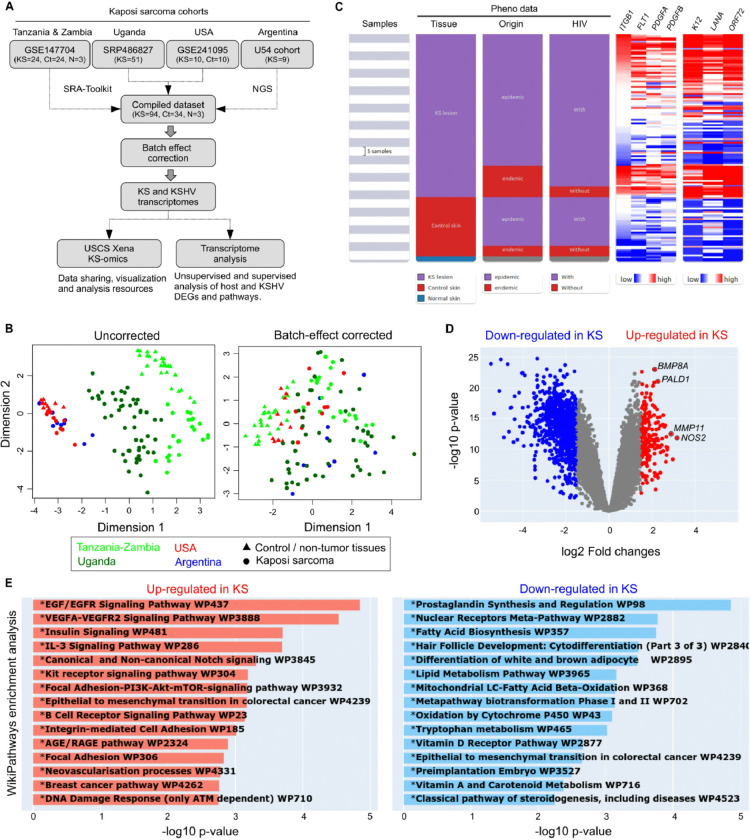
Kaposi sarcoma (KS) is an AIDS-defining cancer and a significant global health challenge caused by KS-associated herpesvirus (KSHV). NGS-based approaches have profiled KS lesions in a minimal number of studies compared with other neoplastic diseases. Here we present a compiled and harmonized dataset of 131 KS and non-tumor cutaneous samples in the context of their predicted pathway activities, immune infiltrate, KSHV and HIV gene expression profiles, and their associated clinical data representing patient populations from Argentina, United States (USA), and Sub-Saharan Africa cohorts. RNA-seq data from 9 Argentinian KS lesions were generated and integrated with previously published datasets derived from the USA and sub-Saharan African cohorts from Tanzania, Zambia, and Uganda. An unsupervised analysis of 131 KS-related samples allowed us to identify four KS clusters based on their host and KSHV gene expression profiles, immune infiltrate, and the activity of specific signaling pathways. The compiled RNA-seq profile is shared with the research community through the UCSC Xena browser for further visualization, download, and analysis (https://kaposi.xenahubs.net/). These resources will allow biologists without bioinformatics knowledge to explore and correlate the host and viral transcriptome in a curated dataset of different KS RNA-seq-based cohorts, which can lead to novel biological insights and biomarker discovery.
卡波西肉瘤(KS)是一种由卡波西肉瘤相关疱疹病毒(KSHV)引起的、可定义艾滋病的癌症,也是一项重大的全球健康挑战。与其他肿瘤性疾病相比,基于二代测序(NGS)的方法在最少数量的研究中对KS病变进行了分析。在此,我们展示了一个经过汇编和整合的数据集,该数据集包含131份KS和非肿瘤皮肤样本,涉及它们预测的信号通路活性、免疫浸润、KSHV和HIV基因表达谱,以及代表来自阿根廷、美国和撒哈拉以南非洲队列患者群体的相关临床数据。我们生成了来自9个阿根廷KS病变的RNA测序数据,并将其与先前发表的来自美国以及来自坦桑尼亚、赞比亚和乌干达的撒哈拉以南非洲队列的数据集进行整合。对131个与KS相关的样本进行无监督分析,使我们能够根据宿主和KSHV基因表达谱、免疫浸润以及特定信号通路的活性,识别出四个KS簇。通过加州大学圣克鲁兹分校(UCSC)的Xena浏览器(https://kaposi.xenahubs.net/),将汇编的RNA测序图谱分享给研究界,以便进一步可视化、下载和分析。这些资源将使没有生物信息学知识的生物学家能够在一个经过整理的、基于不同KS RNA测序队列的数据集中探索宿主和病毒转录组,并进行关联分析,这可能会带来新的生物学见解和生物标志物发现。