Dictor M, Rambech E, Way D, Witte M, Bendsöe N
Department of Pathology, University of Lund Hospital, Lund, Sweden.
Am J Pathol. 1996 Jun;148(6):2009-16.
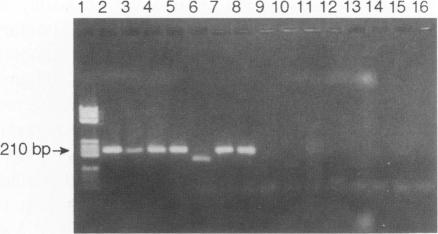
We used the polymerase chain reaction on 63 tissue specimens of histologically staged classic Kaposi's sarcoma (KS) from 40 patients, 14 specimens from 14 acquired immune deficiency syndrome (AIDS)-KS cases (all from the same geographic area over a 10-year period), and peripheral blood mononuclear cells from 1 of the non-AIDS KS patients to amplify a specific 210-bp genomic sequence of the newly discovered KS-associated herpesvirus (KSHV). Also tested were 86 benign and malignant endothelial lesions, which potentially simulated each KS histological stage and were further matched by age approximation and by sex with a classical KS specimen. The lesions included hemangioma, lymphangioma, pyogenic granuloma, and angiosarcoma. KSHV was also sought in multiple well characterized vascular endothelial cell lines from AIDS-KS lesions and in 20 mainly cutaneous benign and malignant lesions from 15 immunosuppressed transplant patients. Overall, 92% of KS tissue specimens, representing 88% of classical KS and 100% of AIDS-KS patients, and in addition the sample of peripheral blood mononuclear cell DNA, were positive as visualized on ethidium bromide gels and confirmed by Southern blot hybridization (only 1 case was negative on gell visualization but positive on Southern blot), thus confirming the close association of KSHV with KS of different clinical forms. None of the various other endothelial lesion, skin lesions in immunosuppressed patients, or AIDS-KS endothelial cell lines contained amplifiable KSHV DNA, which indicates that reactivation of KSHV is not present in the skin lesions of immunosuppressed patients and probably is not a ubiquitous agent that secondarily infects proliferative endothelium. The absence of amplifiable virus DNA in the cultured endothelium of KS suggests that the stimulus for angioproliferation originates in another host cell or under conditions not reproduced in culture. The polymerase chain reaction is a specific and sensitive means of verifying KS in the differential diagnosis of angioproliferative lessons.
我们对40例组织学分期为经典型卡波西肉瘤(KS)患者的63份组织标本、14例获得性免疫缺陷综合征(AIDS)相关KS患者的14份标本(均来自同一地理区域,历时10年)以及1例非AIDS KS患者的外周血单个核细胞,运用聚合酶链反应来扩增新发现的KS相关疱疹病毒(KSHV)的一段特定的210碱基对基因组序列。同时还检测了86例良性和恶性内皮病变,这些病变可能模拟了每个KS组织学分期,并且在年龄和性别上与经典KS标本进一步匹配。病变包括血管瘤、淋巴管瘤、化脓性肉芽肿和血管肉瘤。还在来自AIDS-KS病变的多个特征明确的血管内皮细胞系以及15例免疫抑制移植患者的20例主要为皮肤的良性和恶性病变中寻找KSHV。总体而言,92%的KS组织标本呈阳性,其中经典KS患者占88%,AIDS-KS患者占100%,此外外周血单个核细胞DNA样本在溴化乙锭凝胶上显示为阳性,并经Southern印迹杂交确认(仅1例在凝胶上显示为阴性,但Southern印迹为阳性),从而证实KSHV与不同临床形式的KS密切相关。其他各种内皮病变、免疫抑制患者的皮肤病变或AIDS-KS内皮细胞系中均未检测到可扩增的KSHV DNA,这表明免疫抑制患者的皮肤病变中不存在KSHV的再激活,并且KSHV可能不是一种普遍存在的、继发感染增殖性内皮的病原体。KS培养的内皮细胞中未检测到可扩增的病毒DNA,这表明血管增殖的刺激源自另一种宿主细胞或培养中未重现的条件。聚合酶链反应是在血管增殖性病变的鉴别诊断中验证KS的一种特异且敏感的方法。