Swee Melissa, Kumar Bharat, Sanders M Lee, Thumann Angie, Phisitkul Kantima, Griffin Benjamin R, Yamada Masaaki, Sambharia Meenakshi, Vaughan-Sarrazin Mary, Reisinger Heather S, Dixon Bradley S, Jalal Diana I
Division of Nephrology, University of Iowa Carver College of Medicine, 200 Hawkins Drive, Iowa City, IA, 52245, USA.
Center for Access Delivery & Research and Evaluation (CADRE) Center, Iowa City VA Health Care System, Iowa City, IA, USA.
BMC Nephrol. 2025 Mar 31;26(1):164. doi: 10.1186/s12882-025-04076-5.
Ensuring that patients, especially those in underserved areas, have access to specialized nephrology care is essential to addressing the increasing burden of chronic kidney disease. To address this, we developed the Telenephrology Dashboard for the 150,000 Veterans served by the Iowa City Veterans Affairs Health Care System (ICVAHCS). Our goal was to optimize the dashboard as a comprehensive and practical tool for end-users in order to monitor kidney health and facilitate remote nephrology consultations.
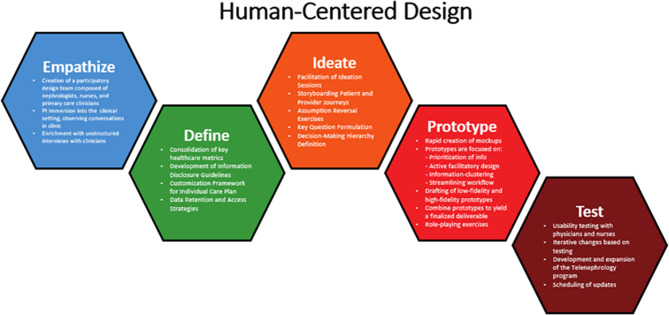
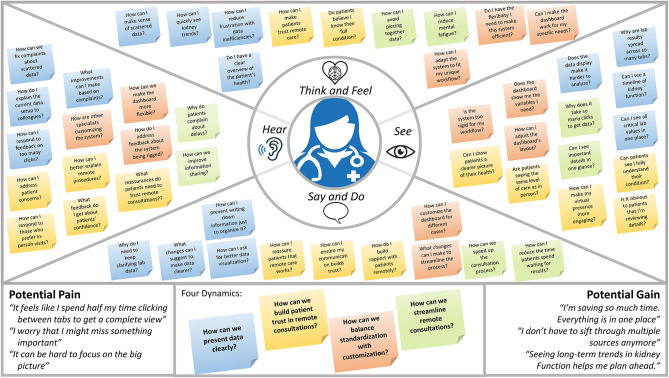
The optimization process adhered to the Human-Centered Design (HCD) framework, encompassing five stages: Empathize, Define, Ideate, Prototype and Test. Research team members spent 10 h observing nephrologists during remote consultations and supplemented these observations with semi-structured interviews with clinicians to gain insights into existing workflows and challenges. A rapid ideation workshop was then held to propose innovative solutions that balanced technical needs with user preferences. Subsequent prototyping and testing helped refine and evaluate the proposed designs, identifying key areas for improvement.
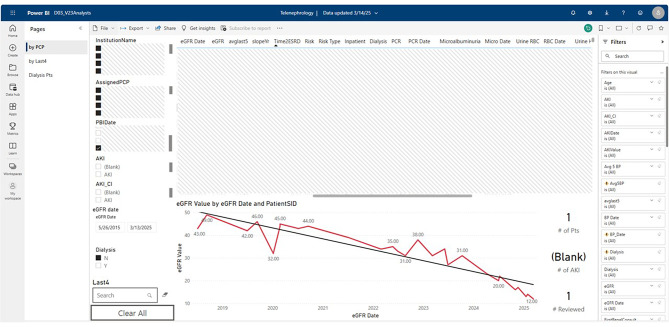
The iterative design process identified three critical needs: (1) improved clarity in visual data representation, (2) enhanced data accuracy, and (3) a balance between standardized features and customization options. Five dashboard prototypes were created, tested, and iteratively refined into a final version. The completed Telenephrology Dashboard includes five core features: (1) graphical representation of kidney function trends, (2) tables summarizing key lab data, (3) functionality to examine specific events in detail, (4) customizable views tailored to user workflows, and (5) integration of predictive kidney disease progression models.
The Telenephrology Dashboard was developed using a Human-Centered Design approach to improve remote nephrology consultations. Future efforts will focus on evaluating its impact on user satisfaction, referring clinician satisfaction, access to nephrology care, and patient care outcomes.
Not applicable, as this is not a clinical trial.
确保患者,尤其是那些服务欠缺地区的患者能够获得专业的肾脏病护理,对于应对日益增加的慢性肾脏病负担至关重要。为解决这一问题,我们为艾奥瓦市退伍军人事务医疗保健系统(ICVAHCS)所服务的150,000名退伍军人开发了远程肾脏病仪表板。我们的目标是将该仪表板优化为一个全面且实用的终端用户工具,以监测肾脏健康状况并促进远程肾脏病会诊。
优化过程遵循以人为本的设计(HCD)框架,包括五个阶段:共情、定义、构思、原型制作和测试。研究团队成员花费10小时观察远程会诊期间的肾脏病医生,并通过对临床医生进行半结构化访谈来补充这些观察结果,以深入了解现有工作流程和挑战。随后举办了一个快速构思研讨会,以提出创新解决方案,平衡技术需求与用户偏好。后续的原型制作和测试有助于完善和评估所提出的设计,确定关键的改进领域。
迭代设计过程确定了三个关键需求:(1)提高视觉数据表示的清晰度,(2)提高数据准确性,(3)在标准化功能和定制选项之间取得平衡。创建了五个仪表板原型,进行测试并迭代完善为最终版本。完成的远程肾脏病仪表板包括五个核心功能:(1)肾功能趋势的图形表示,(2)总结关键实验室数据的表格,(3)详细检查特定事件的功能,(4)根据用户工作流程定制的视图,(5)整合预测性肾脏病进展模型。
远程肾脏病仪表板是采用以人为本的设计方法开发的,以改善远程肾脏病会诊。未来的工作将集中在评估其对用户满意度、转诊临床医生满意度、获得肾脏病护理的机会以及患者护理结果的影响。
不适用,因为这不是一项临床试验。