Cruchaga Carlos, Heo Gyujin, Thomas Alvin, Wang Erming, Oh Hamilton, Ali Muhammad, Timsina Jigyasha, Song Soomin, Liu Menghan, Gong Katherine, Western Daniel, Chen Yike, Kohlfeld Patsy, Flynn Allison, Lowery Joseph, Morris John, Holtzman David, Perlmutter Joel, Schindler Suzanne, Zhang Bin, Bennett David, Benzinger Tammie, Wyss-Coray Tony, Ibanez Laura, Sung Yun Ju, Xu Ying, Losada Patricia Moran, Anastasi Federica, Gonzalez-Escalante Armand, Puerta Raquel, Vilor-Tejedor Natalia, Suárez-Calvet Marc, Garcia-Gonzalez Pablo, Fernández Maria, Boada Mercè, Cano Amanda, Ruiz Agustín
Washington University, School of Medicine.
Washington University Medical School.
Res Sq. 2025 Mar 18:rs.3.rs-5167552. doi: 10.21203/rs.3.rs-5167552/v1.
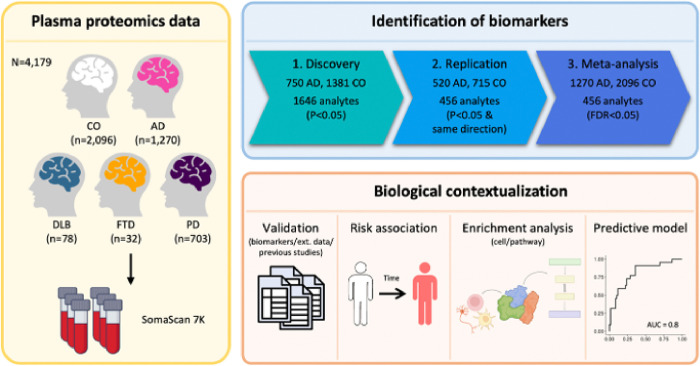
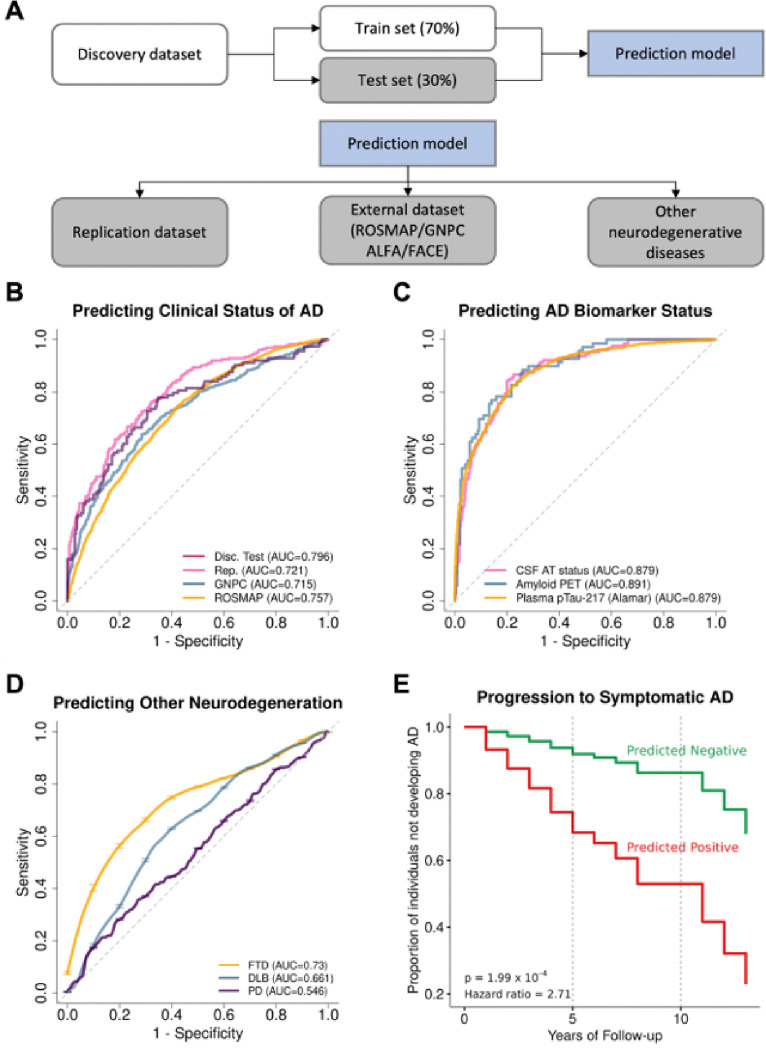
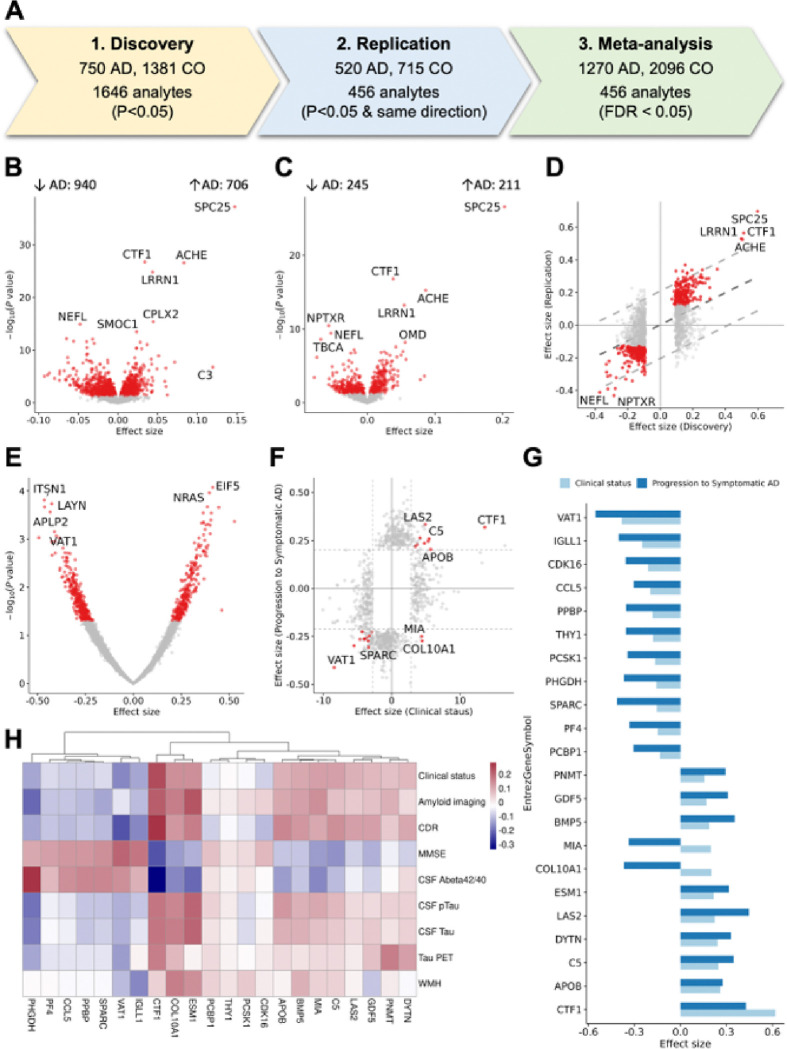
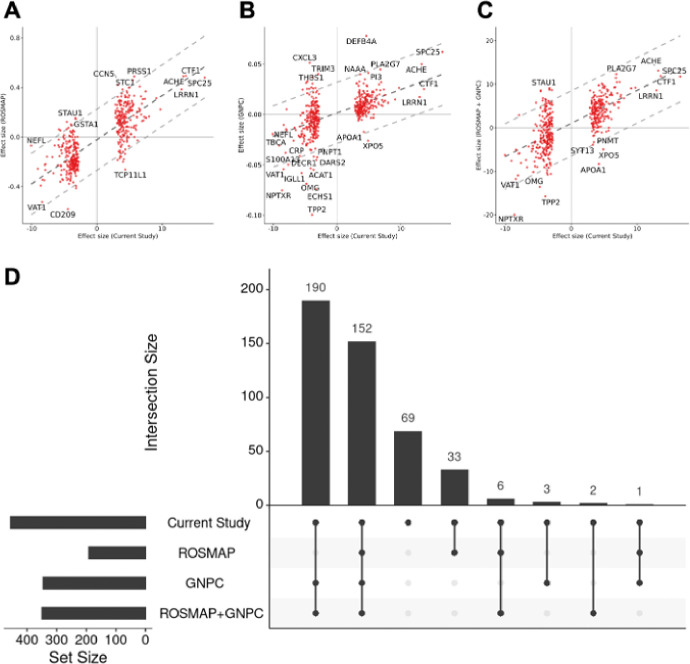
Alzheimer disease (AD) is a complex neurodegenerative disorder. Proteomic studies have been instrumental in identifying AD-related proteins present in the brain, cerebrospinal fluid, and plasma. This study comprehensively examined 6,905 plasma proteins in more than 3,300 well-characterized individuals to identify new proteins, pathways, and predictive model for AD. With three-stage analysis (discovery, replication, and meta-analysis) we identified 416 proteins (294 novel) associated with clinical AD status and the findings were further validated in two external datasets including more than 7,000 samples and seven previous studies. Pathway analysis revealed that these proteins were involved in endothelial and blood hemostatic (ACHE, SMOC1, SMOC2, VEGFA, VEGFB, SPARC), capturing blood brain barrier (BBB) disruption due to disease. Other pathways were capturing known processes implicated in AD, such as lipid dysregulation (APOE, BIN1, CLU, SMPD1, PLA2G12A, CTSF) or immune response (C5, CFB, DEFA5, FBXL4), which includes proteins known to be part of the causal pathway indicating that some of the identified proteins and pathways are involved in disease pathogenesis. An enrichment of brain and neural pathways (axonal guidance signaling or myelination signaling) indicates that, in fact, blood proteomics capture brain- and disease-related changes, which can lead to the identification of novel biomarkers and predictive models. Machine learning model was employed to identify a set of seven proteins that were highly predictive of both clinical AD (AUC > 0.72) and biomarker-defined AD status (AUC > 0.88), that were replicated in multiple external cohorts as well as with orthogonal platforms. These extensive findings underscore the potential of using plasma proteins as biomarkers for early detection and monitoring of AD, as well as potentially guiding treatment decisions.
阿尔茨海默病(AD)是一种复杂的神经退行性疾病。蛋白质组学研究有助于识别存在于大脑、脑脊液和血浆中的与AD相关的蛋白质。本研究全面检测了3300多名特征明确的个体中的6905种血浆蛋白,以确定AD的新蛋白、通路和预测模型。通过三阶段分析(发现、复制和荟萃分析),我们确定了416种与临床AD状态相关的蛋白质(294种为新发现的),这些发现已在两个外部数据集中得到进一步验证,这两个数据集包含7000多个样本以及七项先前的研究。通路分析表明,这些蛋白质参与了内皮和血液止血过程(乙酰胆碱酯酶、富含半胱氨酸的分泌型蛋白1、富含半胱氨酸的分泌型蛋白2、血管内皮生长因子A、血管内皮生长因子B、富含半胱氨酸的酸性分泌蛋白),反映了疾病导致的血脑屏障(BBB)破坏。其他通路反映了AD中已知的过程,如脂质失调(载脂蛋白E、桥连整合因子1、集群蛋白、鞘磷脂磷酸二酯酶1、磷脂酶A2G12A、组织蛋白酶F)或免疫反应(补体成分5、补体因子B、防御素5、F-box和亮氨酸丰富重复蛋白4),其中包括已知为因果通路一部分的蛋白质,这表明一些已识别的蛋白质和通路参与了疾病的发病机制。大脑和神经通路(轴突导向信号或髓鞘形成信号)的富集表明,事实上,血液蛋白质组学能够捕捉与大脑和疾病相关的变化,这可能会促成新型生物标志物和预测模型的识别。机器学习模型用于识别一组七种蛋白质,它们对临床AD(曲线下面积>0.72)和生物标志物定义的AD状态(曲线下面积>0.88)均具有高度预测性,这些蛋白质在多个外部队列以及正交平台中得到了重复验证。这些广泛的发现强调了使用血浆蛋白作为生物标志物用于AD早期检测和监测以及潜在指导治疗决策的潜力。