Osmanski-Zenk Katrin, Mittelmeier Wolfram, Melsheimer Oliver
Orthopädische Klinik und Poliklinik, Universitätsmedizin Rostock, Doberaner Straße 142, 18057, Rostock, Deutschland.
EPRD Deutsche Endoprothesenregister gGmbH, Berlin, Deutschland, Straße des 17. Juni 106-108 , 10623.
Orthopadie (Heidelb). 2025 Jun;54(6):478-485. doi: 10.1007/s00132-025-04639-2. Epub 2025 Apr 1.
Quality assurance in arthroplasty is based on established systems such as the German Arthroplasty Registry (EPRD) and the EndoCert certification system. These systems enable continuous improvement in the quality of care through targeted feedback and audits. After the introduction of the semi-annual EPRD hospital evaluations, detailed analyses and comparisons of their revision rates for hip and knee arthroplasties (THA, TKA) became possible for the hospitals.
The aim of this study was to compare and evaluate the standardised revision ratios (SRR) of the EPRD clinics.
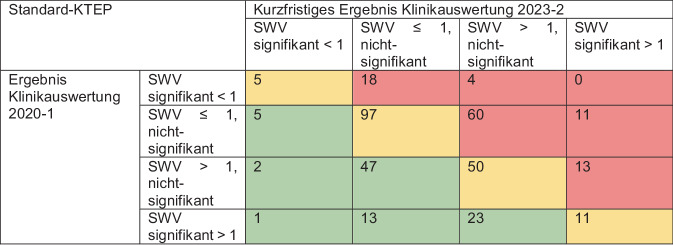
The study analysed whether poor results in previous evaluations led to an improvement over time. The analysis was based on hospital evaluations from June 2020 and December 2023 for elective THA with cementless stems and standard TKA. Of the 603 clinics with THA responses, 315 were analysed, compared to 360 of the 588 TKA clinics.
The results show that regular feedback mechanisms can improve the quality of care; 69.2% of clinics were able to maintain or improve the quality of their THA care and 70.6% of clinics were able to maintain or improve their TKA care. No dependence on case volumes was found, which indicates that all EPRD clinics can benefit equally from the feedback.
The hospital evaluations enable precise tracking of results, promote transparency and reveal potential for improvement. In view of new legislation such as the Implant Register Act and the hospital reform, it is essential to further strengthen existing systems such as the EPRD and EndoCert and integrate them even more closely into clinical practice in order to ensure the quality of care in the long term.
关节置换术的质量保证基于德国关节置换登记处(EPRD)和EndoCert认证系统等既定体系。这些系统通过有针对性的反馈和审核,实现护理质量的持续改进。在引入EPRD半年期医院评估后,各医院对其髋关节和膝关节置换术(THA、TKA)的翻修率进行详细分析和比较成为可能。
本研究的目的是比较和评估EPRD诊所的标准化翻修率(SRR)。
该研究分析了先前评估中的不佳结果是否会随着时间推移而得到改善。分析基于2020年6月至2023年12月对采用非骨水泥柄的择期THA和标准TKA的医院评估。在603家回复THA评估的诊所中,分析了315家,而在588家TKA诊所中分析了360家。
结果表明,定期反馈机制可提高护理质量;69.2%的诊所能够维持或提高其THA护理质量,70.6%的诊所能够维持或提高其TKA护理质量。未发现对病例数量的依赖性,这表明所有EPRD诊所都能从反馈中平等受益。
医院评估能够精确跟踪结果,促进透明度并揭示改进潜力。鉴于《植入物登记法》和医院改革等新立法,进一步加强EPRD和EndoCert等现有系统并使其更紧密地融入临床实践以确保长期护理质量至关重要。