Wang Yang, Dong Jiajia, Zhu Jianwen, Fu Jie, Zhang Xia, Wang Sizhe, Wen Lu, Fan Hong
School of Nursing, Nanjing Medical University, 101 Longmian Road, Nanjing, Jiangsu, 211100, People's Republic of China.
School of Public Health, Nanjing Medical University, 101 Longmian Road, Nanjing, Jiangsu, 211100, People's Republic of China.
BMC Psychiatry. 2025 Apr 2;25(1):316. doi: 10.1186/s12888-025-06714-6.
Individuals with severe mental illnesses (SMIs) are at an increased risk of exhibiting violent behaviors, which may result in significant negative consequences, including damaged relationships, property destruction, and harm to themselves or others. The purpose is to investigate the current status of violent behaviors among individuals with SMIs and identify factors within the demographic information, psychological status, and treatment status of individuals with SMIs that may influence the occurrence of violent behaviors.
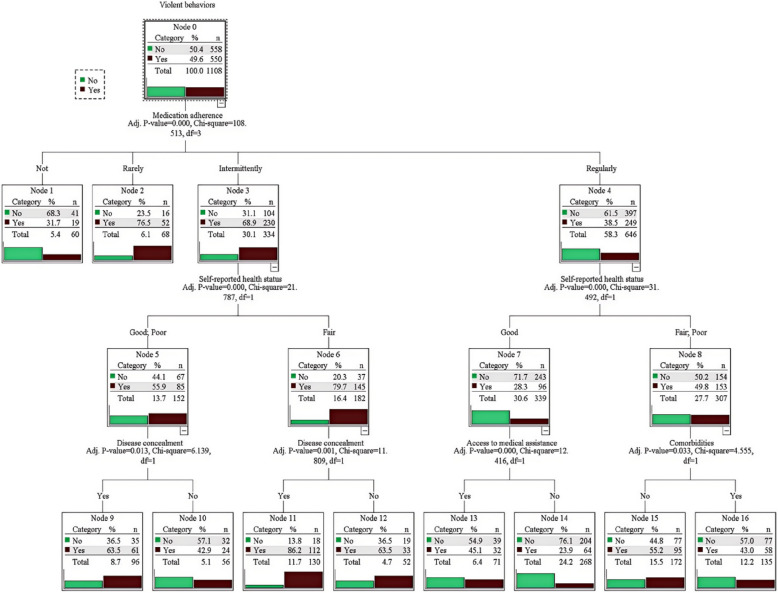
We conducted a cross-sectional survey of 1108 individuals with SMIs. The Logistic regression and Chi-squared Automatic Interaction Detection (CHAID) tree model were employed to analyze the influencing factors of violent behaviors in individuals with SMIs and compare their predictive performance.
49.6% of the participants engaged in violent behaviors in the past 12 months. The study identified that factors influencing violent behavior in individuals with SMIs include medication adherence, self-reported health status, employment, household income, experience of discrimination, disease concealment, access to medical assistance, and comorbidities. Medication adherence was identified as the most critical factor affecting violent behavior in individuals with SMIs. Logistic regression model and CHAID tree model had comparable predictive accuracy with AUC values of 0.734 and 0.730, respectively. No statistically significant difference was observed in the predictive performance of the two models (Z = -0.745, P = 0.456).
Individuals with SMIs are at a higher risk of violent behavior, which is influenced by multiple factors, particularly medication adherence. This adherence may be a key determinant in the occurrence of violent behavior among individuals with SMIs. Healthcare professionals should implement targeted interventions addressing these influencing factors to prevent the manifestation of violent behavior in individuals with SMIs.
患有严重精神疾病(SMIs)的个体表现出暴力行为的风险增加,这可能会导致重大的负面后果,包括人际关系受损、财产破坏以及对自身或他人的伤害。目的是调查患有严重精神疾病个体的暴力行为现状,并确定在患有严重精神疾病个体的人口统计学信息、心理状态和治疗状态中可能影响暴力行为发生的因素。
我们对1108名患有严重精神疾病的个体进行了横断面调查。采用逻辑回归和卡方自动交互检测(CHAID)树模型分析患有严重精神疾病个体暴力行为的影响因素,并比较它们的预测性能。
49.6%的参与者在过去12个月内有暴力行为。研究确定,影响患有严重精神疾病个体暴力行为的因素包括药物依从性、自我报告的健康状况、就业、家庭收入、歧视经历、疾病隐瞒、获得医疗救助的情况以及合并症。药物依从性被确定为影响患有严重精神疾病个体暴力行为的最关键因素。逻辑回归模型和CHAID树模型具有可比的预测准确性,AUC值分别为0.734和0.730。在两个模型的预测性能方面未观察到统计学上的显著差异(Z = -0.745,P = 0.456)。
患有严重精神疾病的个体暴力行为风险较高,这受到多种因素影响,尤其是药物依从性。这种依从性可能是患有严重精神疾病个体暴力行为发生的关键决定因素。医疗保健专业人员应实施针对性干预措施来解决这些影响因素,以预防患有严重精神疾病个体出现暴力行为。