M Bader Stefanie, Calleja Dale J, Devine Shane M, Kuchel Nathan W, Lu Bernadine G C, Wu Xinyu, Birkinshaw Richard W, Bhandari Reet, Loi Katie, Volpe Rohan, Khakham Yelena, Au Amanda E, Blackmore Timothy R, Mackiewicz Liana, Dayton Merle, Schaefer Jan, Scherer Lena, Stock Angus T, Cooney James P, Schoffer Kael, Maluenda Ana, Kleeman Elizabeth A, Davidson Kathryn C, Allison Cody C, Ebert Gregor, Chen Gong, Katneni Kasiram, Klemm Theresa A, Nachbur Ueli, Georgy Smitha Rose, Czabotar Peter E, Hannan Anthony J, Putoczki Tracy L, Tanzer Maria, Pellegrini Marc, Lechtenberg Bernhard C, Charman Susan A, Call Melissa J, Mitchell Jeffrey P, Lowes Kym N, Lessene Guillaume, Doerflinger Marcel, Komander David
Walter and Eliza Hall Institute of Medical Research, Parkville, VIC, Australia.
Department of Medical Biology, University of Melbourne, Melbourne, Australia.
Nat Commun. 2025 Apr 3;16(1):2900. doi: 10.1038/s41467-025-57905-4.
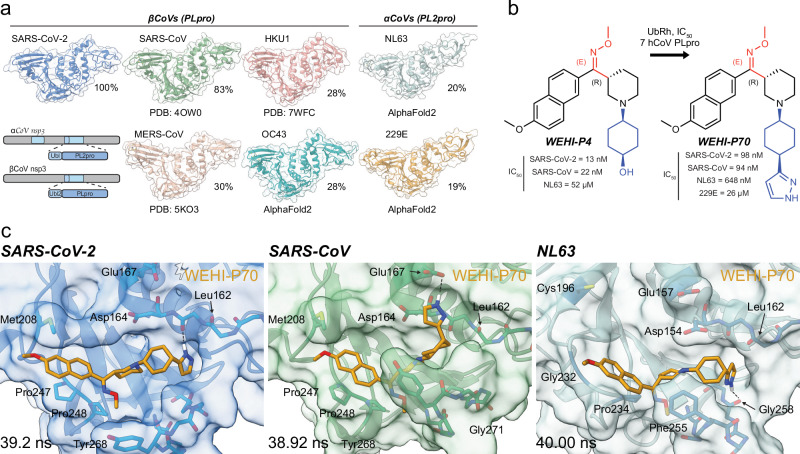
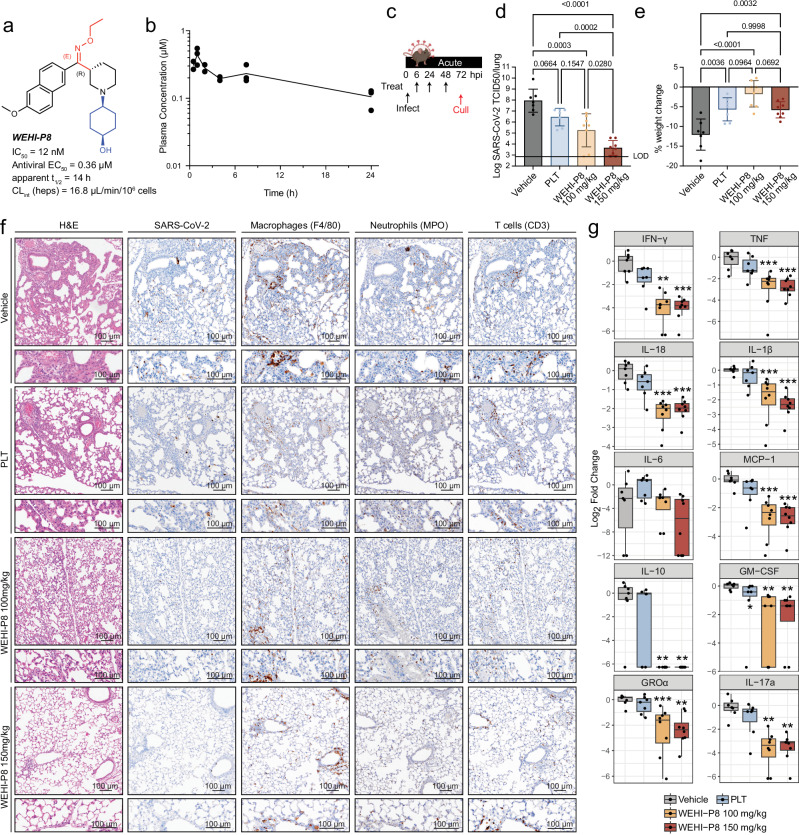
The COVID-19 pandemic caused by the coronavirus SARS-CoV-2 has highlighted the vulnerability of a globally connected population to zoonotic viruses. The FDA-approved coronavirus antiviral Paxlovid targets the essential SARS-CoV-2 main protease, Mpro. Whilst effective in the acute phase of a COVID infection, Paxlovid cannot be used by all patients, can lead to viral recurrence, and does not protect against post-acute sequelae of COVID-19 (PASC), commonly known as long COVID, an emerging significant health burden that remains poorly understood and untreated. Alternative antivirals that are addressing broader patient needs are urgently required. We here report our drug discovery efforts to target PLpro, a further essential coronaviral protease, for which we report a novel chemical scaffold that targets SARS-CoV-2 PLpro with low nanomolar activity, and which exhibits activity against PLpro of other pathogenic coronaviruses. Our lead compound shows excellent in vivo efficacy in a mouse model of severe acute disease. Importantly, our mouse model recapitulates long-term pathologies matching closely those seen in PASC patients. Our lead compound offers protection against a range of PASC symptoms in this model, prevents lung pathology and reduces brain dysfunction. This provides proof-of-principle that PLpro inhibition may have clinical relevance for PASC prevention and treatment going forward.
由冠状病毒SARS-CoV-2引起的COVID-19大流行凸显了全球互联人群对人畜共患病毒的脆弱性。美国食品药品监督管理局(FDA)批准的冠状病毒抗病毒药物帕罗韦德(Paxlovid)靶向关键的SARS-CoV-2主要蛋白酶Mpro。虽然帕罗韦德在COVID感染的急性期有效,但并非所有患者都能使用,可能导致病毒复发,并且不能预防COVID-19的急性后遗症(PASC),即通常所说的长期COVID,这是一种新出现的重大健康负担,目前仍知之甚少且未得到有效治疗。迫切需要能满足更广泛患者需求的替代抗病毒药物。我们在此报告我们针对另一种关键的冠状病毒蛋白酶PLpro的药物研发工作,我们报告了一种新型化学支架,它以低纳摩尔活性靶向SARS-CoV-2 PLpro,并且对其他致病性冠状病毒的PLpro也有活性。我们的先导化合物在严重急性疾病小鼠模型中显示出优异的体内疗效。重要的是,我们的小鼠模型概括了与PASC患者所见非常相似的长期病理状况。在该模型中,我们的先导化合物能预防一系列PASC症状,防止肺部病变并减轻脑功能障碍。这提供了原理证明,即抑制PLpro可能对未来PASC的预防和治疗具有临床意义。