Ren Tiantian, Shi Xuqian, Zhou Shuxin, Fan Kanghui, Zhang Rui, Nie Lanchun, Zhao Wensheng
College of Horticulture, Hebei Agricultural University, Baoding, Hebei, 071000, China.
Hebei Key Laboratory of Vegetable Germplasm Innovation and Utilization, Baoding, Hebei, 071000, China.
BMC Plant Biol. 2025 Apr 3;25(1):420. doi: 10.1186/s12870-025-06444-7.
Melon is an important horticultural crop cultivated extensively worldwide. The size of the fruit navel, the terminal region of melon fruits, significantly influences the appearance quality of the fruit. However, the regulatory factors and molecular mechanisms governing the fruit navel development remain poorly understood in melon.
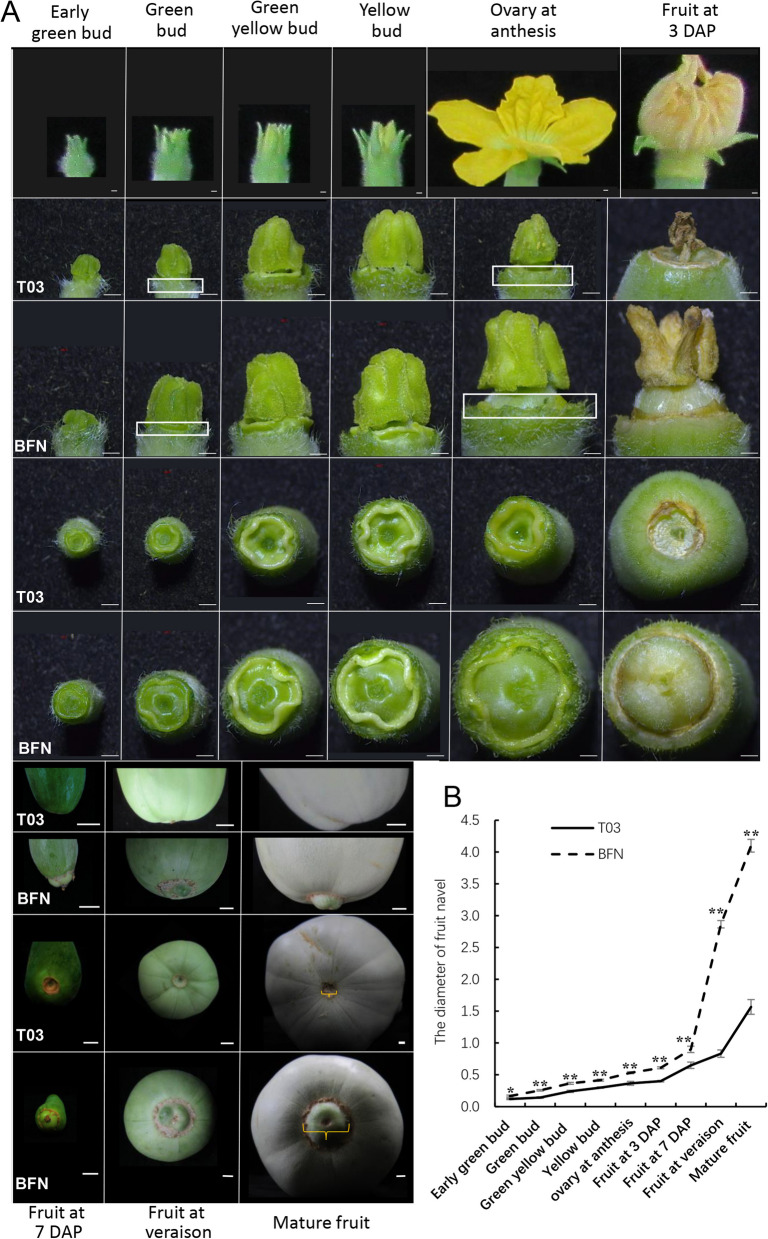
In this study, the regulators and mechanisms underlying fruit navel development were investigated through phenotypic analysis, RNA sequencing (RNA-seq) and RT-qPCR methods. The inbred line 'T03' and a big fruit navel mutant 'BFN' of melon were used as experimental materials. RNA-seq analysis identified 116 differentially expressed genes (DEGs), including 54 up-regulated and 62 down-regulated genes, in both the green bud (GB) and ovary at anthesis (OA) stages of the 'BFN' melon compared to the 'T03' melon. Functional enrichment analysis revealed that these 116 DEGs were significantly associated with "Sesquiterpenoid and triterpenoid biosynthesis", "Circadian rhythm-plant", "Galactose metabolism" and "Biosynthesis of various alkaloids" pathways. There were three (AP2/ERF, MYB and C2H2 types) and eight (AP2/ERF, MADS-box, homeobox domain and bZIP types) transcription factors presented in up-regulated and down-regulated DEGs, and their putative target genes were predicted. Based on KEGG and expression analyses, two terpene cyclase/mutase genes (MELO3 C001812 and MELO3 C004329) were identified as being involved in the "Sesquiterpenoid and triterpenoid biosynthesis" pathway, and their transcripts were significantly downregulated in all detected development stages (EGB, GB, GYB, YB and OA) of 'BFN' fruits compared with 'T03' fruits.
The findings of this study elucidate a fundamental regulatory mechanism underlying fruit navel formation, and identify two key negative regulators, MELO3C001812 and MELO3C004329, involved in the development of the fruit navel in melon.
甜瓜是一种在全球广泛种植的重要园艺作物。果实脐部是甜瓜果实的末端区域,其大小对果实外观品质有显著影响。然而,甜瓜果实脐部发育的调控因子和分子机制仍不清楚。
本研究通过表型分析、RNA测序(RNA-seq)和RT-qPCR方法,对果实脐部发育的调控因子和机制进行了研究。以甜瓜自交系‘T03’和大果实脐突变体‘BFN’为实验材料。RNA-seq分析确定,与‘T03’甜瓜相比,‘BFN’甜瓜在绿芽(GB)期和开花期子房(OA)期有116个差异表达基因(DEG),其中54个上调,62个下调。功能富集分析表明,这116个DEG与“倍半萜和三萜生物合成”、“昼夜节律-植物”、“半乳糖代谢”和“各种生物碱的生物合成”途径显著相关。上调和下调的DEG中分别有3种(AP2/ERF、MYB和C2H2类型)和8种(AP2/ERF、MADS-box、同源异型框结构域和bZIP类型)转录因子,并预测了它们的假定靶基因。基于KEGG和表达分析,鉴定出两个萜烯环化酶/变位酶基因(MELO3C001812和MELO3C004329)参与“倍半萜和三萜生物合成”途径,与‘T03’果实相比,它们在‘BFN’果实的所有检测发育阶段(EGB、GB、GYB、YB和OA)中的转录本均显著下调。
本研究结果阐明了果实脐部形成的基本调控机制,并鉴定出两个参与甜瓜果实脐部发育的关键负调控因子MELO3C001812和MELO3C004329。