Mallareddy Jayapal Reddy, Yang Lin, Lin Wan-Hsin, Feathers Ryan, Ayers-Ringler Jennifer, Tolosa Ezequiel, Kizhake Amritha G, Kizhake Smitha, Kubica Sydney P, Boghean Lidia, Alvarez Sophie, Naldrett Michael J, Singh Sarbjit, Rana Sandeep, Zahid Muhammad, Schaefer-Klein Janet, Roden Anja, Kosari Farhad, Anastasiadis Panos Z, Borad Mitesh, Natarajan Amarnath, Mansfield Aaron S
Eppley Institute for Cancer Research, University of Nebraska Medical Center Omaha NE 68198 USA
Precision Cancer Therapeutics, Center for Individualized Medicine, Mayo Clinic Rochester MN 55905 USA
RSC Adv. 2025 Apr 3;15(13):10419-10425. doi: 10.1039/d5ra01441g. eCollection 2025 Mar 28.
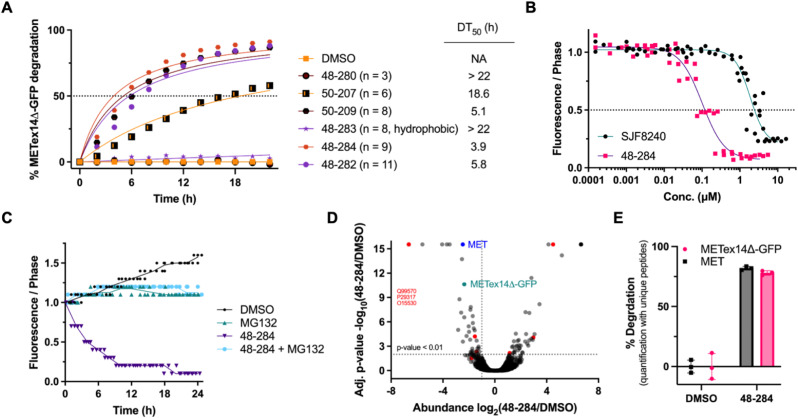
Despite ongoing efforts to employ structure-based methods to discover targeted protein degraders (TPD), the prevailing strategy continues to be the synthesis of a focused set of heterobifunctional compounds and screening them for target protein degradation. Here we used a fluorescence based live cell imaging screen to identify degraders that target exon 14 skipped hepatocyte growth factor receptor (MET). MET is a known oncogenic driver. MET exon 14 skipping mutations (METex14Δ) are found in lung cancers and result in the loss of a degron that is required for E3-ligase recognition and subsequent ubiquitination, prolonging the half-life and oncogenicity of MET. Since proteolysis targeting chimeras (PROTACs) are heterobifunctional molecules that promote target degradation by the proteosome, we sought to restore degradation of MET lost with METex14Δ using a MET-targeting PROTAC. We generated a library of sixty PROTACs of which 37 used the MET inhibitor capmatinib as the protein of interest targeting ligand. We screened this PROTAC library for targeted degradation of METex14Δ-GFP using live cell imaging. We benchmarked the MET-targeting PROTACs to that of a previously reported MET-targeting PROTAC, SJF8240. Curve fitting live cell imaging data affords determination of time required to degrade 50% of the target protein (DT), which was used in determining structure activity relationships. A promising candidate, 48-284, identified from the screen, exhibited classic PROTAC characteristics, was >15-fold more potent than SJF8240, had fewer off targets compared to SJF8240, and degraded MET in multiple cell lines.
尽管人们不断努力采用基于结构的方法来发现靶向蛋白降解剂(TPD),但目前流行的策略仍然是合成一组有针对性的异双功能化合物,并对其进行筛选以寻找能够降解目标蛋白的化合物。在这里,我们使用基于荧光的活细胞成像筛选方法来鉴定靶向14号外显子跳跃型肝细胞生长因子受体(MET)的降解剂。MET是一种已知的致癌驱动因子。在肺癌中发现了MET 14号外显子跳跃突变(METex14Δ),该突变导致E3连接酶识别和随后泛素化所需的降解结构域缺失,从而延长了MET的半衰期和致癌性。由于蛋白酶靶向嵌合体(PROTAC)是通过蛋白酶体促进目标蛋白降解的异双功能分子,我们试图使用靶向MET的PROTAC来恢复因METex14Δ而丧失的MET降解功能。我们构建了一个包含60种PROTAC的文库,其中37种使用MET抑制剂卡马替尼作为靶向目标蛋白的配体。我们使用活细胞成像技术对这个PROTAC文库进行筛选,以寻找能够靶向降解METex14Δ-GFP的化合物。我们将靶向MET的PROTAC与之前报道的靶向MET的PROTAC SJF8240进行了比较。通过对活细胞成像数据进行曲线拟合,可以确定降解50%目标蛋白所需的时间(DT),这被用于确定结构活性关系。从筛选中鉴定出的一个有前景的候选化合物48-284,具有典型的PROTAC特征,其效力比SJF8240高15倍以上,与SJF8240相比脱靶效应更少,并且能够在多种细胞系中降解MET。