Little Isaiah, Bersie Stephanie, Redente Elizabeth F, McCubbrey Alexandra L, Tarling Elizabeth J
Division of Cardiology, Department of Medicine, David Geffen School of Medicine at UCLA, University of California Los Angeles, Los Angeles, California.
Toxicology Graduate Program, Skaggs School of Pharmacy and Pharmaceutical Sciences.
Curr Opin Lipidol. 2025 Jun 1;36(3):153-162. doi: 10.1097/MOL.0000000000000987. Epub 2025 Apr 2.
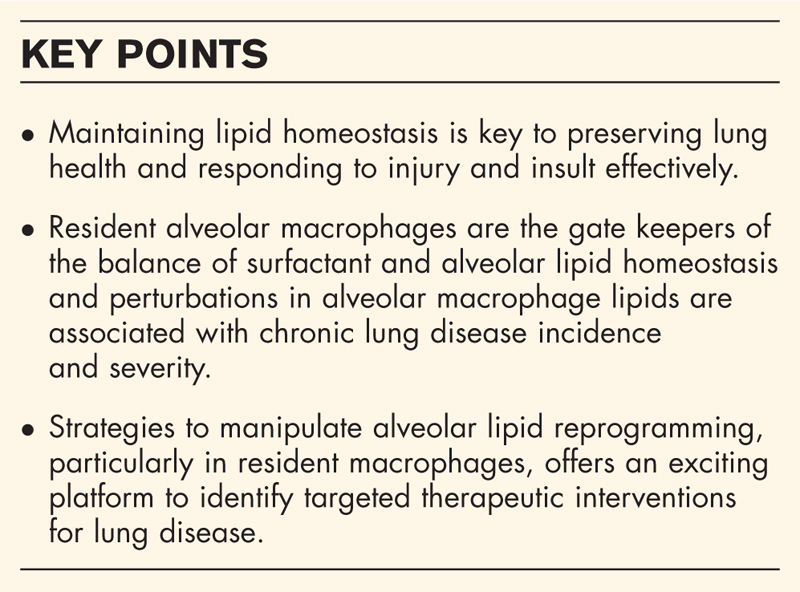
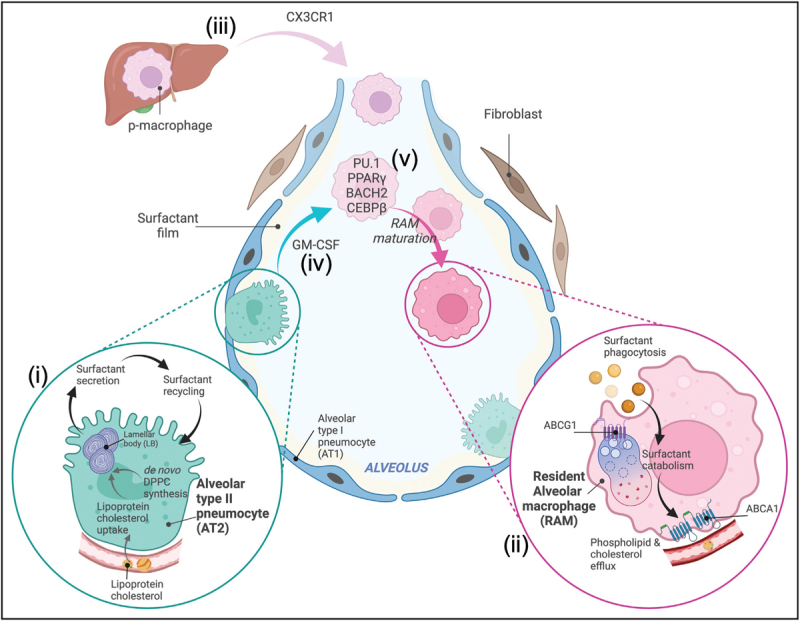
As the primary guardians at the air-surface interface, the functional profile of alveolar macrophages (AM) is wide-ranging from establishment of the alveolar niche, homeostatic maintenance of surfactant levels, to pathogen clearance and resolution and repair processes. Alveolar lipid homeostasis is disturbed in chronic lung diseases and contributes to disease pathogenesis through extracellular localization in the alveolar lumen or intracellular accumulation in AM. This review aims to provide a focused overview of the state of knowledge of AM, their ontogeny and development during health and disease, and how dysregulated AM lipids play a key role in disease processes, from initiation to resolution.
While lipid-laden macrophages are observed across a broad spectrum of lung diseases, their occurrence has largely been considered consequential. Recent advances in lipidomic profiling of single cell types has revealed that disturbances to lipid homeostasis occur early in disease in tissue-resident cells. Comparisons between inflammatory and fibrotic injury models reveal specific alveolar macrophage subsets with different lipid utilization that contribute to the disease process.
Understanding the intricate web of AM population seeding and development and how this niche is perturbed by lipid disturbances may help provide leverage for new interventions.
作为气-液界面的主要守护者,肺泡巨噬细胞(AM)的功能广泛,涵盖肺泡微环境的建立、表面活性剂水平的稳态维持、病原体清除以及炎症消退和修复过程。慢性肺部疾病中肺泡脂质稳态受到干扰,并通过在肺泡腔内的细胞外定位或在AM中的细胞内积累促进疾病发病机制。本综述旨在重点概述AM的知识现状、它们在健康和疾病状态下的个体发生和发育,以及失调的AM脂质如何在从疾病起始到消退的过程中在疾病进程中发挥关键作用。
虽然在广泛的肺部疾病中都观察到了脂质负载的巨噬细胞,但它们的出现大多被认为是继发性的。单细胞类型脂质组学分析的最新进展表明,脂质稳态的干扰在疾病早期就发生在组织驻留细胞中。炎症和纤维化损伤模型之间的比较揭示了具有不同脂质利用情况的特定肺泡巨噬细胞亚群,这些亚群促成了疾病进程。
了解AM群体播种和发育的复杂网络,以及这个微环境如何受到脂质干扰的影响,可能有助于为新的干预措施提供依据。