
在结肠癌小鼠模型中,膳食补充水飞蓟素可增强卡培他滨和伊立替康的化疗疗效,并减轻肝毒性。
Dietary silymarin supplementation enhances chemotherapy efficacy of capecitabine and irinotecan and mitigates hepatotoxicity in a mouse model of colon cancer.
作者信息
Hassani Sepideh, Malekinejad Hassan, Khadem-Ansari Mohammad Hassan, Abbasi Ata, Kheradmand Fatemeh
机构信息
Department of Clinical Biochemistry, School of Medicine, Urmia University of Medical Sciences, Urmia, Iran.
Cellular and Molecular Research Center, Cellular and Molecular Medicine Institute, Urmia University of Medical Sciences, Urmia, Iran.
出版信息
Res Pharm Sci. 2025 Feb 20;20(1):77-94. doi: 10.4103/RPS.RPS_204_24. eCollection 2025 Feb.
BACKGROUND AND PURPOSE
The flavonoid silymarin (SMN) has shown promise due to its antioxidant, anti-inflammatory, and anticancer properties. SMN has been widely used in preclinical and clinical studies to treat various types of cancer, alone and with chemotherapy agents. Recent research suggests that SMN may increase conventional chemotherapy efficacy and reduce adverse effects. Herein, we investigated the therapeutic efficacy of SMN and its combination with capecitabine (CAP) and irinotecan (IRI) in a mouse model of colon cancer.
EXPERIMENTAL APPROACH
Following 1,2 dimethylhydrazine-induced colon cancer, a modified diet supplemented with SMN (2500 ppm) and mono- and combined therapy of CAP and IRI was used. Serum samples were analyzed for lipid profile, liver function, and inflammatory cytokines. Oxidative stress and inflammation markers, including malondialdehyde (MDA), nitric oxide (NO), myeloperoxidase (MPO), superoxide dismutase (SOD), and glutathione peroxidase (GPx) were measured in colonic, hepatic, and circulatory samples. Colonic BAX and Bcl-2 levels were examined western blotting and histopathological analysis of colon sections was conducted.
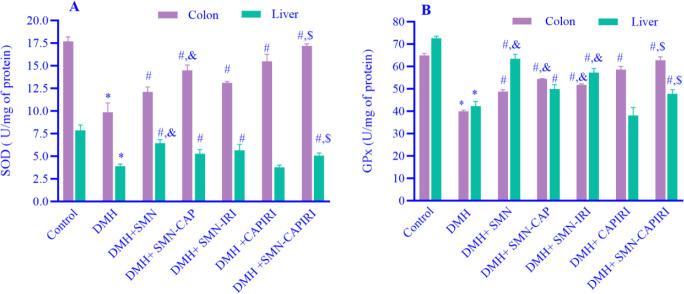
FINDINGS/RESULTS: SMN alone and combined with chemotherapeutic agents significantly mitigated the elevated inflammatory cytokines liver function enzyme levels, and hyperlipidemia. Furthermore, SMN supplementation with chemotherapy agents enhanced antioxidant activity and reduced lipid peroxidation and inflammatory markers. Significant upregulation of BAX and downregulation of Bcl-2 were observed. In addition, treatment regimens ameliorated carcinogen-induced polyp multiplicity, adenoma formation, dysplastic changes, and lymphocytic aggregation.
CONCLUSION AND IMPLICATIONS
Our results demonstrated that the potential anticancer properties of SMN could enhance chemotherapy efficacy and reduce carcinogen- and chemotherapy-induced hepatotoxicity.
背景与目的
类黄酮水飞蓟素(SMN)因其抗氧化、抗炎和抗癌特性而展现出应用前景。SMN已广泛用于临床前和临床研究,单独或与化疗药物联合用于治疗各类癌症。近期研究表明,SMN可能提高传统化疗疗效并减少不良反应。在此,我们在结肠癌小鼠模型中研究了SMN及其与卡培他滨(CAP)和伊立替康(IRI)联合应用的治疗效果。
实验方法
在用1,2-二甲基肼诱导结肠癌后,采用补充有SMN(2500 ppm)的改良饮食以及CAP和IRI的单一及联合治疗。分析血清样本的血脂、肝功能和炎性细胞因子。在结肠、肝脏和循环样本中测量氧化应激和炎症标志物,包括丙二醛(MDA)、一氧化氮(NO)、髓过氧化物酶(MPO)、超氧化物歧化酶(SOD)和谷胱甘肽过氧化物酶(GPx)。通过蛋白质免疫印迹法检测结肠BAX和Bcl-2水平,并对结肠切片进行组织病理学分析。
研究结果
单独使用SMN以及与化疗药物联合使用均显著减轻了炎性细胞因子、肝功能酶水平的升高以及高脂血症。此外,SMN与化疗药物联合使用增强了抗氧化活性,减少了脂质过氧化和炎症标志物。观察到BAX显著上调和Bcl-2下调。此外,治疗方案改善了致癌物诱导的息肉多发性、腺瘤形成、发育异常变化和淋巴细胞聚集。
结论与意义
我们的结果表明,SMN的潜在抗癌特性可提高化疗疗效,并减少致癌物和化疗诱导的肝毒性。




 Zotero 插件