Malhotra Alka, Thorpe Erin, Coffey Alison J, Rajkumar Revathi, Adjeman Josephine, Naa Adjeley Adjetey Naomi Dianne, Aglobitse Sharron, Allotey Felix, Arsov Todor, Ashong Joyce, Badoe Ebenezer Vincent, Basel Donald, Brew Yvonne, Brown Chester, Bosfield Kerri, Casas Kari, Cornejo-Olivas Mario, Davis-Keppen Laura, Freed Abbey, Gibson Kate, Jayakar Parul, Jones Marilyn C, Kawome Martina, Lumaka Aimé, Maier Ursula, Makay Prince, Manassero Gioconda, Marbell-Wilson Marilyn, Marcuccilli Charles, Masser-Frye Diane, McCarrier Julie, Mills Hannah-Sharon, Montoya Jeny Balazar, Mubungu Gerrye, Ngole Mamy, Perez Jorge, Pivnick Eniko, Duenas-Roque Milagros M, Pena Salguero Hildegard, Serize Arturo, Shinawi Marwan, Sirchia Fabio, Soler-Alfonso Claudia, Taylor Alan, Thompson Lauren, Vance Gail, Vanderver Adeline, Vaux Keith, Velasco Danita, Wiafe Samuel, Taft Ryan J, Perry Denise L, Kesari Akanchha
Illumina Inc., San Diego, CA, USA.
Illumina Inc., San Diego, CA, USA; Genetic Alliance, Damascus, MD, USA.
HGG Adv. 2025 Apr 7;6(3):100430. doi: 10.1016/j.xhgg.2025.100430.
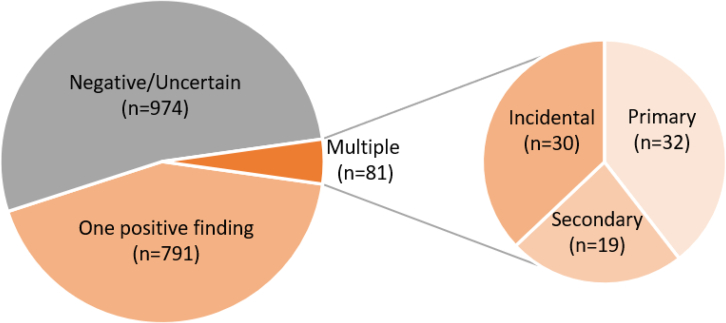
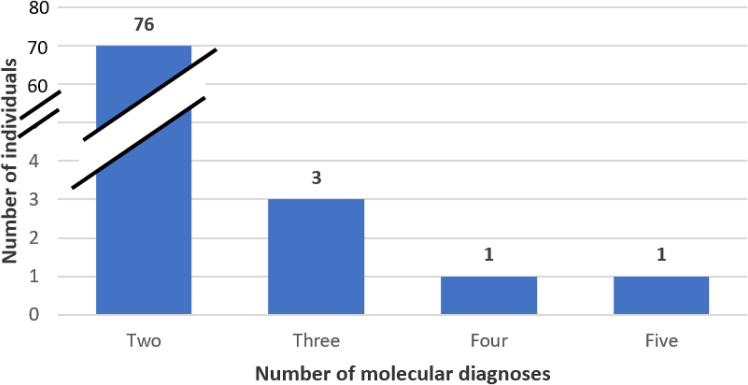
Genome sequencing is a powerful and comprehensive test that detects multiple variants of different types. The interrogation of variants across the genome enables the identification of multiple molecular diagnoses (MMDs) in a single individual. In this retrospective study, we describe individuals in whom MMDs were associated with the proband's indication for testing (IFT), secondary findings, or incidental findings. An MMD is considered where at least one of the findings is associated with the primary IFT and all variants are classified as either likely pathogenic or pathogenic. Clinical genome sequencing was performed for all individuals as part of the iHope program at the Illumina Laboratory Services between September 2017 and December 2023. The iHope cohort included 1,846 affected individuals, with 872 (47.2%) found to have at least one likely pathogenic or pathogenic variant associated with the primary IFT. Of these, 81 (9.3%) individuals had multiple clinically significant molecular findings, including 76 individuals with reported variants associated with 2 different conditions, and 5 individuals with more than 2 molecular findings. A total of 32 individuals (3.7%) had at least 2 molecular diagnoses related to the primary IFT, while in 49 (5.6%) individuals, the variant(s) reported for the second condition constituted a secondary or incidental finding. Our study highlights that among individuals with a likely pathogenic or pathogenic finding identified through genome sequencing, 9% have MMDs, which may have been missed with different testing methods. Of note, approximately 60% of the 81 individuals with an MMD had a potentially actionable secondary or incidental finding.
基因组测序是一项强大而全面的检测,可检测多种不同类型的变异。对整个基因组的变异进行检测能够在单个个体中识别出多种分子诊断结果(MMDs)。在这项回顾性研究中,我们描述了那些MMDs与先证者的检测指征(IFT)、次要发现或偶然发现相关的个体。当至少一项发现与主要IFT相关且所有变异被分类为可能致病或致病时,即认为存在MMD。作为Illumina实验室服务公司iHope项目的一部分,对所有个体进行了临床基因组测序,时间为2017年9月至2023年12月。iHope队列包括1846名受影响个体,其中872名(47.2%)被发现至少有一个与主要IFT相关的可能致病或致病变异。在这些个体中,81名(9.3%)有多项具有临床意义的分子发现,包括76名报告的变异与2种不同疾病相关的个体,以及5名有超过2项分子发现的个体。共有32名个体(3.7%)至少有2项与主要IFT相关的分子诊断,而在49名(5.6%)个体中,为第二种疾病报告的变异构成了次要或偶然发现。我们的研究强调,在通过基因组测序确定有可能致病或致病发现的个体中,9%有MMDs,而采用不同检测方法可能会遗漏这些发现。值得注意的是,81名有MMD的个体中约60%有潜在可采取行动的次要或偶然发现。