Leonard Krista S, Larouche Miranda, Mitchell Nathan R, Rydell Sarah A, Toledo Meynard John, Mullane Sarah L, Hasanaj Kristina, Buman Matthew P, Pereira Mark A
College of Health Solutions, Arizona State University, Phoenix, USA.
School of Public Health, Department of Epidemiology & Community Health, University of Minnesota, Minneapolis, USA.
Int J Behav Nutr Phys Act. 2025 Apr 7;22(1):39. doi: 10.1186/s12966-025-01731-w.
The long-term impact of multilevel workplace sedentary behavior interventions has not been established beyond 12-months. We conducted a 2-arm group randomized trial examining the 24-month efficacy of a multilevel workplace intervention with sit-stand workstations (SSW) relative to the same multilevel intervention with delayed SSW implementation until 12-months.
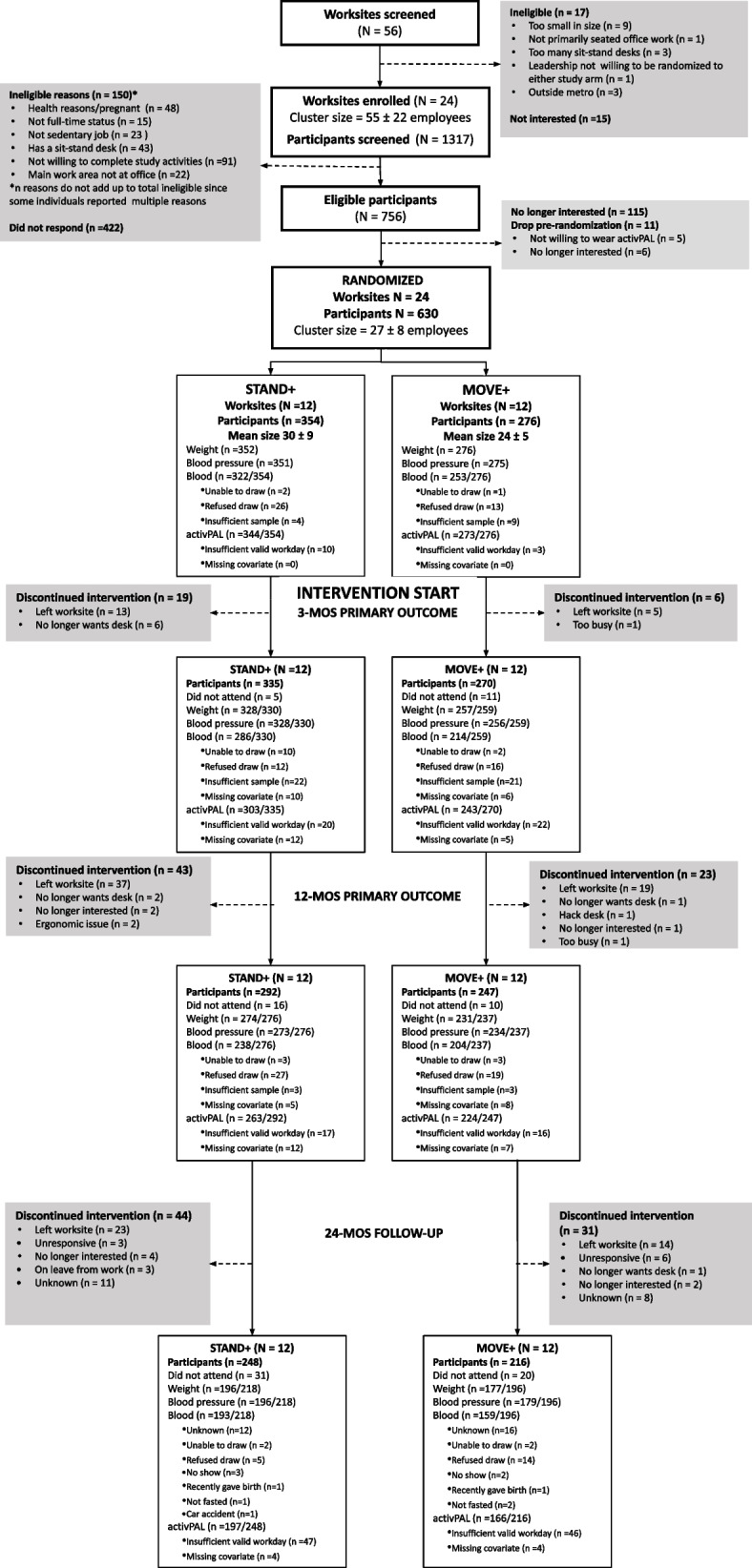
Worksites (N = 24 worksites, N = 630 employees) were randomized to participate in Stand and Move at Work and received: (a) STAND + , a 12-month multilevel behavioral intervention targeting reductions in sedentary time and increases in light physical activity (LPA) with SSW delivery during the 12-months or (b) MOVE + , the same multilevel intervention, however with SSW delivery at the end of the 12-month primary assessment period. We present maintenance endpoints (24-month follow-up) of objectively measured sedentary behavior variables as well as cardiometabolic biomarkers of the total sample and an at-risk exploratory dysglycemic (prediabetes or diabetes) subgroup per study arm.
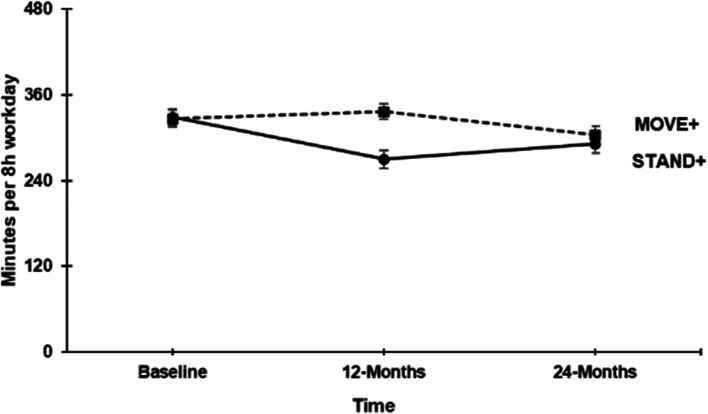
All worksites (N = 24; from academic [n = 8], industry/healthcare [n = 8], and government [n = 8] sectors) were retained and participated in 24-month follow-up data collection. A total of 464 participants (248 STAND + , 216 MOVE + ; 19 ± 6 per worksite; 45.8 ± 10.6 years of age, 73% female) completed the 24-month assessment. At 24 months, the adjusted within-arm difference in sitting was -37.3 (CI:-51.9, -22.7) min per 8 h workday for STAND + and -23.4 (-39.7, -7.0) min per 8 h workday for MOVE + . Findings at 12-months were reproduced at 24-months, in which the majority of reductions in sitting translated to increasing standing with minimal change in LPA. There were no significant changes in cardiometabolic risk within the total sample, while there were some significant changes in triglycerides and blood pressure for the dysglycemic participants.
Multilevel workplace interventions incorporating SSWs have the potential to sustain reductions in workplace sedentary time through 24-months. Further, delayed introduction of SSWs following a 12-month multilevel workplace intervention seem to produce similar sitting time reductions relative to immediate introduction. SSWs are a robust environmental stimulus within multilevel interventions targeting workplace sedentary behavior. A larger sample size is needed to detect concomitant impact on cardiometabolic health.
ClinicalTrials.gov Identifier: NCT02566317. Registered on 2 October 2015, the first participant enrolled 11 January 2016. https://clinicaltrials.gov/ct2/show/NCT02566317 . See Consort checklist.
超过12个月后,多级工作场所久坐行为干预措施的长期影响尚未明确。我们进行了一项双臂组随机试验,研究与同样的多级干预措施(其中坐站两用工作站(SSW)的实施延迟至12个月)相比,包含坐站两用工作站的多级工作场所干预措施在24个月时的疗效。
工作场所(N = 24个工作场所,N = 630名员工)被随机分配参与“工作时站立与活动”项目,并接受:(a)“站立+”,一项为期12个月的多级行为干预措施,目标是减少久坐时间并增加轻度身体活动(LPA),在12个月期间提供坐站两用工作站;或(b)“活动+”,同样的多级干预措施,但在12个月的主要评估期结束时提供坐站两用工作站。我们展示了客观测量的久坐行为变量的维持终点(24个月随访),以及每个研究组中总样本和处于风险中的探索性血糖异常(糖尿病前期或糖尿病)亚组的心脏代谢生物标志物。
所有工作场所(N = 24个;来自学术领域[n = 8]、行业/医疗保健领域[n = 8]和政府部门[n = 8])均被保留,并参与了24个月的随访数据收集。共有464名参与者(248名“站立+”参与者,216名“活动+”参与者;每个工作场所19±6名;年龄45.8±10.6岁,73%为女性)完成了24个月的评估。在24个月时,“站立+”组每8小时工作日的调整后组内久坐时间差异为-37.3(CI:-51.9,-22.7)分钟,“活动+”组为-23.4(-39.7,-7.0)分钟。12个月时的结果在24个月时得到重现,即大部分久坐时间的减少转化为站立时间的增加,而轻度身体活动的变化最小。总样本中的心脏代谢风险没有显著变化,而血糖异常参与者的甘油三酯和血压有一些显著变化。
包含坐站两用工作站的多级工作场所干预措施有可能在24个月内持续减少工作场所的久坐时间。此外,在为期12个月的多级工作场所干预措施之后延迟引入坐站两用工作站,似乎与立即引入相比能产生类似的久坐时间减少效果。坐站两用工作站是针对工作场所久坐行为的多级干预措施中的一种有力环境刺激因素。需要更大的样本量来检测对心脏代谢健康的伴随影响。
ClinicalTrials.gov标识符:NCT02566317。于2015年10月2日注册,第一名参与者于2016年1月11日入组。https://clinicaltrials.gov/ct2/show/NCT02566317 。见CONSORT检查表。