Lontuo-Fogang Robertine, Nutman Thomas B
Laboratory of Parasitic Diseases, NIAID, National Institutes of Health, Bethesda, Maryland, United States of America.
PLoS Negl Trop Dis. 2025 Apr 8;19(4):e0013018. doi: 10.1371/journal.pntd.0013018. eCollection 2025 Apr.
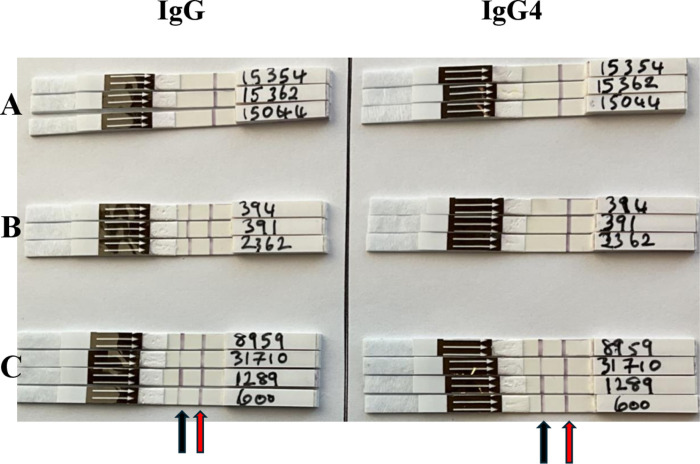
Strongyloidiasis is a serious public health issue affecting millions of people worldwide particularly in tropical and subtropical regions. The laboratory diagnosis of strongyloidiasis is often serologically based, typically by enzyme linked immunosorbent assays (ELISA). However, the use of these assays at the point of care requires significantly different approaches for serologic measurements. We sought to determine the diagnostic performance of 2 prototype lateral flow tests alongside the Strongy Detect ELISAs (IgG and IgG4) that uses a cocktail of 2 Ss-specific recombinant antigens, Ss-NIE and Ss-IR.
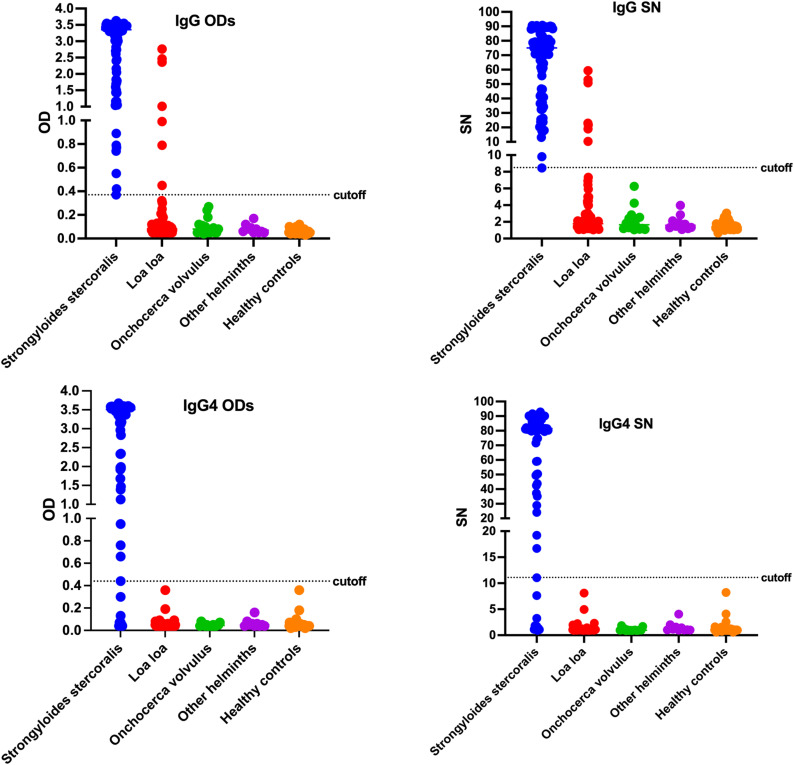
The diagnostic performance of the Rapid Diagnostic Tests (RDTs) and ELISAs was determined by using stored serum samples from 17 healthy volunteers, 77 individuals known to be stool positive for Strongyloides stercoralis (Ss), 44 Ss stool-negative individuals but positive for Loa loa (n=32), or other helminths (n=12) (hookworm infection, Schistosoma mansoni, or Wuchereria bancrofti). Concordance between the RDTs and ELISAs was calculated with the Cohen's kappa statistic (κ).
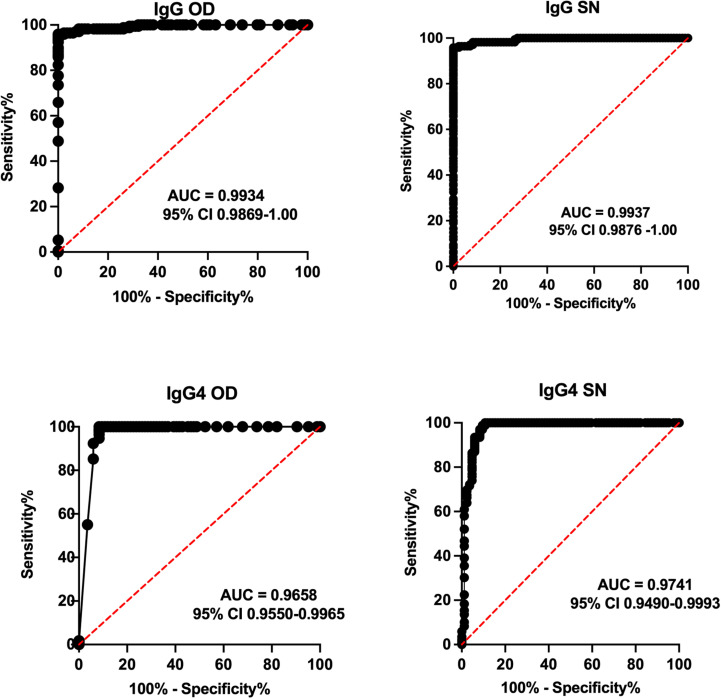
The sensitivity and specificity of the IgG RDT was 95% (95% CI; 87.84 to 98.64%) and 94% (95% CI; 84.99 to 98.30%) respectively. The IgG4 RDT showed a sensitivity of 86.5% (95% CI; 77.63 to 92.83%) with 100% (95% CI; 94.13 to 100%) specificity. The IgG-based ELISA showed 100% (95% CI; 95.6-100%) sensitivity and 96% specificity (95% CI; 91.7-98%), whereas the IgG4-based ELISA revealed a 90% (95% CI; 81-94.3%) sensitivity with 100% (95% CI; 97.8-100%) specificity. Concordance between the RDTs and the ELISAs was excellent with κ = 0.94 (95% CI; 0.88-1.0%) for the IgGs and κ = 0.89 (95% CI; 0.81-0.97%) for IgG4 assays.
Given the high degree of sensitivity and specificity of both the IgG- and IgG4-based RDT, either of these would be useful in assessing Ss seropositivity in population-based studies and in screening patients at the point of contact.
类圆线虫病是一个严重的公共卫生问题,影响着全球数百万人,特别是在热带和亚热带地区。类圆线虫病的实验室诊断通常基于血清学,典型方法是酶联免疫吸附测定(ELISA)。然而,在护理点使用这些测定法进行血清学测量需要显著不同的方法。我们试图确定两种原型侧流检测法与使用两种类圆线虫特异性重组抗原(Ss-NIE和Ss-IR)混合物的Strongy Detect ELISAs(IgG和IgG4)的诊断性能。
通过使用来自17名健康志愿者、77名已知粪便中类圆线虫(Ss)呈阳性的个体、44名粪便中类圆线虫呈阴性但罗阿丝虫呈阳性(n = 32)或其他蠕虫呈阳性(n = 12)(钩虫感染、曼氏血吸虫或班氏吴策线虫)的个体的储存血清样本,确定快速诊断检测(RDT)和ELISA的诊断性能。使用科恩kappa统计量(κ)计算RDT和ELISA之间的一致性。
IgG RDT的敏感性和特异性分别为95%(95%置信区间;87.84%至98.64%)和94%(95%置信区间;84.99%至98.30%)。IgG4 RDT的敏感性为86.5%(95%置信区间;77.63%至92.83%),特异性为100%(95%置信区间;94.13%至100%)。基于IgG的ELISA显示敏感性为100%(95%置信区间;95.6 - 100%),特异性为96%(95%置信区间;91.7 - 98%),而基于IgG4的ELISA显示敏感性为90%(95%置信区间;81 - 94.3%),特异性为100%(95%置信区间;97.8 - 100%)。RDT和ELISA之间的一致性非常好,IgG检测的κ = 0.94(95%置信区间;0.88 - 1.0%),IgG4检测的κ = 0.89(95%置信区间;0.81 - 0.97%)。
鉴于基于IgG和IgG4的RDT都具有高度的敏感性和特异性,这两种方法在基于人群的研究中评估类圆线虫血清阳性以及在接触点筛查患者时都将是有用的。