Department of Infectious Tropical Diseases and Microbiology, IRCCS Sacro Cuore Don Calabria Hospital, Verona, Negrar di Valpolicella, Italy.
University of Ferrara, Ferrara, Italy.
Parasit Vectors. 2021 Aug 18;14(1):412. doi: 10.1186/s13071-021-04916-x.
The diagnosis of strongyloidiasis is challenging. Serological tests are acknowledged to have high sensitivity, but issues due to cross-reactions with other parasites, native parasite antigen supply and intrinsic test variability do occur. Assays based on recombinant antigens could represent an improvement. The aim of this study was to assess the sensitivity and specificity of two novel immunoglobulin (Ig)G and IgG4 enzyme-linked immunosorbent assays (ELISAs) based on the recombinant antigens NIE/SsIR for the diagnosis of strongyloidiasis.
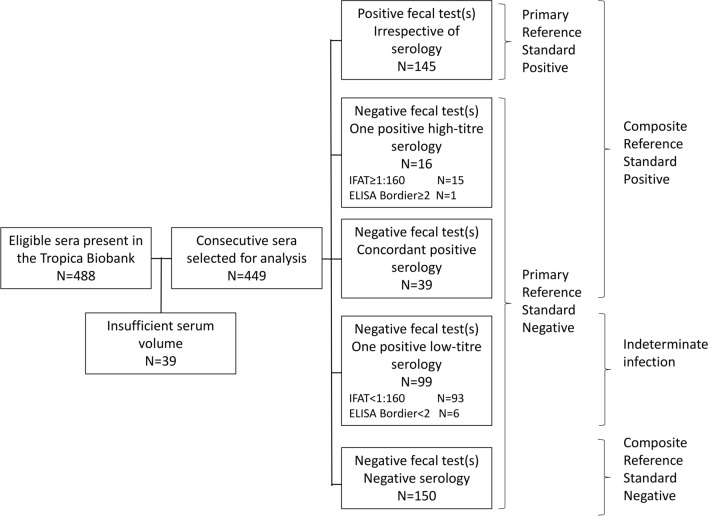
This was a retrospective diagnostic accuracy study. We included serum samples collected from immigrants from strongyloidiasis endemic areas for whom there was a matched result for Strongyloides stercoralis on agar plate culture and/or PCR assay, or a positive microscopy for S. stercoralis larvae. For the included samples, results were also available from an in-house indirect fluorescent antibody test (IFAT) and a commercial (Bordier ELISA; Bordier Affinity Products SA) ELISA. We excluded: (i) samples with insufficient serum volume; (ii) samples from patients treated with ivermectin in the previous 6 months; and (iii) sera from patients for whom only routine coproparasitology was performed after formol-ether concentration, if negative for S. stercoralis larvae. The performance of the novel assays was assessed against: (i) a primary reference standard, with samples classified as negative/positive on the basis of the results of fecal tests; (ii) a composite reference standard (CRS), which also considered patients to be positive who had concordant positive results for the IFAT and Bordier ELISA or with a single "high titer" positive result for the IFAT or Bordier ELISA. Samples with a single positive test, either for the IFAT or Bordier ELISA, at low titer, were considered to be "indeterminate," and analyses were carried out with and without their inclusion.
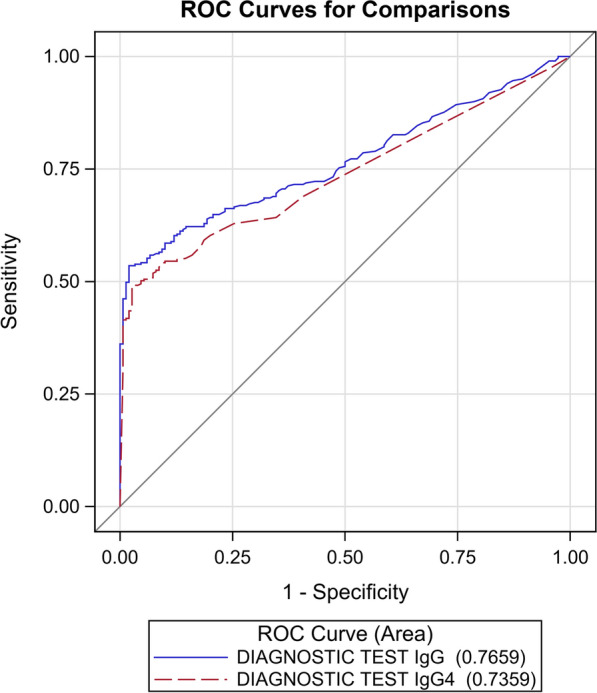
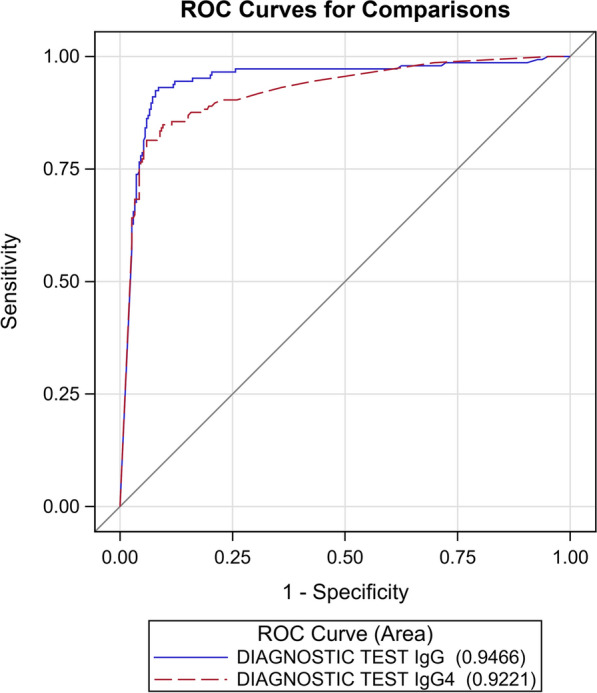
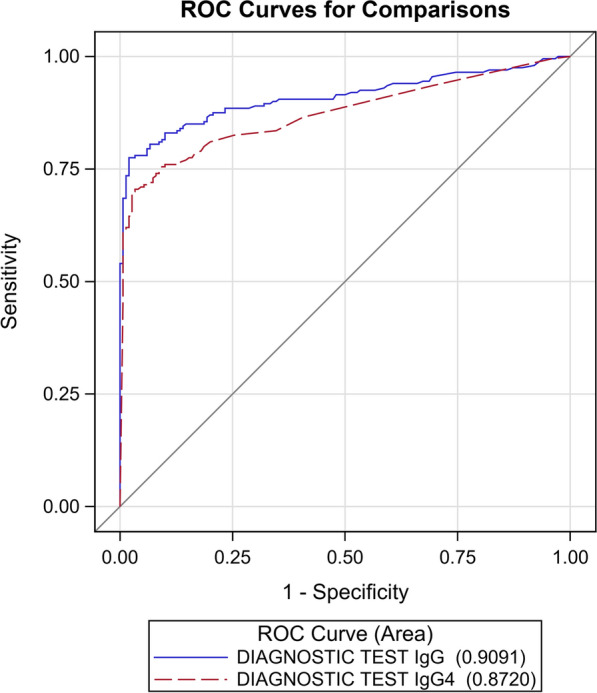
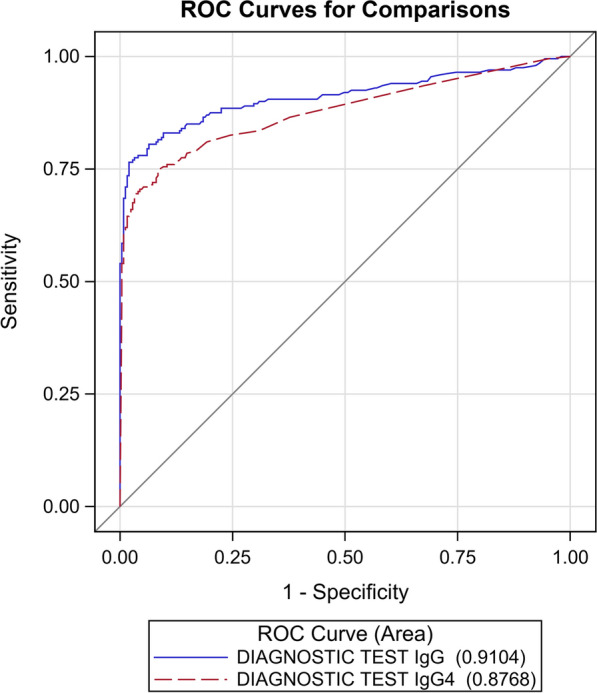
When assessed against the primary reference standard, the sensitivities of the IgG and IgG4 ELISAs were 92% (95% confidence interval [CI]: 88-97%) and 81% (95% CI: 74-87%), respectively, and the specificities were 91% (95% CI: 88-95%) and 94% (95% CI: 91-97%), respectively. When tested against the CRS, the IgG ELISA performed best, with 78% sensitivity (95% CI: 72-83%) and 98% specificity (95% CI: 96-100%), when a cut-off of 0.675 was applied and the indeterminate samples were excluded from the analysis.
The NIE-SsIR IgG ELISA demonstrated better accuracy than the IgG4 assay and was deemed promising particularly for serosurveys in endemic areas.
旋毛虫病的诊断具有挑战性。血清学检测被认为具有很高的敏感性,但确实存在与其他寄生虫交叉反应、固有检测变异性等问题,以及寄生虫抗原供应的问题。基于重组抗原的检测方法可能会有所改善。本研究旨在评估两种新型 IgG 和 IgG4 酶联免疫吸附试验(ELISA)基于重组抗原 NIE/SsIR 对旋毛虫病诊断的敏感性和特异性。
这是一项回顾性诊断准确性研究。我们纳入了来自旋毛虫病流行地区的移民血清样本,这些移民的琼脂平板培养和/或 PCR 检测结果与 Strongyloides stercoralis 相匹配,或粪便镜检幼虫阳性。对于纳入的样本,也可获得内部间接荧光抗体检测(IFAT)和商业(Bordier ELISA;Bordier Affinity Products SA)ELISA 的结果。我们排除了以下样本:(i)血清量不足的样本;(ii)在过去 6 个月内接受伊维菌素治疗的患者样本;(iii)仅进行福尔马林乙醚浓缩后常规粪便寄生虫学检查且粪便镜检幼虫阴性的患者血清。新型检测方法的性能是根据以下情况进行评估的:(i)初级参考标准,粪便检查结果为阴性/阳性;(ii)复合参考标准(CRS),IFAT 和 Bordier ELISA 结果一致或 IFAT 或 Bordier ELISA 单次“高滴度”阳性的患者也被认为是阳性。IFAT 或 Bordier ELISA 检测滴度较低的单次阳性检测结果被认为是“不确定”,并进行了包含和不包含这些结果的分析。
当与初级参考标准进行比较时,IgG 和 IgG4 ELISA 的敏感性分别为 92%(95%置信区间 [CI]:88-97%)和 81%(95% CI:74-87%),特异性分别为 91%(95% CI:88-95%)和 94%(95% CI:91-97%)。当与 CRS 进行测试时,IgG ELISA 的表现最佳,当应用 0.675 的截断值且排除不确定样本进行分析时,其敏感性为 78%(95% CI:72-83%),特异性为 98%(95% CI:96-100%)。
NIE-SsIR IgG ELISA 与 IgG4 检测相比具有更高的准确性,尤其适用于流行地区的血清学调查。