
司美格鲁肽副作用及安全性问题的在线信息:YouTube视频的混合方法研究
Online Information About Side Effects and Safety Concerns of Semaglutide: Mixed Methods Study of YouTube Videos.
作者信息
Yeung Andy Wai Kan, Hammerle Fabian Peter, Behrens Sybille, Matin Maima, Mickael Michel-Edwar, Litvinova Olena, Parvanov Emil D, Kletecka-Pulker Maria, Atanasov Atanas G
机构信息
Oral and Maxillofacial Radiology, Applied Oral Sciences and Community Dental Care, Faculty of Dentistry, The University of Hong Kong, Hong Kong, China.
Ludwig Boltzmann Institute Digital Health and Patient Safety, Medical University of Vienna, Vienna, Austria.
出版信息
JMIR Infodemiology. 2025 Apr 8;5:e59767. doi: 10.2196/59767.
BACKGROUND
Social media has been extensively used by the public to seek information and share views on health issues. Recently, the proper and off-label use of semaglutide drugs for weight loss has attracted huge media attention and led to temporary supply shortages.
OBJECTIVE
The aim of this study was to perform a content analysis on English YouTube (Google) videos related to semaglutide.
METHODS
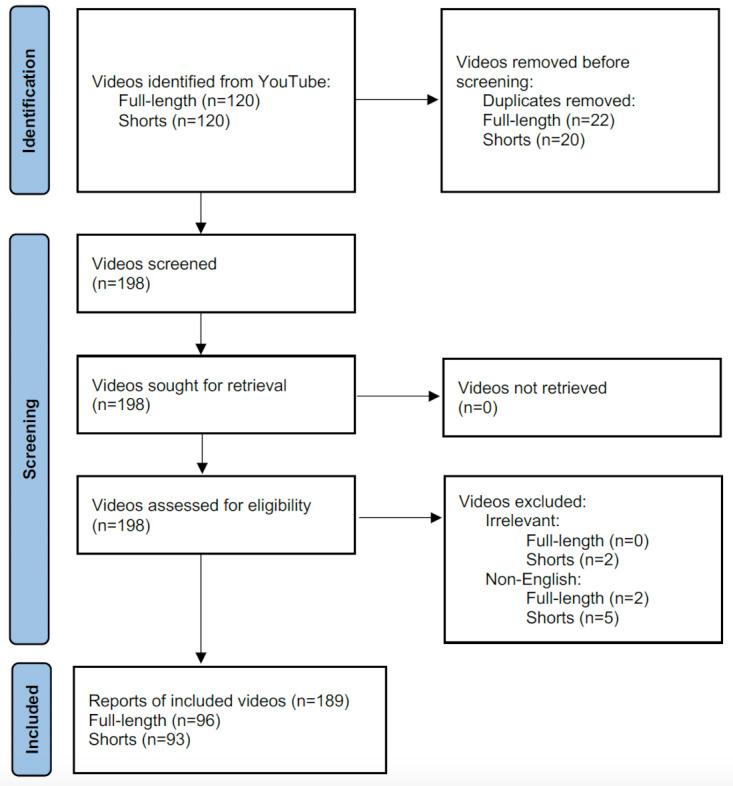
YouTube was searched with the words semaglutide, Ozempic, Wegovy, and Rybelsus. The first 30 full-length videos (videos without a time limit) and 30 shorts (videos that are no longer than 1 minute) resulting from each search word were recorded. After discounting duplicates resulting from multiple searches, a total of 96 full-length videos and 93 shorts were analyzed. Video content was evaluated by 3 tools, that is, a custom checklist, a Global Quality Score (GQS), and Modified DISCERN. Readability and sentiment of the transcripts were also assessed.
RESULTS
There was no significant difference in the mean number of views between full-length videos and shorts (mean 288,563.1, SD 513,598.3 vs mean 188,465.2, SD 780,376.2, P=.30). The former had better content quality in terms of GQS, Modified DISCERN, and the number of mentioned points from the custom checklist (all P<.001). The transcript readability of both types of videos was at a fairly easy level and mainly had a neutral tone. Full-length videos from health sources had a higher content quality in terms of GQS and Modified DISCERN (both P<.001) than their counterparts.
CONCLUSIONS
The analyzed videos lacked coverage of several important aspects, including the lack of long-term data, the persistence of side effects due to the long half-life of semaglutide, and the risk of counterfeit drugs. It is crucial for the public to be aware that videos cannot replace consultations with physicians.
背景
社交媒体已被公众广泛用于获取有关健康问题的信息并分享观点。最近,司美格鲁肽药物用于减肥的合理及超说明书用药引起了媒体的广泛关注,并导致了暂时的供应短缺。
目的
本研究旨在对与司美格鲁肽相关的英文YouTube(谷歌)视频进行内容分析。
方法
在YouTube上搜索司美格鲁肽、奥泽米皮克、韦戈维、瑞百安。记录每个搜索词产生的前30个全长视频(无时间限制的视频)和30个短视频(不超过1分钟的视频)。在剔除多次搜索产生的重复视频后,共分析了96个全长视频和93个短视频。视频内容由3种工具进行评估,即自定义检查表、全球质量评分(GQS)和改良版DISCERN。还评估了文字记录的可读性和情感倾向。
结果
全长视频和短视频的平均观看次数无显著差异(平均288,563.1,标准差513,598.3 vs平均188,465.2,标准差780,376.2,P = 0.30)。就GQS、改良版DISCERN和自定义检查表中提到的要点数量而言,前者的内容质量更好(均P < 0.001)。两种类型视频的文字记录可读性都处于相当容易的水平,且主要为中性语气。来自健康来源频道的全长视频在GQS和改良版DISCERN方面的内容质量高于其他来源的全长视频(均P < 0.001)。
结论
分析的视频缺乏对几个重要方面的报道,包括缺乏长期数据、司美格鲁肽半衰期长导致副作用持续存在以及假药风险。公众必须意识到视频不能替代与医生的咨询,这一点至关重要。


 Zotero 插件