Falcone Jerome I, Cleveland Kristan H, Kang Mingu, Odle Brianna J, Forbush Katherine A, Scott John D
Department of Pharmacology, University of Washington School of Medicine, Seattle, Washington, USA.
Department of Pharmacology, University of Washington School of Medicine, Seattle, Washington, USA.
J Biol Chem. 2025 Apr 6;301(5):108480. doi: 10.1016/j.jbc.2025.108480.
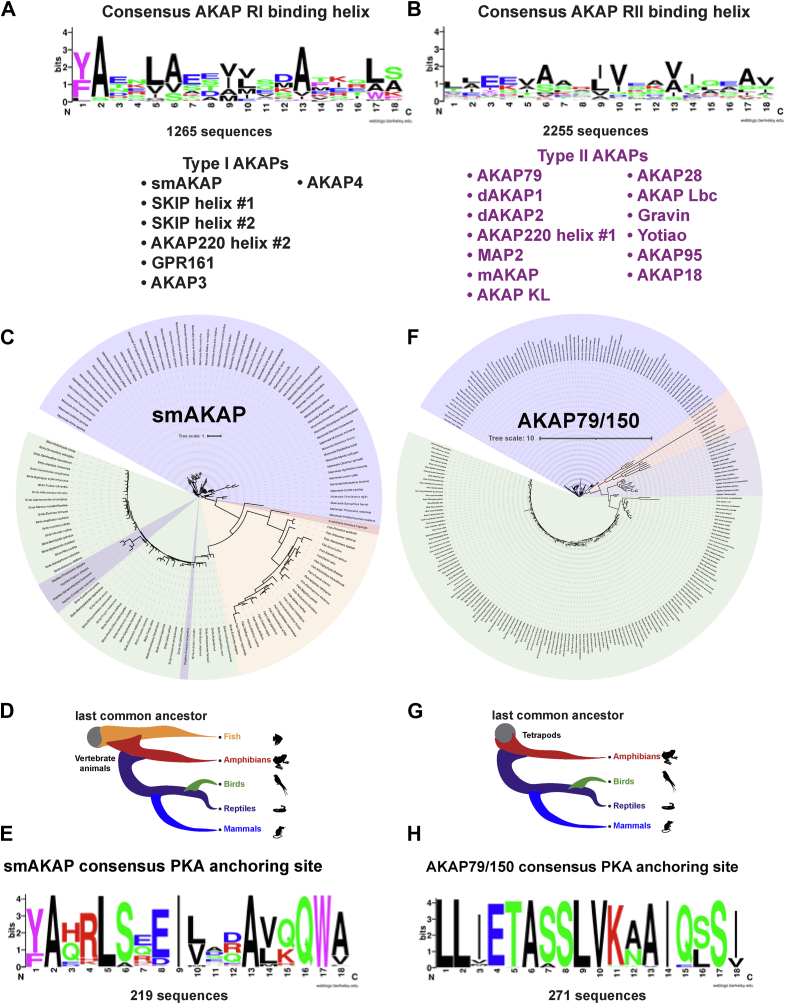
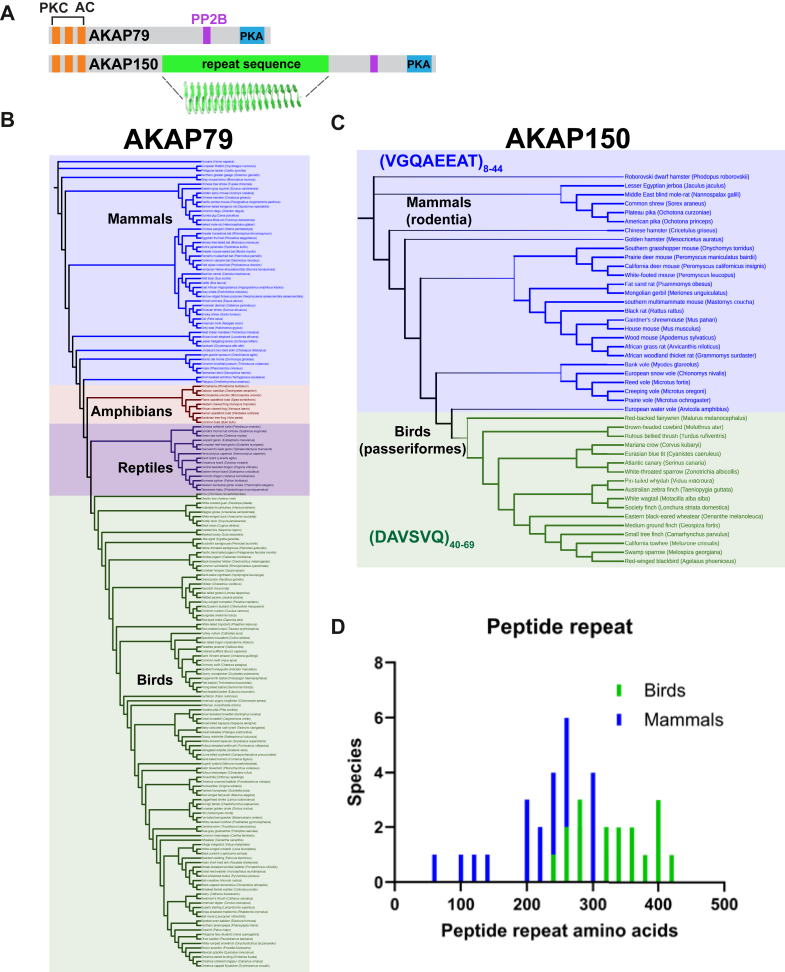
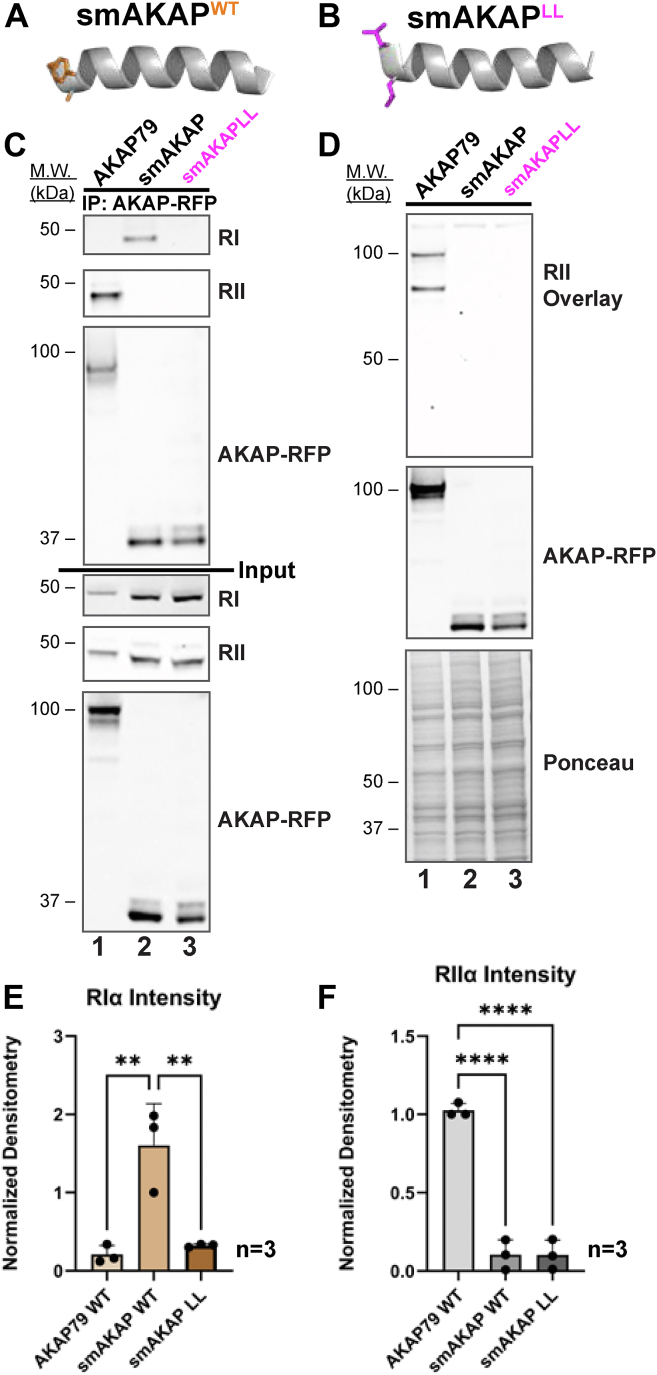
Cyclic AMP is a versatile signaling molecule utilized throughout the eukaryotic domain. A frequent use is to activate protein kinase A (PKA), a serine/threonine kinase that drives many physiological responses. Spatiotemporal organization of PKA occurs though association with A-kinase anchoring proteins (AKAPs). Sequence alignments and phylogenetic analyses trace the evolution of PKA regulatory (R) and catalytic (C) subunits and AKAPs from the emergence of metazoans. AKAPs that preferentially associate with the type I (RI) or type II (RII) regulatory subunits diverged at the advent of the vertebrate clade. Type I PKA anchoring proteins including smAKAP contain an FA motif at positions 1 and 2 of their amphipathic binding helices. Fluorescence recovery after photobleaching measurements indicate smAKAP preferentially associates with RI (T 1/2. 4.37 ± 1.2 s; n = 3) as compared to RII (T 1/2. 2.19 ± 0.5 s; n = 3). Parallel studies measured AKAP79 recovery half times of 8.74 ± 0.3 s (n = 3) for RI and 14.42 ± 2.1 s (n = 3) and for RII, respectively. Introduction of FA and AF motifs at either ends of the AKAP79 helix biases the full-length anchoring protein toward type I PKA signaling to reduce corticosterone release from adrenal cells by 61.5 ± 0.8% (n = 3). Conversely, substitution of the YA motif at the beginning of the smAKAP helix for a pair of leucine's abrogates RI anchoring. Thus, AKAPs have evolved from the base of the metazoan clade into specialized type I and type II PKA anchoring proteins.
环磷酸腺苷(cAMP)是一种在整个真核生物领域广泛使用的信号分子。其常见用途是激活蛋白激酶A(PKA),这是一种驱动多种生理反应的丝氨酸/苏氨酸激酶。PKA的时空组织通过与A激酶锚定蛋白(AKAPs)的结合而发生。序列比对和系统发育分析追踪了后生动物出现以来PKA调节(R)亚基和催化(C)亚基以及AKAPs的进化。在脊椎动物进化枝出现时,优先与I型(RI)或II型(RII)调节亚基结合的AKAPs出现了分化。包括小分子AKAP(smAKAP)在内的I型PKA锚定蛋白在其两亲性结合螺旋的第1和第2位含有一个FA基序。光漂白后荧光恢复测量表明,与RII(半衰期T1/2. 2.19±0.5秒;n = 3)相比,smAKAP优先与RI结合(半衰期T1/2. 4.37±1.2秒;n = 3)。平行研究测量了AKAP79与RI结合的恢复半衰期为8.74±0.3秒(n = 3),与RII结合的恢复半衰期分别为14.42±2.1秒(n = 3)。在AKAP79螺旋的任一端引入FA和AF基序会使全长锚定蛋白偏向I型PKA信号传导,从而使肾上腺细胞皮质酮释放减少61.5±0.8%(n = 3)。相反,将smAKAP螺旋开头的YA基序替换为一对亮氨酸会消除RI的锚定。因此,AKAPs已经从后生动物进化枝的基部演化为专门的I型和II型PKA锚定蛋白。