Wexler Lisa, White Lauren, Ginn Joel, Schmidt Tara, Rataj Suzanne, Wells Caroline C, Schultz Katie, Kapoulea Eleni A, McEachern Diane, Habecker Patrick, Laws Holly
Department of Social Work and Research Center for Group Dynamics, Institute for Social Research, University of Michigan, Ann Arbor, MI, 48104, USA.
School of Social Work, University of Washington, 4101 15th Ave NE, Seattle, WA, 98105, USA.
BMC Public Health. 2025 Apr 8;25(1):1323. doi: 10.1186/s12889-025-22465-1.
Suicide is a serious and growing health inequity for Alaska Native (AN) youth (ages 15-24), who experience suicide rates significantly higher than the general U.S. youth population. In under-served, remote AN communities, building on existing local and cultural resources can increase uptake of prevention behaviors like lethal means reduction, interpersonal support, and postvention by family members, workers and community members, which can be important for preventing suicide in places where mental health services are sparce. This study expands the variables we hypothesize as important for reducing suicide risk and supporting mental wellness. These variables are: (1) perceived suicide prevention self-efficacy, (2) perceived wellness self-efficacy, and (3) developing a 'community of practice' (CoP) for prevention/wellness work.
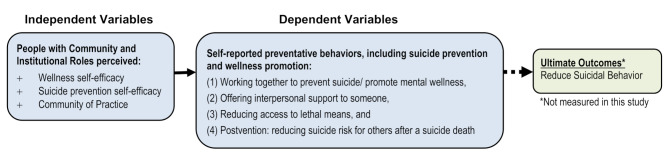
With a convenience sample (N = 398) of participants (ages 15+) in five remote AN communities, this study characterizes respondents' social roles: institutional role if they have a job that includes suicide prevention (e.g. teachers, community health workers) and community role if their primary role is based on family or community positioning (e.g. Elder, parent). The cross-sectional analysis then explores the relationship between respondents' wellness and prevention self-efficacy and CoP as predictors of their self-reported suicide prevention and wellness promotion behaviors: (1) working together with others (e.g. community initiatives), (2) offering interpersonal support to someone (3), reducing access to lethal means, and (4) reducing suicide risk for others after a suicide death in the community.
Community and institutional roles are vital, and analyses detected distinct patterns linking our dependent variables to different preventative behaviors. Findings associated wellness self-efficacy and CoP (but not prevention self-efficacy) with "working together" behaviors, wellness and prevention self-efficacy (but not CoP) with interpersonal supportive behaviors; both prevention self-efficacy and CoP with higher postvention behaviors. Only prevention self-efficacy was associated with lethal means reduction.
The study widens the scope of suicide prevention. Promising approaches to suicide prevention in rural low-resourced communities include: (1) engaging people in community and institutional roles (2), developing communities of practice for suicide prevention among different sectors of a community, and (3) broadening the scope of suicide prevention to include wellness promotion as well as suicide prevention.
自杀是阿拉斯加原住民(AN)青年(15 - 24岁)面临的一个严重且日益严重的健康不平等问题,他们的自杀率显著高于美国普通青年人群。在服务不足的偏远AN社区,利用现有的当地和文化资源可以增加预防行为的采用率,如减少致命手段的使用、人际支持以及家庭成员、工作者和社区成员的善后干预,这对于在心理健康服务匮乏的地方预防自杀可能很重要。本研究扩展了我们假设对降低自杀风险和支持心理健康至关重要的变量。这些变量包括:(1)感知到的自杀预防自我效能感,(2)感知到的健康自我效能感,以及(3)为预防/健康工作建立一个“实践社区”(CoP)。
本研究以五个偏远AN社区中15岁及以上的参与者(N = 398)为便利样本,对受访者的社会角色进行了特征描述:如果他们有一份包括自杀预防工作的职业(如教师、社区卫生工作者),则为机构角色;如果他们的主要角色基于家庭或社区定位(如长者、父母),则为社区角色。横断面分析随后探讨了受访者的健康和预防自我效能感与CoP之间的关系,将其作为自我报告的自杀预防和健康促进行为的预测因素:(1)与他人合作(如社区倡议),(2)向某人提供人际支持,(3)减少获取致命手段的机会,以及(4)在社区发生自杀死亡事件后降低他人的自杀风险。
社区和机构角色至关重要,分析发现了将我们的因变量与不同预防行为联系起来的不同模式。研究结果表明,健康自我效能感和CoP(但不是预防自我效能感)与“合作”行为相关,健康和预防自我效能感(但不是CoP)与人际支持行为相关;预防自我效能感和CoP都与更高的善后干预行为相关。只有预防自我效能感与减少致命手段的使用相关。
该研究拓宽了自杀预防的范围。在资源匮乏的农村社区,有前景的自杀预防方法包括:(1)让人们承担社区和机构角色,(2)在社区的不同部门中建立自杀预防实践社区,以及(3)拓宽自杀预防的范围,将健康促进以及自杀预防都包括在内。