Ni Yiyun, Liu Bin, Zhang Weizhen, Pang Yilin, Tian Yaling, Lv Qingsong, Shi Shengwen, Zheng Yang, Fan Huihui
The Central Hospital of Yongzhou, Yongzhou Clinical College, University of South China, Yongzhou, Hunan, China.
School of Laboratory Medicine and Life Sciences, Wenzhou Medical University, Wenzhou, Zhejiang, China.
Front Oncol. 2025 Mar 25;15:1533865. doi: 10.3389/fonc.2025.1533865. eCollection 2025.
Hepatocellular carcinoma (HCC) is the most prevalent liver cancer, with a 5-year survival rate below 20% and an average survival time of 3-6 months. Identifying new biomarkers is crucial for early diagnosis and prognosis. The function of PDZ domain protein 11 (PDZD11) in HCC remains unclear.
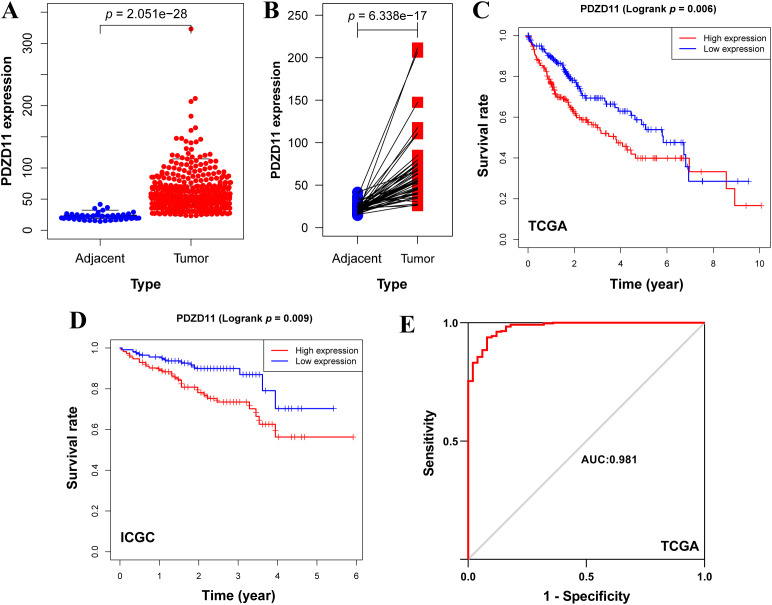
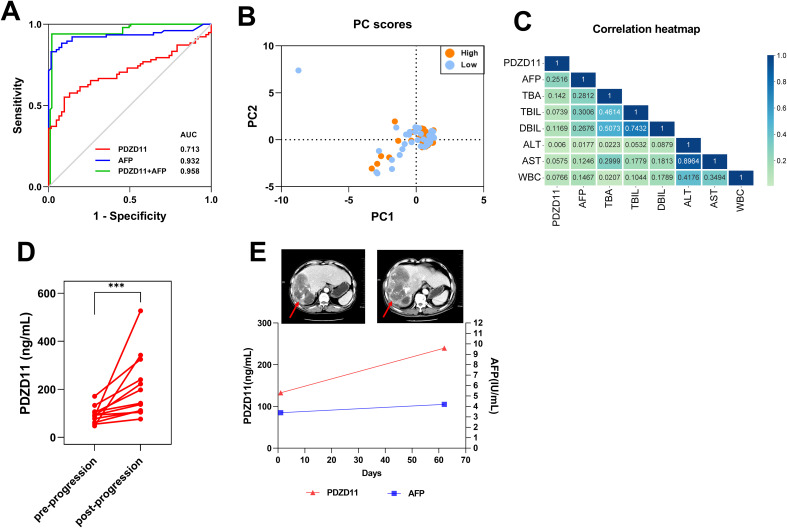
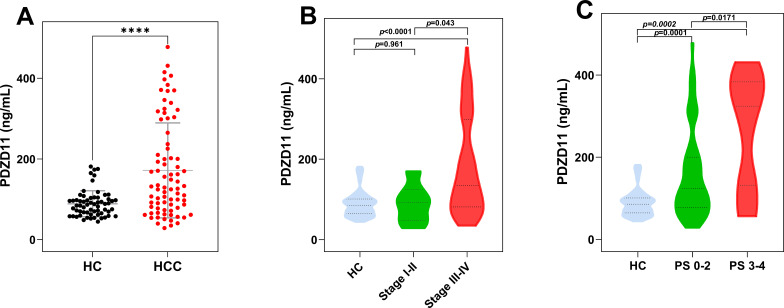
In this study, PDZD11 was investigated as a potential biomarker for HCC using bioinformatic analysis of the TCGA and ICGC datasets. Furthermore, we assessed the potential of serum PDZD11 as a clinical diagnostic marker by enrolling a cohort comprising 78 HCC patients and 62 healthy controls (HC) using the ELISA analysis and combining its expression with common tumor markers.
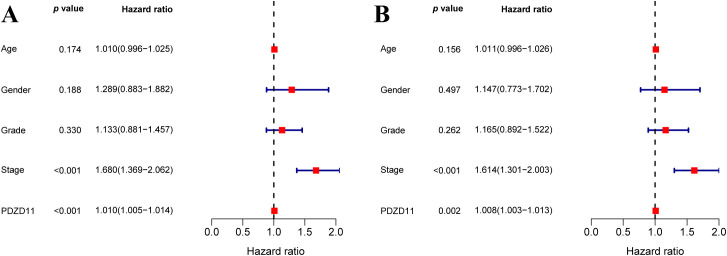
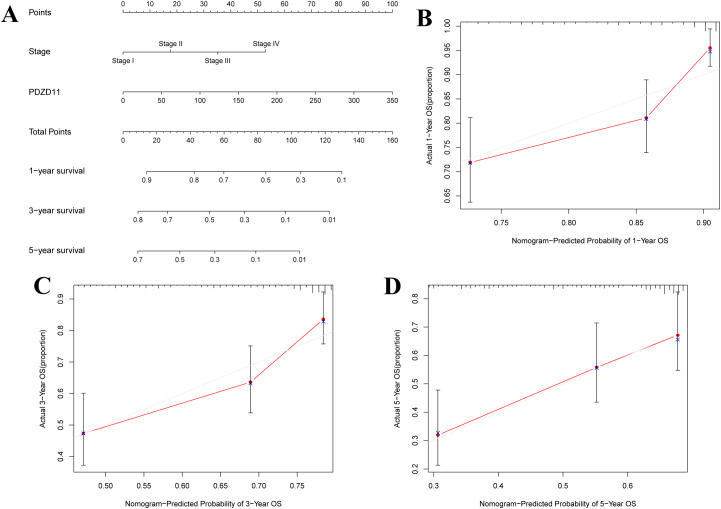
Our research found significantly higher PDZD11 mRNA expression in HCC tissues compared to tumor-adjacent tissues ( < 0.001), which was associated with lower overall survival (OS) rates ( < 0.01). Multivariate evaluation methods established PDZD11 as a standalone predictor of prognosis. A nomogram incorporating PDZD11 expression and clinicopathological factors predicted OS rates for HCC patients over various years. Patients with HCC exhibited notably elevated serum PDZD11 levels compared to HC, with these levels rising further in advanced disease stages and deteriorating performance status (PS). ROC analysis showed high diagnostic accuracy when PDZD11 is combined with AFP (AUC = 0.958).
PDZD11 is more sensitive than AFP in assessing HCC prognosis. In conclusion, PDZD11 is a promising supplementary biomarker for HCC diagnosis and prognosis alongside AFP.
肝细胞癌(HCC)是最常见的肝癌,5年生存率低于20%,平均生存时间为3至6个月。识别新的生物标志物对于早期诊断和预后至关重要。PDZ结构域蛋白11(PDZD11)在HCC中的功能尚不清楚。
在本研究中,通过对TCGA和ICGC数据集进行生物信息学分析,将PDZD11作为HCC的潜在生物标志物进行研究。此外,我们招募了一个由78例HCC患者和62例健康对照(HC)组成的队列,采用酶联免疫吸附测定(ELISA)分析并将其表达与常见肿瘤标志物相结合,评估血清PDZD11作为临床诊断标志物的潜力。
我们的研究发现,与癌旁组织相比,HCC组织中PDZD11 mRNA表达显著更高(<0.001),这与较低的总生存率(OS)相关(<0.01)。多变量评估方法将PDZD11确立为预后的独立预测因子。一个纳入PDZD11表达和临床病理因素的列线图预测了不同年份HCC患者的OS率。与HC相比,HCC患者的血清PDZD11水平显著升高,在疾病晚期和体能状态(PS)恶化时,这些水平进一步升高。ROC分析表明,当PDZD11与甲胎蛋白(AFP)联合使用时具有较高的诊断准确性(曲线下面积[AUC]=0.958)。
在评估HCC预后方面,PDZD11比AFP更敏感。总之,PDZD11是一种有前景的辅助生物标志物,可与AFP一起用于HCC的诊断和预后评估。