Wang Kaixuan, Chen Shuaiqi, Wang Mengmeng, Han Qingjiang, Hou Yuchuan, Wang Xiaohui
Department of Urology Surgery, The First Affiliated Hospital and College of Clinical Medicine of Henan University of Science and Technology, Luoyang, China.
Department of Urology, The First Affiliated Hospital of Xinxiang Medical University, Xinxiang, China.
Front Nutr. 2025 Mar 25;12:1555159. doi: 10.3389/fnut.2025.1555159. eCollection 2025.
Dietary risks are increasingly reported as a cause of chronic kidney disease (CKD). However, the trends in the burden of CKD attributable to dietary risks have yet to be fully elucidated.
This study extracted two major indicators related to CKD caused by dietary risks from the Global Burden of Disease (GBD) database for the years 1990 to 2021, including deaths and disability-adjusted life years (DALYs). It used estimated annual percentage change (EAPC) and percentage change to assess the trends in the burden of CKD caused by dietary risks. The relationship between Socio-demographic Index (SDI) and disease burden was also further analyzed. Additionally, we utilized the contemporary age-period-cohort model from NORDPRED to project future burden of CKD attributable to dietary risks.
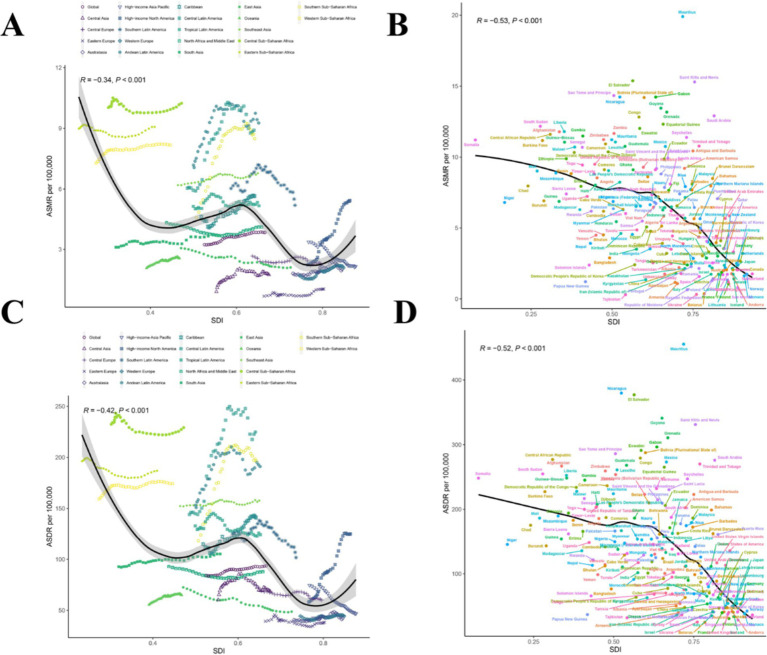
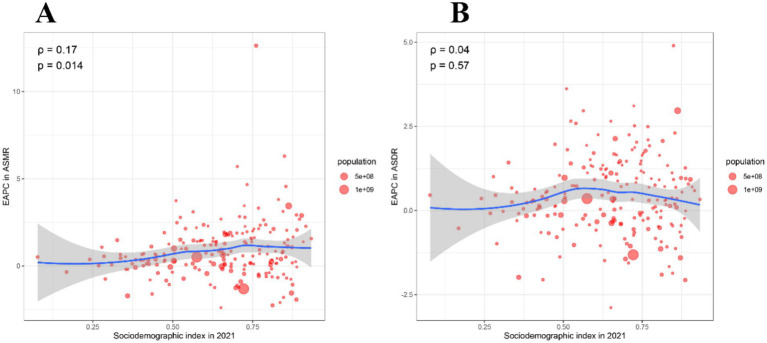
In 2021, globally, the number of deaths due to CKD caused by dietary risks was 317,010, and the number of DALYs was 7,971,281, approximately 2-3 times that of 1990, and it was expected to continue to rise before 2040. The global death rates and DALY rates of CKD related to dietary risks had increased, with EAPCs of 0.63 (95% CI: 0.57 to 0.69) and 0.39 (95% CI: 0.35 to 0.42), respectively. From a gender perspective, men were more likely to suffer from CKD due to dietary risks. From an age pattern perspective, in 2021, the number of deaths due to CKD caused by dietary risks peaked among men aged 70-74 and women aged 85-89. Additionally, the highest number of DALYs due to CKD caused by dietary risks was observed among men and women aged 65-69. In terms of socioeconomic factors, from 1990 to 2021, as the SDI increased, the age-standardized death rates and DALY rates due to CKD caused by dietary risks generally decreased. Among the seven dietary habits related to dietary risks, low vegetable intake, low fruit intake, and high sodium intake had the greatest impact.
In summary, over the past 32 years, the burden of CKD attributable to dietary risks has rapidly increased globally, and it is expected to continue rising until 2040. Therefore, interdisciplinary actions involving education, policy, and healthcare should be taken to mitigate this growing trend.
饮食风险日益被报道为慢性肾脏病(CKD)的一个病因。然而,归因于饮食风险的CKD负担趋势尚未完全阐明。
本研究从1990年至2021年的全球疾病负担(GBD)数据库中提取了与饮食风险导致的CKD相关的两个主要指标,包括死亡人数和伤残调整生命年(DALYs)。它使用估计的年度百分比变化(EAPC)和百分比变化来评估饮食风险导致的CKD负担趋势。还进一步分析了社会人口指数(SDI)与疾病负担之间的关系。此外,我们利用NORDPRED的当代年龄-时期-队列模型来预测未来归因于饮食风险的CKD负担。
2021年,全球范围内,饮食风险导致的CKD死亡人数为317,010人,DALYs数为7,971,281,约为1990年的2至3倍,预计在2040年前将继续上升。与饮食风险相关的CKD全球死亡率和DALY率有所上升,EAPC分别为0.63(95%CI:0.57至0.69)和0.39(95%CI:0.35至0.42)。从性别角度来看,男性因饮食风险患CKD的可能性更大。从年龄模式来看,2021年,饮食风险导致的CKD死亡人数在70 - 74岁男性和85 - 89岁女性中达到峰值。此外,饮食风险导致的CKD的DALYs数在65 - 69岁男性和女性中最高。在社会经济因素方面,从1990年到2021年,随着SDI的增加,饮食风险导致的CKD的年龄标准化死亡率和DALY率总体上有所下降。在与饮食风险相关的七种饮食习惯中,蔬菜摄入量低、水果摄入量低和钠摄入量高的影响最大。
总之,在过去32年中,全球范围内归因于饮食风险的CKD负担迅速增加,预计到2040年将继续上升。因此,应采取涉及教育、政策和医疗保健的跨学科行动来缓解这一增长趋势。