Lee Meng-Lin, Kao Yi-Wei, Yang Yu-Ting, Chen Ming-Chih, Shia Ben-Chang, Huang Shih-Yu, Lee Pei-Shyuan, Chen Thay-Hsiung, Huang Yan-Jiun, Chiu Wei-Che
Division of Cardiovascular Surgery, Department of Surgery, Cathay General Hospital, Taipei, 10630, Taiwan.
School of Medicine, National Tsing Hua University, Hsinchu, 300044, Taiwan.
Int J Colorectal Dis. 2025 Apr 11;40(1):91. doi: 10.1007/s00384-025-04889-8.
Hemorrhoidal disease (HD) and varicose veins (VV) are both common diseases. The aim was to investigate the association between them.
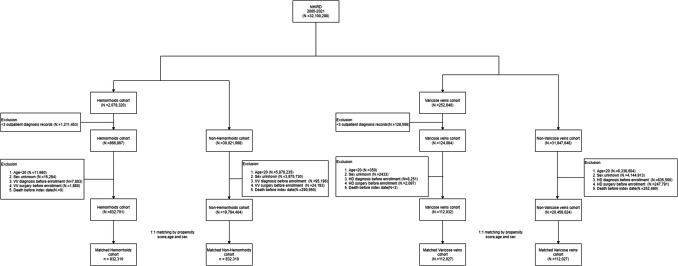
A nationwide cohort study was conducted using the Taiwan National Health Insurance Research Database (NHIRD) from 2005 to 2021, which included information of over 31 million beneficiaries. To assess the risk of developing VV among HD patients, records of 832,310 patients with HD diagnoses (the HD cohort) and those of propensity score-matched patients without HD diagnoses (the non-HD cohort) were identified and compared. Hazard ratios (HRs) and 95% confidence intervals (CIs) derived from the Cox proportional hazards model were used to estimate the association risks. Similarly, an opposite direction was approached using records of 112,027 patients with VV diagnoses (the VV cohort) to assess the risk of developing HD among VV patients.
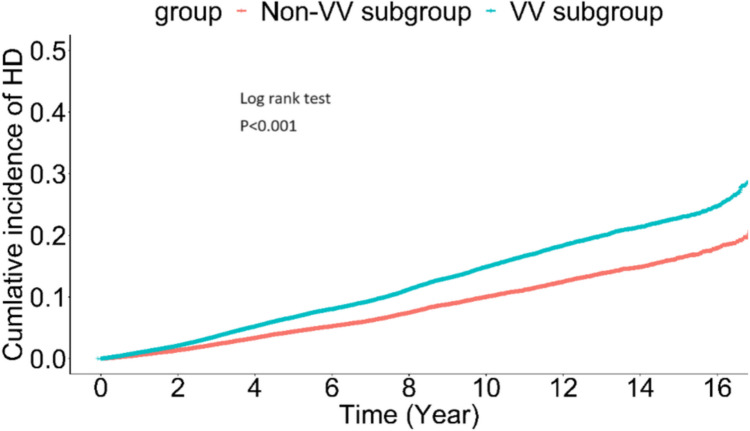
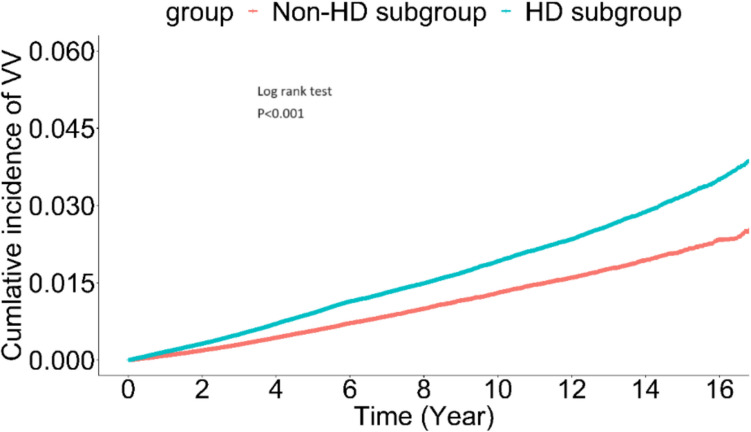
HD was associated with an increased risk of VV (adjusted HR, 1.52; 95% CI: 1.47-1.57). Similarly, VV were associated with an increased risk of HD (adjusted HR, 1.50; 95% CI: 1.45-1.55). The associations between the two diseases were evident in both sexes and all age groups. Patients with comorbid HD and VV had higher incidences of mitral valve regurgitation (P < 0.001), hernia (P < 0.001), varicocele (P = 0.008), and mortality (P = 0.006).
This study revealed a significant bidirectional association between HD and VV. It is recommended that physicians be mindful of either condition in patients already diagnosed with the other, as their coexistence could imply the potential for additional associated connective tissue diseases and adverse long-term outcomes.
痔病(HD)和静脉曲张(VV)都是常见疾病。本研究旨在探讨它们之间的关联。
利用2005年至2021年的台湾全民健康保险研究数据库(NHIRD)进行了一项全国性队列研究,该数据库包含超过3100万受益人的信息。为评估HD患者发生VV的风险,识别并比较了832310例HD诊断患者(HD队列)和倾向评分匹配的非HD诊断患者(非HD队列)的记录。采用Cox比例风险模型得出的风险比(HR)和95%置信区间(CI)来估计关联风险。同样,以相反方向进行研究,利用112027例VV诊断患者(VV队列)的记录来评估VV患者发生HD的风险。
HD与VV风险增加相关(调整后HR为1.52;95%CI:1.47 - 1.57)。同样,VV与HD风险增加相关(调整后HR为1.50;95%CI:1.45 - 1.55)。两种疾病之间的关联在男女及所有年龄组中均明显。HD和VV合并存在的患者二尖瓣反流(P < 0.001)、疝气(P < 0.001)、精索静脉曲张(P = 0.008)和死亡率(P = 0.006)的发生率更高。
本研究揭示了HD和VV之间存在显著的双向关联。建议医生对已诊断患有其中一种疾病的患者留意另一种疾病情况,因为它们的共存可能意味着存在其他相关结缔组织疾病和不良长期预后的可能性。