Lashaki Reza Ahmadi, Raeisi Zahra, Razavi Nasim, Goodarzi Mehdi, Najafzadeh Hossein
Department of Computer Engineering, Faculty of Electrical and Computer Engineering, University of Tabriz, Tabriz, Iran.
Department of Computer Science, University of Fairleigh Dickinson, Vancouver Campus, Vancouver, Canada.
BMC Oral Health. 2025 Apr 11;25(1):535. doi: 10.1186/s12903-025-05704-0.
This study evaluates the performance of various classifiers and pre-trained models for dental implant state classification using preprocessed radiography images with masks.
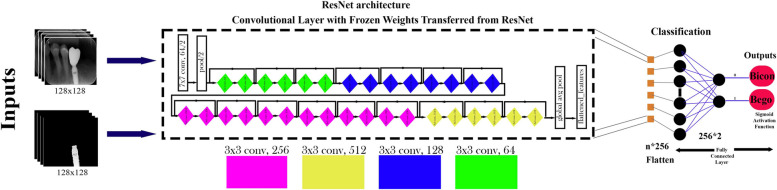
A dataset of 511 periapical images, including 275 for Bicon, 70 for Bego, and 166 for ITI implants, was expanded to 5110 images using data augmentation techniques such as rotation, flipping, and scaling. Preprocessing included resizing, sharpening, noise reduction, CLAHE-based contrast enhancement, implant-specific masking, and normalization. Classifiers including Convolutional Neural Networks (CNN), Convolutional Support Vector Machine (CSVM), Convolutional Decision Tree (CDT), and Convolutional Random Forest (CRF) were employed. Pre-trained models such as VGG16, ResNet50, and Xception enhanced feature extraction. Model performance was assessed using accuracy, precision, recall, F1 score, and ROC AUC, with fivefold cross-validation ensuring robustness.
CRF achieved the highest performance for ITI with Bego implants, with accuracy of 0.8966, precision of 0.9364, recall of 0.9253, F1 score of 0.9304, and ROC AUC of 0.9351. CNN delivered the best results for Bicon with Bego implants, achieving 0.9533 accuracy. Among pre-trained models, VGG16 with preprocessed data achieved superior results for Bicon vs. ITI classification, with 0.9865 accuracy and 0.9877 ROC AUC. Data augmentation and preprocessing significantly improved classifier performance.
Preprocessing steps, coupled with data augmentation, enhanced classification performance, ensuring robustness across models. CRF and CNN were the top-performing classifiers, with VGG16 excelling among pre-trained models. These results highlight the importance of data augmentation and preprocessing in improving dental implant classification accuracy.
本研究使用带有掩码的预处理X线影像评估各种分类器和预训练模型在牙种植体状态分类方面的性能。
一个包含511张根尖片图像的数据集,其中275张为Bicon种植体的图像,70张为Bego种植体的图像,166张为ITI种植体的图像,通过旋转、翻转和缩放等数据增强技术将其扩展到5110张图像。预处理包括调整大小、锐化、降噪、基于对比度受限自适应直方图均衡化(CLAHE)的对比度增强、特定种植体的掩码处理和归一化。使用的分类器包括卷积神经网络(CNN)、卷积支持向量机(CSVM)、卷积决策树(CDT)和卷积随机森林(CRF)。VGG16、ResNet50和Xception等预训练模型用于增强特征提取。使用准确率、精确率、召回率、F1分数和ROC曲线下面积(ROC AUC)评估模型性能,并采用五折交叉验证以确保稳健性。
对于ITI与Bego种植体,CRF表现最佳,准确率为0.8966,精确率为0.9364,召回率为0.9253,F1分数为0.9304,ROC AUC为0.9351。对于Bicon与Bego种植体,CNN取得了最佳结果,准确率达到0.9533。在预训练模型中,使用预处理数据的VGG16在Bicon与ITI分类方面取得了更好的结果,准确率为0.9865,ROC AUC为0.9877。数据增强和预处理显著提高了分类器的性能。
预处理步骤与数据增强相结合,提高了分类性能,确保了各模型的稳健性。CRF和CNN是表现最佳的分类器,VGG16在预训练模型中表现出色。这些结果凸显了数据增强和预处理在提高牙种植体分类准确性方面的重要性。