Quaranta Michela, Laios Alexandros, Rogers Charlie, Mavromatidou Anastasia Ioanna, Thangavelu Amudha, Theophilou Georgios, Nugent David, DeJong Diederick, Kalampokis Evangelos
Department of Gynaecologic Oncology, ESGO Centre of Excellence for Ovarian Cancer Surgery, St James's University Hospital, Leeds LS9 7TF, UK.
Information Systems Lab, Department of Business Administration, University of Macedonia, 54636 Thessaloniki, Greece.
J Clin Med. 2025 Mar 25;14(7):2223. doi: 10.3390/jcm14072223.
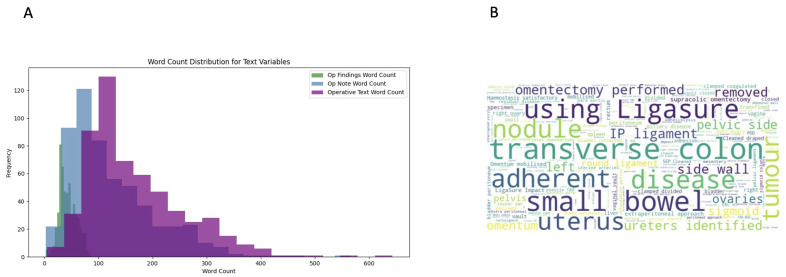
The advancement of natural language processing (NLP) technologies has transformed various sectors. However, their application in the healthcare domain, particularly for analysing clinical notes, remains underdeveloped. We investigated the use of deep neural networks, specifically transformer-based models, to predict intraoperative and post-operative outcomes related to advanced-stage epithelial ovarian cancer cytoreduction (aEOC) using unstructured surgical notes. We evaluated the performance of RoBERTa, a general-purpose language model, and GatorTron, a domain-specific model, across eight binary classification tasks using the same dataset. The dataset consisted of 560 surgical records from patients with aEOC who underwent cytoreductive surgery at a tertiary UK reference centre. Predictive outcomes were converted into binary features to facilitate classification tasks. To enhance the contextual information available to the models, textual data from "operative findings" and "operative notes" were concatenated. Our findings highlight the tangible benefits of employing domain-specific language models for clinical text analysis. GatorTron generally outperformed RoBERTa across most predictive tasks, underscoring the advantages of domain-specific pretraining for understanding medical terminology and context. Both models struggled to predict certain outcomes, particularly those involving post-operative events like major complications and length of hospital stay, despite adjustments in hyperparameters and training strategies. This limitation suggests that operative text alone may not sufficiently capture the complexities of post-operative recovery. These findings have valuable implications for developing medical AI systems to improve the delivery of modern aEOC healthcare.
自然语言处理(NLP)技术的进步已经改变了各个领域。然而,它们在医疗保健领域的应用,特别是在分析临床记录方面,仍然不够发达。我们研究了使用深度神经网络,特别是基于Transformer的模型,通过非结构化手术记录来预测与晚期上皮性卵巢癌细胞减灭术(aEOC)相关的术中及术后结果。我们使用相同的数据集,在八个二分类任务中评估了通用语言模型RoBERTa和领域特定模型GatorTron的性能。该数据集由560份来自在英国一家三级参考中心接受细胞减灭术的aEOC患者的手术记录组成。将预测结果转换为二元特征以方便分类任务。为了增强模型可用的上下文信息,将“手术发现”和“手术记录”中的文本数据进行了拼接。我们的研究结果突出了采用领域特定语言模型进行临床文本分析的切实好处。在大多数预测任务中,GatorTron通常优于RoBERTa,这凸显了领域特定预训练在理解医学术语和上下文方面 的优势。尽管对超参数和训练策略进行了调整,但两个模型在预测某些结果时都遇到了困难,特别是那些涉及术后事件(如重大并发症和住院时间)的结果。这一局限性表明,仅手术文本可能无法充分捕捉术后恢复的复杂性。这些发现对于开发医疗人工智能系统以改善现代aEOC医疗保健的提供具有宝贵的意义。