Choi Jin-Won, Byeon Seon-Mi, Lee Da-Hyun, Yun Pil-Young, Ku Jeong-Kui
Department of Oral and Maxillofacial Surgery, Section of Dentistry, Seoul National University Bundang Hospital, Seongnam 13620, Republic of Korea.
Department of Dental Biomaterials, Institute of Biodegradable Materials and Oral Bioscience, School of Dentistry, Jeonbuk National University, Jeonju 54907, Republic of Korea.
J Clin Med. 2025 Apr 2;14(7):2429. doi: 10.3390/jcm14072429.
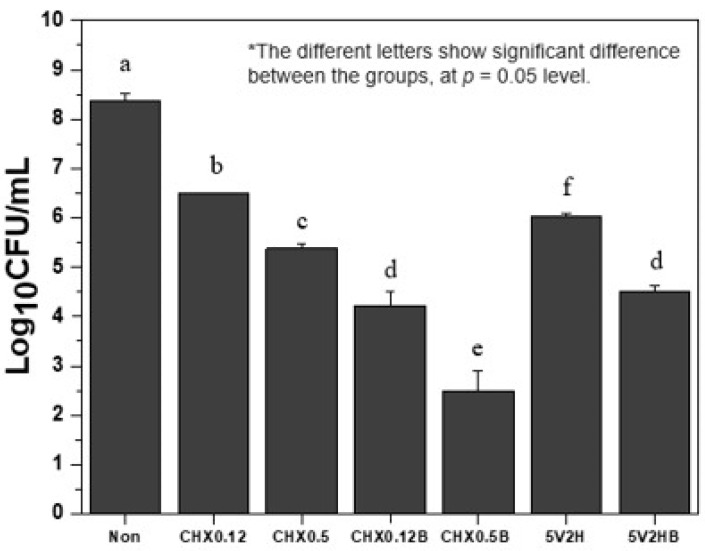
: Oral health is critical for overall health, particularly in hospitalized patients whose weakened physical state can lead to oral changes, such as dry mouth and gingivitis due to anxiety and stress. Neglected oral hygiene can lead to infections and systemic complications. This study aims to evaluate the antibacterial efficacy of low-frequency square-wave positive voltage electrical stimulation compared to chlorhexidine and to assess its potential as a next-generation solution for preventing hospital-acquired infections. : Sixty-three tooth specimens were randomly assigned to seven groups, including various concentrations of chlorhexidine and electrical stimulation with or without brushing. Biofilm formation was induced using saliva from healthy donors and standard strains of Streptococcus mutans and Aggregatibactor actinomycetemcomitans. Bacterial colony-forming units (CFU) and absorbance changes were measured post-treatment. : Significant reductions in CFU counts were observed in both the chlorhexidine and electrical stimulation groups compared to the control, with the 5V2H group showing superior antibacterial efficacy over 0.12% chlorhexidine. Chlorhexidine-treated specimens demonstrated a dose-dependent response and minimal bacterial presence, while electrical stimulation showed effectiveness but with re-growth observed after 4 h. Scanning electron microscopy revealed substantial biofilm on untreated and electrically stimulated specimens, whereas chlorhexidine-treated specimens exhibited minimal bacterial presence. : Intermittent electrical stimulation shows promise as an alternative to chlorhexidine for oral hygiene management in critical care settings, though an optimization of electrical parameters is necessary for sustained effects. This approach could reduce hospital-acquired infections by providing an effective, non-chemical method for maintaining oral hygiene.
口腔健康对整体健康至关重要,尤其是在住院患者中,他们虚弱的身体状态可能导致口腔变化,如因焦虑和压力引起的口干和牙龈炎。忽视口腔卫生会导致感染和全身并发症。本研究旨在评估低频方波正电压电刺激与氯己定相比的抗菌效果,并评估其作为预防医院获得性感染的下一代解决方案的潜力。:63颗牙齿标本被随机分为7组,包括不同浓度的氯己定以及有无刷牙的电刺激组。使用健康供体的唾液以及变形链球菌和伴放线聚集杆菌的标准菌株诱导生物膜形成。治疗后测量细菌菌落形成单位(CFU)和吸光度变化。:与对照组相比,氯己定组和电刺激组的CFU计数均显著降低,其中5V2H组显示出优于0.12%氯己定的抗菌效果。氯己定处理的标本呈现出剂量依赖性反应且细菌存在极少,而电刺激显示出有效性,但4小时后观察到有再生长现象。扫描电子显微镜显示未处理和电刺激的标本上有大量生物膜,而氯己定处理的标本上细菌存在极少。:间歇性电刺激有望作为氯己定在重症监护环境中进行口腔卫生管理的替代方法,不过为了获得持续效果,有必要优化电参数。这种方法可以通过提供一种有效的非化学方法来维持口腔卫生,从而减少医院获得性感染。