Xavier Salomé M, Iyer Srividya N
Department of Psychiatry, McGill University, Montreal, Canada.
Prevention and Early Intervention Program for Psychosis, Douglas Mental Health University Institute, Montreal, Canada.
Transcult Psychiatry. 2025 Feb;62(1):11-32. doi: 10.1177/13634615251326020. Epub 2025 Apr 13.
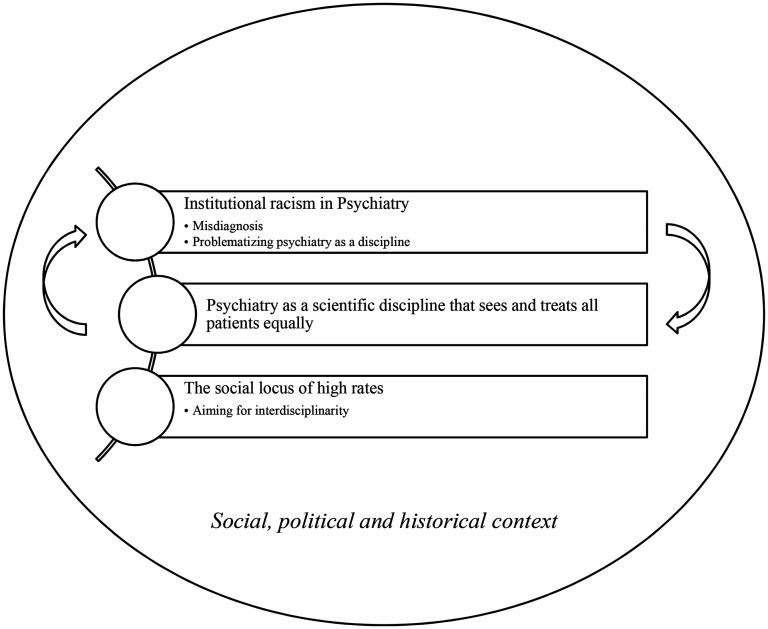
A growing number of studies suggest that migrant and ethnic minority populations are at higher risk for being diagnosed with psychosis. However, the reasons why have been disputed. This study aims to explore different interpretations of the observed higher rates of psychosis diagnosis among immigrants and ethnic minorities in some parts of the world. We sought to examine these interpretations through a critical lens, acknowledging the social underpinnings of discourses and their power to shape real-world practices. Peer-reviewed editorials, commentaries and letters regarding the topics of interest were retrieved from database searches and subjected to a pattern-based critical discourse analysis. Across a 30-year span of literature, conceptualizations and explanations of higher psychosis rates amongst migrant and minoritized populations evolved in relation to the larger social context, at times opposing one another. Three discursive themes were identified, reflecting intersecting explanations: institutional racism in psychiatry; psychiatry as a scientific discipline that sees and treats all patients equally; and the social locus of high rates. Tensions surrounding psychiatry as a field, including issues of evidence, biological reductionism, and the conceptualization of psychiatric nosological categories have played out within the evolution of this discourse. Exploring how discursive constructions in relation to psychosis and minoritization have been shaped by historical and social factors, we consider the role of local and global dynamics of social power in favouring one explanatory model over another and how these may have affected efforts to prevent and better treat psychosis amongst immigrant and minoritized groups.
越来越多的研究表明,移民和少数族裔人群被诊断为精神病的风险更高。然而,其原因一直存在争议。本研究旨在探讨对世界某些地区移民和少数族裔中观察到的较高精神病诊断率的不同解读。我们试图通过批判性视角审视这些解读,承认话语的社会基础及其塑造现实世界实践的力量。通过数据库搜索检索了关于感兴趣主题的同行评审社论、评论和信件,并对其进行基于模式的批判性话语分析。在30年的文献跨度中,关于移民和少数族裔人群中较高精神病发病率的概念化和解释随着更大的社会背景而演变,有时相互对立。确定了三个话语主题,反映了相互交织的解释:精神病学中的制度性种族主义;作为一门科学学科的精神病学平等看待和治疗所有患者;以及高发病率的社会根源。围绕精神病学这一领域的紧张关系,包括证据问题、生物还原论以及精神病学疾病分类的概念化,在这一话语的演变过程中一直存在。通过探究与精神病和少数族裔化相关的话语建构是如何受到历史和社会因素影响的,我们考虑了社会权力的地方和全球动态在支持一种解释模型而非另一种解释模型方面所起的作用,以及这些作用可能如何影响预防和更好地治疗移民和少数族裔群体中的精神病的努力。