School of Psychology, Bangor University, UK.
North Wales Clinical Psychology Programme, School of Psychology, Bangor University; and Betsi Cadwaladr University Health Board, Bangor, UK.
Br J Psychiatry. 2021 Dec;219(6):632-643. doi: 10.1192/bjp.2021.96.
An 'ethnic' or 'group' density effect in psychosis has been observed, whereby the risk of psychosis in minority group individuals is inversely related to neighbourhood-level proportions of others belonging to the same group. However, there is conflicting evidence over whether this effect differs between minority groups and limited investigation into other moderators.
To conduct a comprehensive systematic review and meta-analysis of the group density effect in psychosis and examine moderators.
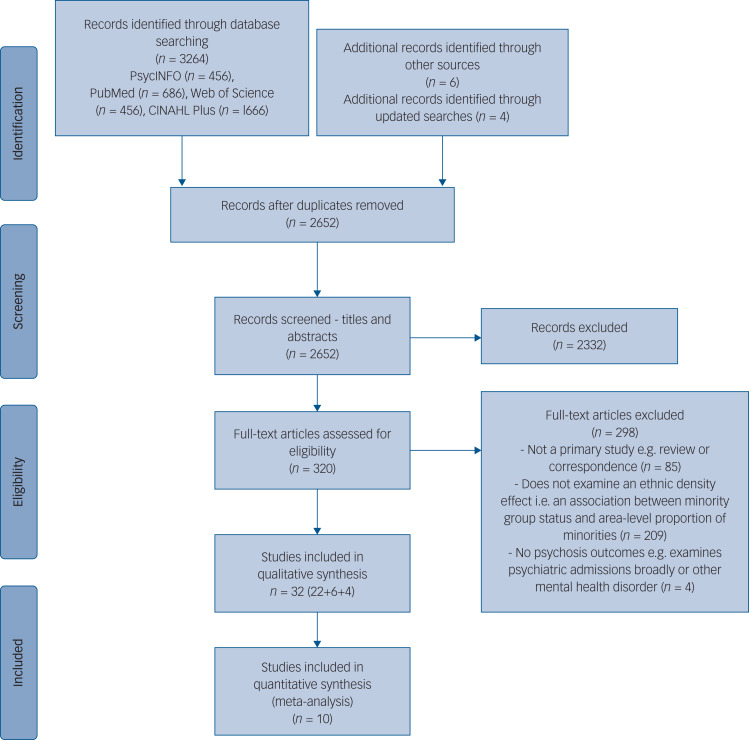
Four databases were systematically searched. A narrative review was conducted and a three-level meta-analysis was performed. The potential moderating effect of crudely and specifically defined minority groups was assessed. Country, time, area size and whether studies used clinical or non-clinical outcomes were also tested as moderators.
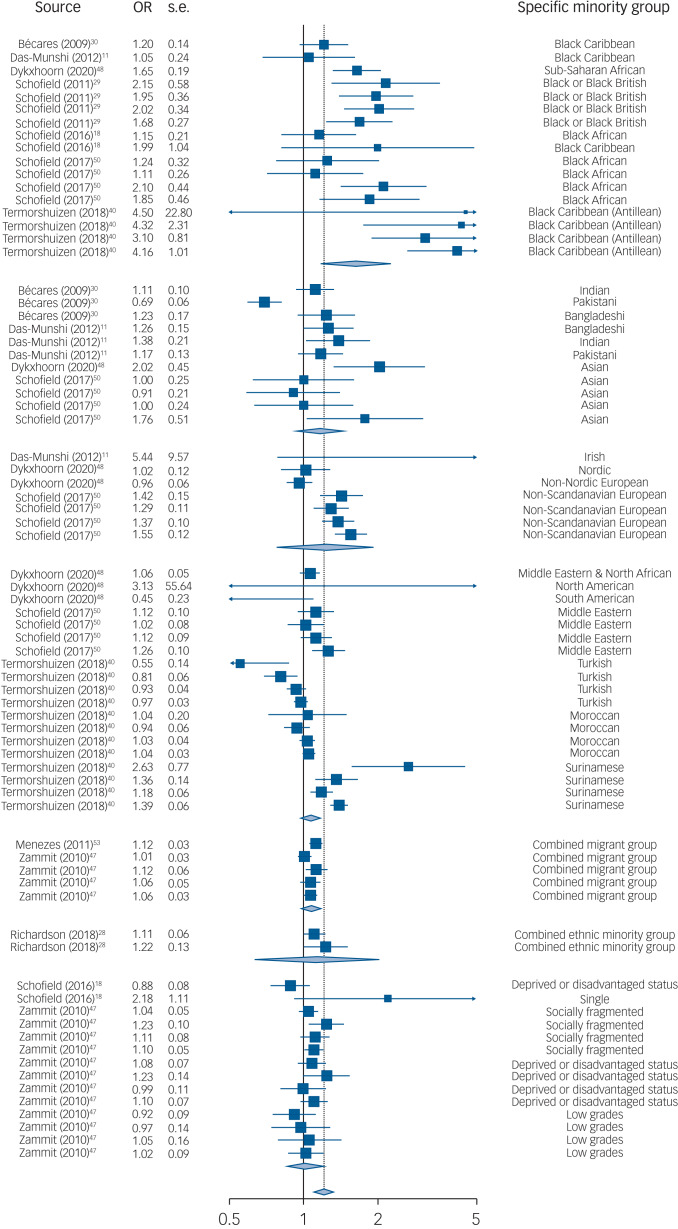
Thirty-two studies were included in the narrative review and ten in the meta-analysis. A 10 percentage-point decrease in own-group density was associated with a 20% increase in psychosis risk (OR = 1.20, 95% CI 1.09-1.32, P < 0.001). This was moderated by crudely defined minority groups (F6,68 = 6.86, P < 0.001), with the strongest associations observed in Black populations, followed by a White Other sample. Greater heterogeneity was observed when specific minority groups were assessed (F25,49 = 7.26, P < 0.001).
This is the first review to provide meta-analytic evidence that the risk of psychosis posed by lower own-group density varies across minority groups, with the strongest associations observed in Black individuals. Heterogeneity in effect sizes may reflect distinctive social experiences of specific minority groups. Potential mechanisms are discussed, along with the implications of findings and suggestions for future research.
精神疾病中存在“族群”或“群体”密度效应,即少数群体个体罹患精神疾病的风险与同族群在社区层面的比例呈反比。然而,关于这种效应是否在不同少数群体之间存在差异,以及对其他调节因素的研究有限,目前存在相互矛盾的证据。
对精神疾病中的群体密度效应进行全面的系统综述和荟萃分析,并探讨调节因素。
系统检索了四个数据库。进行了叙述性综述,并进行了三级荟萃分析。评估了粗略和具体定义的少数群体的潜在调节作用。还测试了国家、时间、区域大小以及研究是否使用临床或非临床结局作为调节因素。
叙述性综述纳入了 32 项研究,荟萃分析纳入了 10 项研究。自身族群密度每降低 10%,精神疾病风险增加 20%(OR=1.20,95%CI 1.09-1.32,P<0.001)。这受到粗略定义的少数群体的调节(F6,68=6.86,P<0.001),在黑人人群中观察到最强的关联,其次是白人其他样本。当评估特定少数群体时,观察到更大的异质性(F25,49=7.26,P<0.001)。
这是第一项提供荟萃分析证据的综述,表明较低的自身族群密度对精神疾病风险的影响因少数群体而异,在黑人个体中观察到最强的关联。效应大小的异质性可能反映了特定少数群体独特的社会经历。讨论了潜在的机制,并提出了对未来研究的意义和建议。